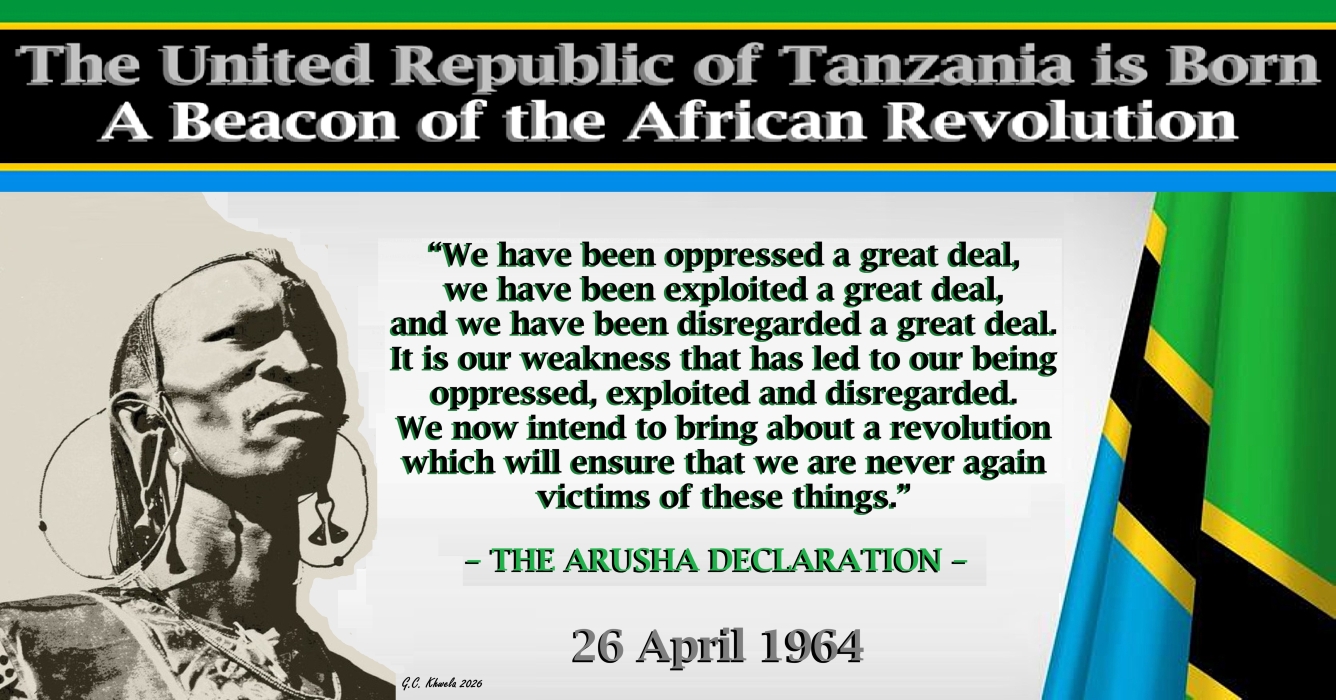
The United Republic of Tanzania is Born: A Beacon of the African Revolution
On 26 April 1964, the United Republic of Tanzania (Kiswahili: Jamhuri ya Muungano wa Tanzania) was established as a result of the unification of Tanganyika (the mainland) and the Zanzibar islands. The union between Tanganyika and Zanzibar, which created the present-day United Republic of Tanzania, stands out among the longest lasting political arrangements of its kind in Africa, and has shaped the country’s construction of national identity. The formalisation of the union was agreed in the Articles of the Union, which outlined eleven areas of cooperation between the two regions.
In 1947, Tanganyika became a United Nations Trust Territory under British control. Beginning in 1954, African revolutionary nationalism centered on the Tanganyika African National Union (TANU), which was a political organisation formed by Julius Kambarage Nyerere in that year as the successor to the Tanganyika African Association (TAA). The TANU won the Legislative Council elections in 1958, 1959, and 1960, with Nyerere becoming Chief Minister after the 1960 election. Internal self-government started on 1 May 1961, and Tanganyika became a democratic republic under an executive president on 9 December 1962.
The island of Zanzibar thrived as a trading hub, successively controlled by the Portuguese, the Sultanate of Oman, and then as a British protectorate by the end of the nineteenth century. As a former British colony, Zanzibar had become an independent constitutional monarchy under Sultan Jamshid bin Abdulla on 10 December 1963. The African majority led a revolution against Arab control on 12 January 1964, establishing a new government led by Abeid Karume.
After the Zanzibar Revolution had overthrown the Arab dynasty, the archipelago merged with mainland Tanganyika on 26 April 1964 and the new country was then named the “United Republic of Tanganyika and Zanzibar”. On 29 October of the same year, the country was renamed the United Republic of Tanzania (“Tan” comes from Tanganyika and “Zan” from Zanzibar). The union of the two hitherto separate regions was accepted by both the Tanganyika government and the Revolutionary Government of Zanzibar owing to shared political values and goals.
President Nyerere emphasised a need to construct a national identity for the citizens of the new country and, even now, the union is credited with construction of Tanzania’s national identity. It has enhanced the social, economic and cultural interactions between residents of Zanzibar and the mainland as the constitution requires the sharing of the president and vice-president positions. Moreover, Nyerere provided what is regarded as one of the most successful cases of ethnic repression and identity transformation in Africa.
This was an exceptional achievement, since Tanzania is one of the most ethnically diverse countries in Africa, with more than 130 languages spoken within its territory. Despite this obstacle, ethnic divisions remained rare in Tanzania when compared to the rest of the continent, notably its immediate neighbour, Kenya. Since its independence and unification, Tanzania has displayed more political stability than most African countries, particularly due to Nyerere’s ethnic repression and nation building methods.
It is interesting that the union was conceived in the midst of debates on Pan-Africanism and the geopolitical challenges of the Cold War, thus making Tanzania to become a flagship, actually a beacon of the African Revolution. Following the Zanzibar revolution of January 1964, western powers such as the United States and Britain labelled Zanzibar as Africa’s Cuba. This was in reference to Cuba’s so-called “proxy role” in the rivalry between the United States and the Soviet Union.
Imperialist designs on Tanzanian independence were exposed for all to see. In December 1964, less than a year after the union, an American plot to overthrow the Tanzanian government and to crush the revolutionary movements using Tanzania as a base, was uncovered by Tanzanian security authorities. In January 1965, two United States “diplomats” were expelled from Zanzibar and Dar es Salaam for subversive activities. Ever since the popular revolution in Zanzibar, the United Statesimperialists were feverishly organising counter-revolutionary activities, while the British gave aid and comfort to the deposed Sultan.
Tanzania’s hardy spirit of independence enabled this East African country to play an increasingly important part in African and world affairs despite imperialist designs to purchase with dollars, pounds or Deutschmarks the freedom and independence which the people of Tanzania had so dearly won. Imperialist efforts foundered on the hard rock of African patriotism which the people, the government and President Nyerere himself courageously and consistently displayed.
Neither did Nyerere succumb to the bullying tactics of the West German Bonn government, which was trying to reclaim its former colony. Tanzania was not deterred from following a path of strict non-alignment and from holding a progressive attitude towards important international questions. It was this robust independence of President Nyerere and his colleagues which inspired every revolutionary globally with confidence that the imperialist powers were not going to succeed in their efforts to force Tanzania to abandon its progressive policies on all-African and international problems.
“We shall not sell the freedom we have won” President Nyerere said and there was no reason to doubt he meant every word of it. According to P. Tlale, “United by the struggle against imperialism and colonialism, such a state is able to meet and solve all the complicated questions of economic and social reform, of industrial development and of raising the living standards of the people. That is, such a state satisfies the unique historical condition in which the colonial and semi-colonial countries find themselves after liberation.”
Fighters for liberation from apartheid South Africa and other parts of Africa oppressed by colonialism, would never forget the brotherhood and aid they received and continued to receive from the government and the people of Tanzania. For instance, in his message to President Nyerere on the occasion of the Arusha Declaration, on 26th to 29th January 1967, the then Deputy President of the African National Congress (ANC) of South Africa, Oliver Tambo said:
“We have always fervently held the conviction that the people of Tanzania, by following the road of unflinching struggle against imperialism. colonialism and neo-colonialism will not only achieve the revolutionary tasks and ideals of the African Revolution but will also render Africa the inestimable duty of affording her sons and daughters an opportunity to learn from Tanzania’s experience and example.”
Sources:
Wikipedia.
P. Tlale, “Marxism and the One-Party State”, The African Communist, No. 19, October-December 1964.
A. Langa, “Tanzania: Background to Five-Year Plans”, The African Communist, No. 22, Third Quarter 1965.
Toussaint, “The Arusha Declaration: Tanzania’s New Revolution”, The African Communist, No. 29, Second Quarter 1967.
O.R. Tambo, “A Great Step Forward”, The African Communist, No. 29, Second Quarter 1967.
Nicodemus Minde, “Tanganyika and Zanzibar: Tanzania’s 60-Year-Old Union May Need a Restructure”, The Conversation, 22 May 2024.
Castro Khwela
Good morning fellow Compatriots!🙏🏾✊🏾👊🏾
Discover more from CASTRO KHWELA
Subscribe to get the latest posts sent to your email.