Mdala Oliver Reginald Tambo Passes On
On this day, 24 April 1993, after suffering complications following a stroke, Oliver Tambo passed on at the age of 75. His death came 14 days after Chris Hani’s assassination and one year before the 1994 general elections. “Mdala” or “OR”, as Oliver Reginald Kaizana Tambo was fondly referred to in the camps of Umkhonto we Sizwe, was an outstanding South African revolutionary, a gentle freedom fighter, who served as President of the African National Congress (ANC) from 1967 to 1991, and Commander-in-Chief of the People’s Army, Umkhonto we Sizwe (MK).
When Tambo assumed the Acting Presidency of the ANC following Inkosi Albert Luthuli’s passing on, he had no doubt of what lay ahead of him, as the leader of a massive movement, which the oppressed masses of South Africa looked up to. He correctly inferred and asserted that “The only real solution lies in the victory of the revolutionary forces, the dismantling of the apartheid machinery and the transfer of political and economic power to the democratic majority”.
As a Military Commander, uMdala Tambo was directly responsible for organising active guerilla units and successfully straddled the Eastern bloc with the West, the Non-Aligned Movement and also independent Africa, obtaining their support despite his refusal to repudiate non-racialism. He had borne witness to Albert Luthuli’s crafting of the “moral high ground” and retained the principle into the MK’s concept of armed struggle.
For instance, in 1968, Tambo accompanied the MK group on a number of occasions when they went on reconnaissance expeditions along the Zambezi River, sleeping in the open with the group. Tambo named the group the Luthuli Detachment, in honour of the late ANC President Luthuli, who was killed in a yet unresolved tragic railway accident in July 1967 in Groutville, Natal. All the Detachments that followed thereafter were named personally by OR Tambo based on the relevant historical epoch to which they existed or on a particular event or personality that had significance to the South African struggle for liberation.
The consultative conference at Morogoro in 1969 had confirmed that the armed struggle must not stray from the political lines of the ANC’s holistic concept of struggle. At Novo Catengue, Angola, which was one of MK’s largest and most successful camps, ‘the University of the South’, known for its stimulating education programme, Tambo had encouraged “In building up our own popular army”, he explained to the soldiers “we aim. . .not only at the overthrow of the fascist regime, we aim also at building up a politically conscious and revolutionary army, conscious of its popular origin, unwavering in its democratic functions and guided by our revolutionary orientation.”
Tambo was concerned not only to use “education as a weapon in the struggle”, but also to build an intelligentsia within the army itself. History and political theory were particularly important in developing politically informed cadres in the military. Their key task on their return into the country was to wage a disciplined and conversant guerrilla operation, which would recruit and guide the community in which they found themselves. A grasp of the strategy of liberation as a whole, particularly what was relevant to South Africa, was crucial to the successful outcome of this process.
Infiltration of combatants into South Africa was too slow and there was a need to raise the level of armed struggle. People would ask why the leadership was not deploying cadres. Whenever South African security forces killed ANC cadres, calls would be made for “an eye for an eye”. In fact, between 1977 and 1980, MK initiated the infiltration of “hundreds of combatants back into the country”. Their purpose was to contribute to strengthening the underground, assisted by the student soldiers’ links to the community, and to attack the “hard targets”, the symbols of apartheid.
Tambo was challenged time and again, squaring up international diplomacy ‘versus’ the armed struggle…Tambo’s foresight however went beyond the painful imperatives of the present, for he supplemented the steps he took by laying the foundations of a lasting and major accomplishment in post-apartheid South Africa…He sought instead a democratic solution. For its long-term moral and revolutionary well-being, the movement had to take a principled, collective stand. Proper institutional procedures had to be established so as to forever prevent a reoccurrence of the abuse of power.
For instance, when he was required to tell what type of new South Africa was the ANC envisaging, Tambo was unequivocal to say, “For us, it is of especial importance that that new reality should reinforce and entrench what we are accomplishing now, in struggle: the building of a nation of South Africans. It must reflect and enhance our oneness, breaking down the terrible and destructive idea and practice of defining our people by race, colour or ethnic group. The revolution will guarantee the individual and equal rights of all South Africans without regard to any of these categories… For all this, the victorious revolution demands and must ensure thoroughgoing democratic practice.”
“… But as a people and a movement, we must state it clearly that democracy in our country cannot succeed if it permits the organised propagation of ideas of fascism, racism and ethnicity. Apart from our own experience, we cannot, in the name of democracy, tolerate the organised sustenance of conceptions which led to the Second World War and which have since been categorised and dealt with as a crime against humanity.”
According to Tambo, “Of central importance also is the critical requirement that the new South Africa must guarantee the masses of our people freedom from hunger, disease, ignorance, homelessness and poverty. The democratic state will be representative of all the people of our country, and especially the ordinary working people who own neither land nor factories and neither the mines nor the banks. It will therefore be called upon to ensure that the wealth of the country increases significantly and continuously and that it is shared equitably by all the people to ensure their material and spiritual upliftment and well-being.”
He did not end there, but gave a directive on how these objectives could be achieved, by mentioning that “the new democratic order will necessarily have to address the question of ownership, control and direction of the economy as a whole to ensure that neither the public nor the private sectors serve as a means of enriching the few at the expense of the majority. The transfer of power to the people must therefore be accompanied by the democratisation of the control and direction of the economy so that indeed the people share in the wealth of our country, for the common goal.”
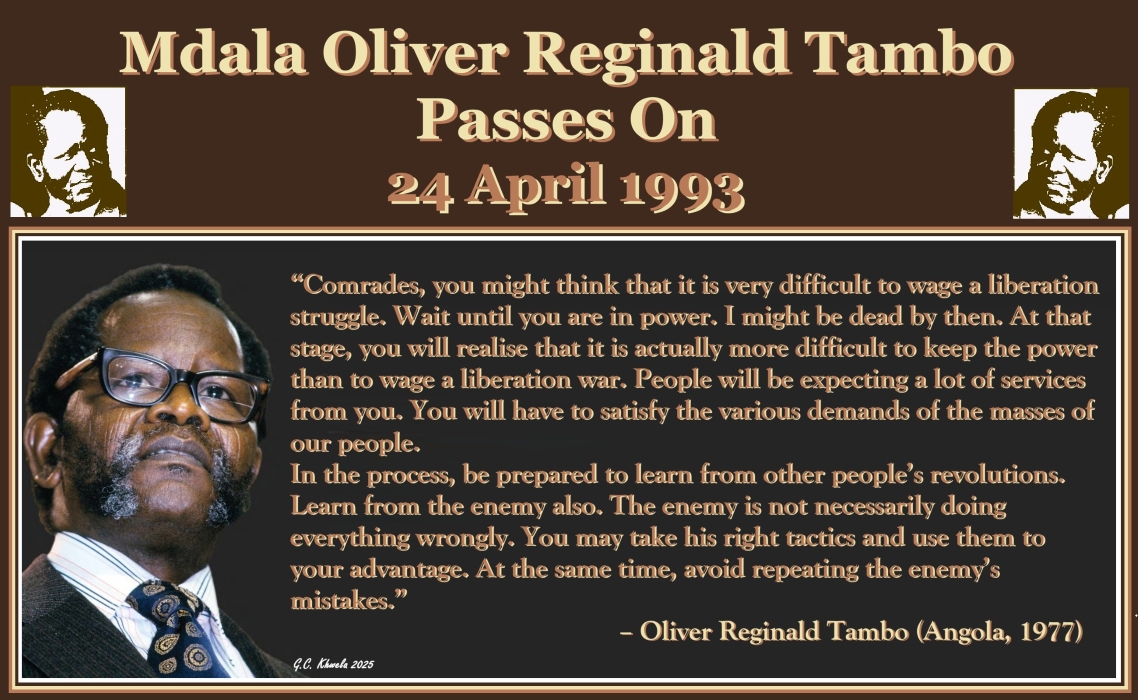
One of Tambo’s characteristics of visionary and foresightful leadership was the warning which he gave to his comrades in Angola, in which he said, “Comrades, you might think that it is very difficult to wage a liberation struggle. Wait until you are in power. I might be dead by then. At that stage, you will realise that it is actually more difficult to keep the power than to wage a liberation war. People will be expecting a lot of services from you. You will have to satisfy the various demands of the masses of our people. In the process, be prepared to learn from other people’s revolutions. Learn from the enemy also. The enemy is not necessarily doing everything wrongly. You may take his right tactics and use them to your advantage. At the same time, avoid repeating the enemy’s mistakes” – Oliver Reginald Tambo (Angola, 1977).
Similarly, at the ANC’s 48th National Conference, in Durban, on 2 July 1991, OR Tambo’s farsighted characteristic became prominent, as he cautioned the delegates that “Before I sit down, I wish to make a few observations: we did not tear ourselves apart because of lack of progress at times. We were always ready to accept our mistakes and to correct them. Above all we succeeded to foster and defend the unity of the ANC and the unity of our people in general. Even in bleak moments, we were never in doubt regarding the winning of freedom. We have never been in doubt that the people’s cause shall triumph.”
Sources:
Wikipedia.
South African History Online (SAHO).
Luli Callinicos, “Oliver Tambo and the Dilemma of the Camp Mutinies in the Eighties”, South African Historical Journal, Vol. 64 No. 3, 2012.
Oliver Tambo, “Clarion Call to All Opponents of Apartheid”, African National Congress, 21 March 1984.
Oliver Tambo, “Opening Address to the ANC’s 48th National Conference by O. R. Tambo”, Durban, 2 July 1991.
Oliver Tambo, “Advance to People’s Power: Message from the National Executive Committee of the African National Congress, delivered by President O. R. Tambo on January 8th, 1987, the 75th Anniversary of the founding of the ANC,” Sechaba, February 1987.
E.S. Reddy, “Oliver Tambo: Apartheid and the International Community”, Namedia Foundation Sterling Publishers, 1991.
Castro Khwela
Good morning fellow Compatriots!🙏🏾✊🏾👊🏾
Discover more from CASTRO KHWELA
Subscribe to get the latest posts sent to your email.