A Moment of Unity and Renewal: The Morogoro Conference Revisited
On 25 April 1969, speaking at a conference hall of more than seventy people, in Morogoro, Tanzania, Acting President of the African National Congress (ANC), Oliver Tambo, mentioned that in the past, too much emphasis was placed on international solidarity work, which was perhaps a legacy of the initial role of the ANC’s External Mission. It was not that solidarity work was not necessary, but it also needed to be placed in proper perspective. Therefore, incorrect methods of work and chaotic organisation were the main factors hampering the movement.
According to Oliver Tambo, several developments made the current conference different from its previous ones. Amongst these was the death of Albert Luthuli, the President-General of the Movement; the recommencement of the armed struggle ‘in 1967’ with the Wankie and Sipolilo Campaigns; the increased repression of the people by the fascist oppressors; and organisational problems arising from the commencement of guerrilla warfare. The last, in Tambo’s assessment, was the most critical problem facing the Movement.
For Tambo, the ANC had to cast its eyes south and be prepared to go and wage the struggle at home. “There was sometimes a feeling that far too much emphasis was devoted to ‘training, training, training’, with the consequence that like the Zulu warrior Gumede, who was forever sharpening his spear, we might wear out our spear in the process: ‘Umkhonto wegwala uphelel’ etsheni!’” If the conference failed to resolve the identified immediate problems, the struggle was to be retarded for many years to come.
Related to his assertion that guerrilla warfare represented the “special, and in our case only form in which the armed liberation struggle can be launched”, Joe Slovo, who was tasked to present the document on Strategy and Tactics, noted that people had claimed that guerrilla warfare required a physical environment that conformed to a special pattern, which South Africa didn’t have, such as a thick jungle, inaccessible mountain areas, swamps, a friendly border, etc.
For Joe Slovo, guerrilla warfare could be, and had always been, waged in every conceivable type of terrain and that what was instead required was adjusting survival tactics to the sort of terrain in which operations had to be carried out. Therefore, South Africa may not have a single impregnable mountain or impenetrable jungle, but the country abounds in terrain which in general is certainly no less favourable for guerrilla operations than some of the terrains in which other guerrilla movements operated successfully. The paper was adopted by the conference as the ANC’s Policy for Advancing the Revolutionary Struggle within South Africa.
The momentum for the Conference began on 26 January 1969, at one of the ANC transit camps around Lusaka, all members of the organisation based in Zambia – including all Umkhonto we Sizwe (MK) cadres in the country – attended a crisis meeting. Joe Matthews, who was normally based in London, was also attending.
Oliver Tambo addressed the meeting, indicating that he was infuriated by the implied attack on Moses Kotane, the ANC’s Treasurer-General, in the “Memorandum” of Hani, Hempe, and others. Tambo reminded them that Kotane was at that time in a Moscow hospital recovering from a stroke. However, at the same meeting Tambo made a significant announcement, that a consultative conference was to be held to discuss the condition of the movement.
Following the meeting in Lusaka, on 18 February 1969, the ANC Headquarters in Morogoro issued a directive about the forthcoming consultative conference. It said that the National Executive Committee’s intention was for the conference to serve as the climax of a process of criticisms and proposals covering all aspects of the movements work – only security considerations could limit the scope of the discussion. The directive added that all units of the ANC, both inside and outside South Africa, were allowed to participate in the preliminary discussions, and members of the other components of the Congress Alliance were to be involved.
More than seventy delegates came to Morogoro, and present among them were veterans of the struggle, personified by the towering presence of Uncle J.B. Marks. There were the emissaries who had carried the message of the ANC to every corner of the five continents, who had exposed apartheid mercilessly at the United Nations and won solidarity for the South African people at innumerable meetings in Africa, Asia, Europe, North and South America.
Present too – for the first time as fully participating delegates and not only as bearers of fraternal messages – were outstanding leaders of the partners of the Congress Alliance; the Indian and Coloured People’s Congresses and revolutionary working class movement; tried revolutionaries of the calibre of Dr Yusuf Dadoo, Reg September and Joe Slovo.
But above all, Morogoro was a Conference of the fighting youth of South Africa: delegations from the various encampments of the liberation army, Umkhonto we Sizwe (MK), and among them men who had seen action at Wankie and other engagements of the ZAPU-ANC military alliance against the joint forces of the Smith and Vorster regimes, who had seen the self-styled white ‘supermen’ turn tail and run, and who knew that victory can and shall be won.
It was their presence, their mood of revolutionary urgency, their voice and their demands which prevailed at Morogoro; their insistence on priority for the armed struggle and the mobilisation of all revolutionaries at home and abroad; their demand for changed structures to meet the needs of the new phase of the revolution, for new and higher standards of political and personal conduct of all in the movement.
The battles of Wankie and other places in Zimbabwe were still fresh in the minds of all the members of the liberation movement. Members met to assess the enemy and their own strength. The liberation struggle in Angola and Mozambique was at its peak and their comrades in Namibia and Zimbabwe were harassing the enemy from all sides. The Conference laid down the lines on which the unity of the struggling peoples of South Africa could be established to secure the overthrow of the evil system of apartheid and white domination, and the achievement of people’s power on the basis of the principles set out in the Freedom Charter.
What was fascinating about this conference, was that it took place at the close of the most difficult and challenging decade for all South Africa’s liberation movements. Nine years earlier, the ANC and PAC (Pan Africanist Congress) had been banned. Since then, thousands of activists had been incarcerated or forced into exile. The state’s brutal crackdown had rendered the movement largely ineffective inside South Africa, despite heroic efforts to keep the flames of resistance burning. By the end of the Rivonia Trial in 1964, many of the key internal leaders of the ANC and PAC had been sentenced to long terms in prison, and leadership of the liberation movements shifted decisively to the incipient exile structures.
The turn to armed struggle was a response to the violence of the apartheid state, but was premised on a fundamental reappraisal of the character of the freedom struggle itself. The stresses and strains engendered by these far-reaching changes profoundly affected the functioning of the liberation movements, especially as they tried to reconstitute themselves in exile.
The Conference took important decision; decisions which later had a bearing on the physical composition of the ANC and the development of the political and military theory of the movement. Most of the decisions taken at the conference were designed to concentrate the alliance leadership in Africa; to pare down the National Executive Committee; create a Revolutionary Council to integrate both the political and military components of the struggle; and not to restrict ANC membership for alliance members in exile to Africans only. This reflected the seriousness of the issues that had arisen prior to the conference and the determination of the leadership of the Congress movement to unite its cadres behind a common programme.
The overwhelming and unanimous will of the Morogoro Conference was for unity in the ranks, for rededication of the ANC and its dynamic and capable leader Oliver Tambo, for determined concentration on the central task – the development of the armed struggle, the organisation of the revolution to free the country. The conference affirmed the ‘necessity to integrate all oppressed national groups and revolutionary forces and individuals under the banner of the ANC’ and instructed the National Executive Committee (NEC) to work out the means by which this could be done so as to mobilise all revolutionaries in functioning units of the ANC.
The conference created a Revolutionary Council representative of all national groups and revolutionary forces in the country and charged it with the task of intensifying the armed struggle and the full mobilisation of the masses in support of the revolution. This became the most significant achievement of the conference, the broadening of the conception of African nationalism.
Quite correctly, the conference reaffirmed that ‘the main content of the present stage of the South African revolution is the national liberation of the largest and most oppressed group – the African people’, but stressed that the qualities of African nationalism did not stand in conflict with the principles of internationalism. On the contrary, African nationalism could at that moment confidently draw into its ranks all section of the population dedicated to the overthrow of white domination and who were prepared to abide by the programme and principles of the ANC.
Moreover, the conference declared that the national struggle was now taking place in a new kind of world – a world which was no longer monopolised by the imperialist world system; a world in which the existence of the powerful socialist system and a significant sector of newly liberated areas has altered the balance of forces; a world in which the horizons liberated from foreign oppression extended beyond mere formal political control and encompassed the element which made such control meaningful – economic emancipation.
Besides, the struggle was also happening in a new kind of South Africa: a South Africa in which there was a large and well-developed working class whose class consciousness was highly developed and whose political organs and trade unions were ‘very much part of the liberation front’.
Naturally enough, there were elements in the ranks of the liberation movement who could not accept the new vision of the Morogoro Conference. In his closing address, Acting President Tambo warned against them:
“Close Ranks! This is the order to our people; our youth; the army; to each Umkhonto we Sizwe militant; to all our many supporters the world over. This is the order to the leaders; to all of us. The order that comes from this conference is Close Ranks and Intensify the Armed Struggle! Wage relentless war against disruptors and enemy agents! Defend the revolution against enemy propaganda, whatever from it takes! Be vigilant comrades. The enemy is vigilant. Beware of the wedge-driver! Men who creep from ear to ear, driving wedges among us: who go round creating splits and division. Beware the wedge-driver! Watch his poisonous tongue!”
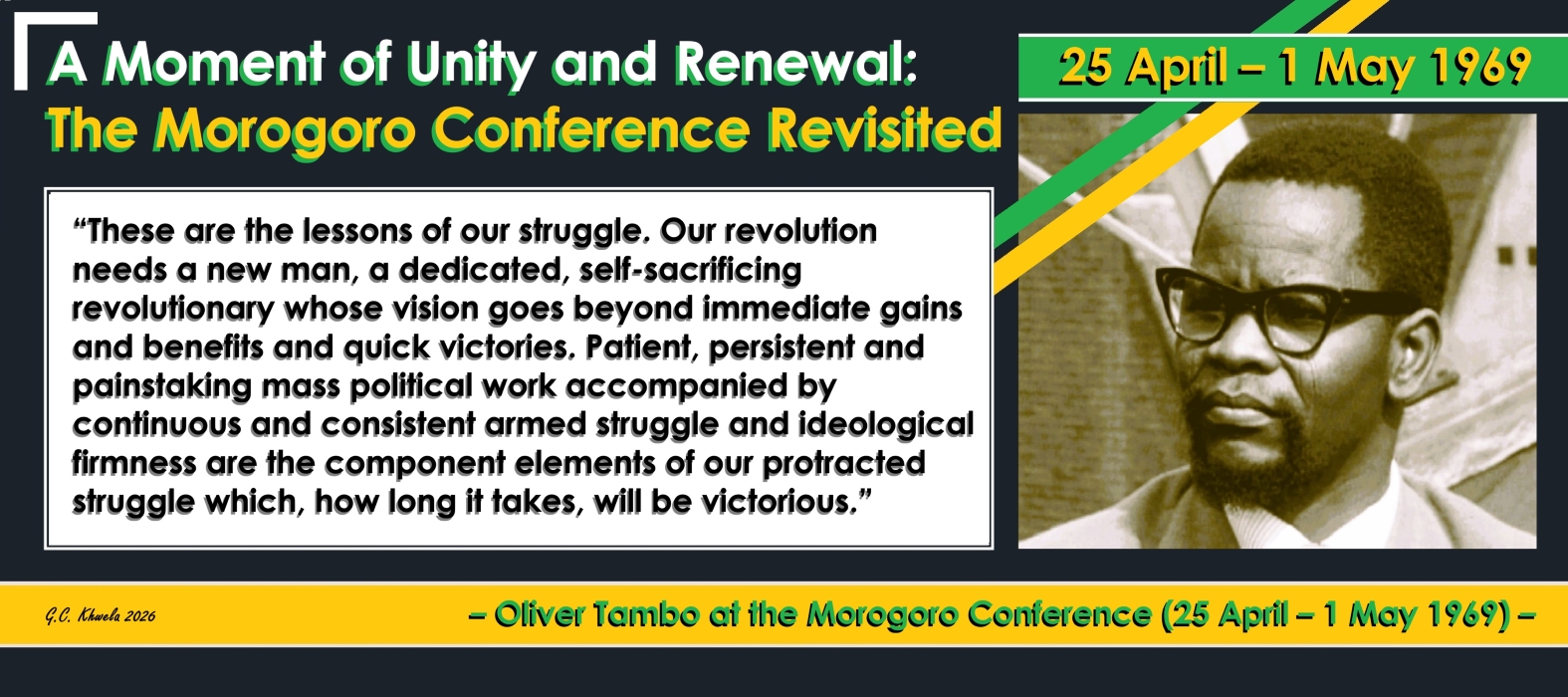
“These are the lessons of our struggle. Our revolution needs a new man, a dedicated, self-sacrificing revolutionary whose vision goes beyond immediate gains and benefits and quick victories. Patient, persistent and painstaking mass political work accompanied by continuous and consistent armed struggle and ideological firmness are the component elements of our protracted struggle which, how long it takes, will be victorious.”
New officials were elected to office. Conference unanimously re-affirmed its confidence in and support for the Acting President-General, Comrade O.R. Tambo. Alfred Nzo was appointed Secretary General with J.B. Marks as Chairman of the National Executive and Moses Kotane as Treasurer-General. In sweeping structural changes, a Presidential Council and a Revolutionary Council were established under the Acting President with Joe Matthews as its Secretary. Dr Yusuf M. Dadoo became the Vice-Chairman of the Revolutionary Council. Since then, the Movement had taken practical steps forward; even the enemy was forced to admit that “the ANC is everywhere”.
The stage was set for an intensification of the armed struggle and for the consolidation and strengthening of the underground forces at home. The ANC, as the Acting President put it at the closing session of the Consultative Conference, had set itself a new standard of unity – unity among all revolutionaries; unity on all fronts – both internal and external. This unity was to permeate into the solidarity movements abroad.
On the international front, the object, apart from rallying the forces of progress into the solidarity movement, was the urgent task of getting all democrats drawn into direct commitment to the ANC and the armed struggle. The Conference committed itself to intensify the armed struggle and to eliminate the fascist-racist hierarchy in South Africa and to urge all those who believed in true democracy, progress and world peace, to express their solidarity with the fighting peoples of South Africa by taking practical steps as suggested therein.
The Conference call was:
“LET US RISE TO THE OCCASION AND CONFRONT THE ENEMY ON ALL FRONTS – OURS IS A BRIGHT FUTURE!”
“WE SHALL WIN! AMANDLA NGAWETHU! POWER TO THE PEOPLE!”
Sources:
Commentary, “Close Ranks! A Call from the Consultative Conference of the African National Congress”, Sechaba, Vol. 3 No. 7, July 1969.
Sechaba Correspondent, “Strategy and Tactics of the African National Congress”, Sechaba, Vol. 3 No. 7, July 1969.
Editorial, “Remember the Morogoro Conference”, Sechaba, July Issue 1979.
Editorial Notes, “Ten Years of Struggle”, African Communist, No. 77, Second Quarter, 1979.
Nhlanhla Ndebele and Noor Nieftagodien, “Chapter 14: The Morogoro Conference: A Moment of Self-Reflection”, The Road to Democracy in South Africa, Vol. 1 (1960 – 1970), South African Democracy Education Trust (SADET), Zebra, 2004.
Thula Simpson, “Umkhonto we Sizwe: The ANC’s Armed Struggle”, Penguin, 2016.
Castro Khwela
Good morning fellow Compatriots!🙏🏾✊🏾👊🏾
Discover more from CASTRO KHWELA
Subscribe to get the latest posts sent to your email.