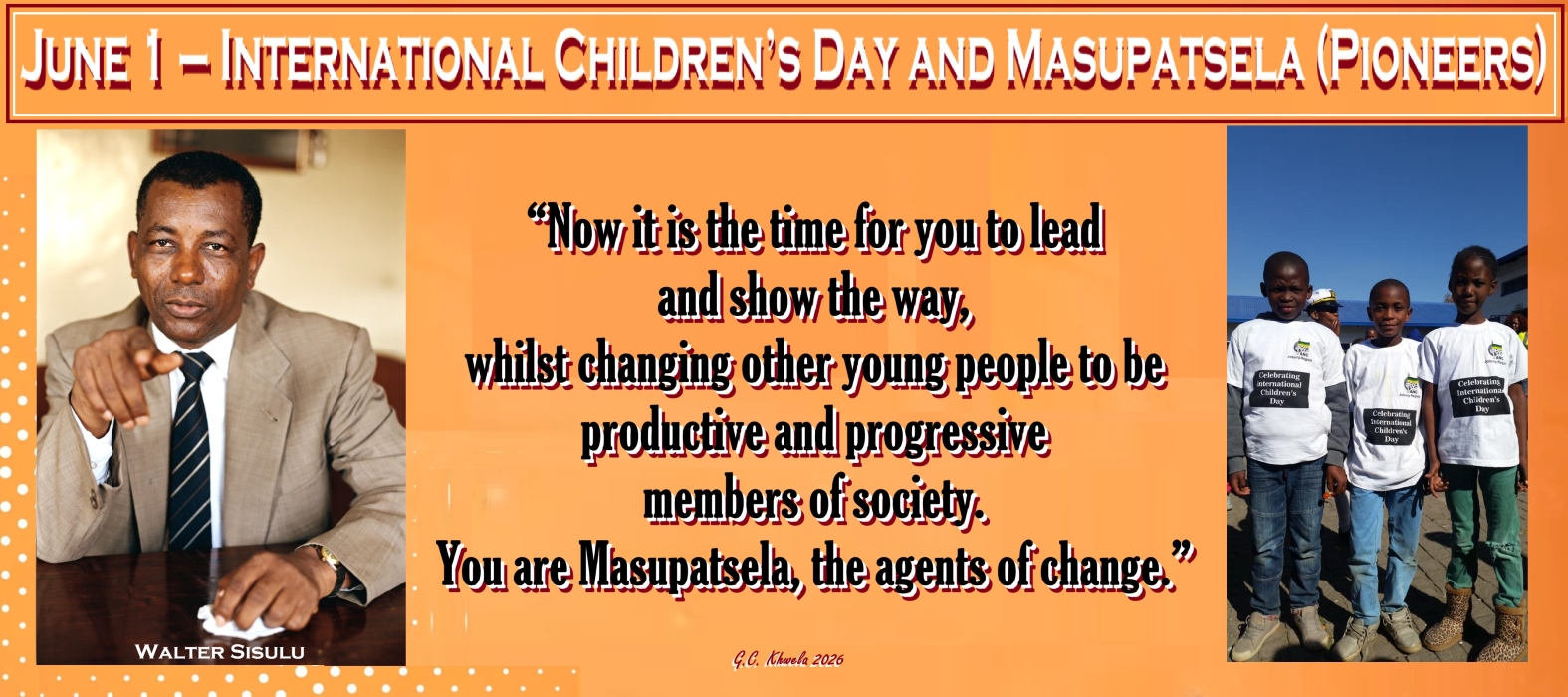
June 1 – International Children’s Day and Masupatsela (Pioneers)
International Children’s Day is celebrated annually on June 1st in many countries worldwide to honor youth, protect children’s rights, and advocate for their well-being and education. First established in 1925 during the “World Conference for the Well-being of Children in Geneva”, it highlights global commitments to protecting children from exploitation, poverty, and violence.
The date traces back to 1925 when the Chinese Consul-General in San Francisco gathered orphaned children to celebrate the Dragon Boat Festival, coinciding with the Geneva child-welfare conference. This observance gained prominent traction on 1 June 1950, after being established by the Women’s International Democratic Federation in Moscow. It is widely observed in ex-Soviet and many Eastern European states. Celebrations on this day include nationwide events, student film festivals, family gatherings and specialised campaigns focused on child protection.
In the context of the national liberation struggle in South Africa, the concept of “Masupatsela a Walter Sisulu” needs to be revisited during this International Children’s Day. The Day directly relates to the concept of “Masupatsela”, the pioneer children movement of the Congress Alliance through the shared focus on child empowerment, rights advocacy and youth development. Both concepts prioritise nurturing the next generation. International Children’s Day celebrates the rights, protection and well-being of children worldwide. Similarly, the “Masupatsela” concept focused on instilling leadership, discipline and community values in South African children and youth to prepare them as future societal leaders.
International Children’s Day advocates for a safe, nurturing environment where children can thrive. In the same way, the “Masupatsela” movement was formed in the spirit of Walter Sisulu’s lifelong struggle to create a free, equal and just society, ensuring that the fundamental rights fought for by anti-apartheid heroes are realised for all children. Walter Sisulu advocated heavily for education and the protection of children and youth. The pioneer movement named after him should continue this legacy by engaging the young in constructive social activities, life skills and civic responsibility, mirroring the global goals of International Children’s Day.
While many countries commemorate the date on June 1st, others observe children’s days on entirely different dates depending on their local cultural traditions. Additionally, the United Nations recognises World Children’s Day on November 20th to mark the adoption of the Declaration of the Rights of the Child. In the African context, the International Day of the African Child is observed annually on June 16, which commemorates the 1976 student uprising in Soweto, South Africa.
On 16 June 1976, nearly 10,000 students marched to protest the poor, unequal quality of education and demanded to be taught in their own languages. The apartheid police responded with violence, tragically resulting in the deaths of hundreds of children and leaving thousands injured. In 1991, the Organisation of African Unity (OAU – now the African Union) established this day to honor those who lost their lives and to draw attention to the rights and welfare of children across the continent.
The day serves as a continent-wide call to action to address major challenges facing African children – such as access to education, healthcare, protection from violence and digital inclusion. The day also highlights the African Charter on the Rights and Welfare of the Child (ACRWC), which sets universal principles and norms for the status of children across the African continent. It is a comprehensive regional treaty outlining the fundamental rights of children, ensuring their survival, protection and development.
While it shares many provisions with the UN Convention on the Rights of the Child (CRC), the ACRWC addresses specific cultural and socio-economic realities unique to Africa, such as protection against harmful practices. It explicitly prohibits child marriage and sets the minimum age of marriage at 18, requiring all marriages to be officially registered. It also insists that no child under the age of 18 can be recruited into armed forces or take part in hostilities. The ACRWC specifically guarantees that pregnant and nursing girls have the right to continue their education and it uniquely outlines the duties and responsibilities children have toward their families, society, the state and the promotion of African unity.
The implementation of the Charter is monitored by the African Committee of Experts on the Rights and Welfare of the Child (ACERWC). This 11-member body of experts evaluates state party reports and investigates violations to ensure the rights established in the Charter are promoted and protected. In the current global landscape, International Children’s Day serves as a critical call to action to protect children facing unprecedented humanitarian crises.
According to humanitarian agencies like UNICEF and Save the Children, children globally face historic levels of displacement, food insecurity and violence. Instead of a casual celebration, this year’s observance centres on addressing the structural, geopolitical and environmental challenges directly threatening the fundamental rights of youth. More than 450 million children live in active conflict zones. Urban warfare frequently targets schools, hospitals and water infrastructure, making explosive weapons the leading cause of youth casualties.
Protecting children in armed conflict remains the most legally binding and morally urgent imperative of our time. Globally, nearly one in five children lives in active conflict zones, prompting international bodies to enforce strict United Nations framework directives targeting the “Six Grave Violations Against Children” (killing/maiming, recruitment, sexual violence, abduction, school/hospital attacks, and denial of humanitarian access). Below are the primary context-specific concerns and coordinated global responses across key conflict areas:
- Palestine (Gaza and West Bank): Concerns include mass civilian casualties, total collapse of healthcare infrastructure, acute famine risks and profound long-term psychological trauma. Decimated water and sanitation networks leave children highly susceptible to preventable, waterborne diseases. Agencies such as UNICEF deploy emergency nutritional interventions, distribute ready-to-use therapeutic food (RUTF), and establish temporary learning spaces. Diplomatic bodies consistently demand immediate, unimpeded humanitarian corridors. Nevertheless, the brutal aggression of the Israeli apartheid state on Palestinian homesteads leaves a number of children maimed and killed, as well as denied humanitarian access.
- Sudan: The children face unprecedented mass displacement, acute severe malnutrition and a complete collapse of the educational system. Nearly half of all school buildings nationwide are closed, destroyed, or utilised as military shelters, leaving over 8 million children out of school. Mobile health clinics run by frontline aid groups cross borders to deliver life-saving treatments in very difficult conditions. Despite massive global funding deficits, several teams coordinate family tracing and reunification (FTR) networks to reconnect separated minors.
- Democratic Republic of Congo (DRC): Challenges include rampant child recruitment by non-state armed groups, systematic gender-based violence (GBV) is used as a weapon of war, and displacement is conspicuously driven by local militia clashes. Dedicated UN child protection units lead delicate negotiations with armed networks to release child soldiers. This is monitored by the Danish Refugee Council, which ensures that local community networks establish safe, “child-friendly spaces” to foster physical security and psychological recovery.
- Russia-Ukraine War: Ongoing aerial, missile and drone strikes on residential neighbourhoods and power grids, result in prolonged disruption of school networks, and the illegal deportation and separation of children. The International Criminal Court (ICC) issued arrest warrants regarding unlawful child transfers. Humanitarian coalitions fund underground bunkers for schools, provide massive winterisation kits, and run localised digital psychological support networks.
- Iran: Casualties from localised spillover strikes impacting schools and civil infrastructure, along with the missile and aerial bombing of school facilities during the war affects the rights and well-being of children in such conflict situations. The UN special rapporteurs and international human rights watchdogs closely track, verify and publicly report on children and youth casualties in order to build accountability frameworks.
Severe foreign aid and humanitarian budget cuts have crippled life-saving child protection services and nutrition programmes precisely when demand has peaked. Driven by war and climate disasters, nearly 38 million children across dozens of countries face acute food insecurity, leaving millions in need of emergency therapeutic treatment to survive. Intensifying climate risks act as a “child rights crisis”. Extreme weather patterns continuously displace families and fundamentally disrupt access to stable schooling and healthcare. The explosive growth of Artificial Intelligence (AI) and digital platforms without proper guardrails exposes children to heightened online exploitation, deepfakes, and privacy violations.
Geneva Conventions and ICC mandates investigate violations against civilian facilities, however lack of state political will to enforce compliance or hand over perpetrators makes legal accountability difficult. In terms of humanitarian financing, launching massive aid appeals, such as the UNICEF 2026 Appeal, aiming for $7,66 billion to assist 73 million children is affected by severe budget cuts and several emergency funds are only 16 percent funded. The United Nations “ACT to Protect” campaign advocates against using explosive weapons in populated areas, however urban warfare tactics continuously breach infrastructure safety lines.
South African society must move from symbolic gestures on June 1st to coordinated, year-round systemic action across all sectors to secure a safe and benevolent environment for every child. Because International Children’s Day coincides with the national Child Protection Week, it serves as a critical annual audit of the country’s progress in fighting high rates of child poverty, gender-based violence (GBV) and educational inequality. There is currently a need to rapidly process child abuse and neglect cases by expanding specialised sexual offences courts and properly funding the National Child Protection Register.
South African authorities and civil society should ensure the increase of the Child Support Grant value to match or exceed the food poverty line, as well as expand the National School Nutrition Programme (NSNP) to cover weekends and school holidays. Moreover, the government needs to eradicate pit latrines entirely, fix unsafe school structures, and provide reliable scholar transport to protect children from long, dangerous walks. Furthermore, there is an imperative requirement to allocate adequate state budgets to subsidise non-profit organisations (NPOs) that employ social workers and run child-care shelters.
The Corporate Sector should direct Corporate Social Investment (CSI) budgets to build and maintain Early Childhood Development (ECD) centres in township and rural communities. Essentially, it is important to implement progressive parental leave policies, offer on-site or subsidised childcare, and pay employees a living wage to reduce household poverty. Mobile networks and tech companies must offer free, zero-rated access to educational platforms and strictly implement digital safety guardrails to shield children and youth from online exploitation. Critically, there is a need to invest heavily in youth skills development and mentorship programmes to prevent older children from falling into systemic unemployment.
Civil Society and NPOs must monitor municipal and national government spending closely to ensure budgets allocated for child welfare are not lost to corruption. There is a need to expand community safe zones, through maintaining and scaling community-based “child-friendly spaces” and after-school centres where children can do homework, receive meals and play safely. Authorities must provide localised trauma counselling and psychosocial support to children exposed to high levels of domestic and community violence. Largely, parents, teachers as well as religious leaders must be educated on positive discipline methods to eradicate corporal punishment which fosters a violent society.
Broad society and communities are supposed to report suspected child abuse, neglect or exploitation immediately to authorities without fear of community backlash. They must challenge and actively dismantle cultural norms that excuse domestic violence, toxic masculinity or the physical punishment of children. They should also form neighbourhood watches and volunteer groups to secure school walking routes and monitor public parks. Vulnerable households, child-headed families and orphans must be supported within the neighbourhood through mutual aid, local business support and community food gardens.
In conclusion, the initiative, championed by leaders like Walter Sisulu, Duma Nokwe and Kate Molale in 1954 in Sophiatown, towards the establishment of the “Masupatsela” (Pioneers of the Struggle) was an appropriate endeavour as well as a vital and necessary response to a brutal system of apartheid colonialism and imperialism. The Movement, which was later renamed “Masupatsela a Walter Sisulu” (Walter Sisulu Pioneers), was the official children pioneer movement of the African National Congress (ANC), structured similarly to the global Cub and Scout movement but adapted for the South African liberation struggle.
While traditional Scouting focused on outdoor survival and citizenship, this political pioneer wing used equivalent structures to train young people in African patriotism, political discipline, resistance, and revolutionary values. “Masupatsela” is a Sotho or Tswana word meaning “guides”, “pathfinders” or “pioneers”. It serves as the direct linguistic equivalent used for “Scouts” in several indigenous Southern African languages. The apartheid regime used the Bantu Education Act of 1953 to deliberately brainwash Black children into accepting permanent societal inferiority. The “Masupatsela” concept served as an alternative, underground educational network that taught children self-worth, African history and revolutionary consciousness.
In terms of creating future leaders, the initiative prioritised long-term development over immediate warfare. The ANC and the Congress Movement heavily invested in the academic, professional and ideological development of these youths, eventually producing a generation of patriotic professionals, including doctors, lawyers, engineers and economic leaders. Because apartheid targeted Black South Africans from birth, liberation leaders believed that no sector of society – including children and the youth – could afford to remain passive or unorganised. Ultimately, Sisulu and his peers viewed the “Masupatsela” as a protective and empowering shield designed to rescue children from imperialist and apartheid brainwashing.
According to Sisulu, “It is the youth who have the capacity to renew the struggle, which today continues in a new form. It is the critical gaze of the youth who play the time-honoured role of re-examining the status quo, sometimes to the discomfort of the ‘old guard’. It is they who have always had the capacity and the energy to renew and reinvigorate the ANC so that its grassroots members could continue to play their rightful part in democratising our society. And … the youth also have the flexibility to scrutinise their own positions and have the courage to adapt them to changing conditions if need be.” – Walter Sisulu, “Freedom In Our Life Time by Anton Muziwakhe Lembede – Foreword by Walter Sisulu”, 13 January 2012.
Sources:
Wikipedia.
South African History Online (SAHO).
Organisation of African Unity, “African Charter on the Rights and Welfare of the Child”, OAU Doc. CAB/LEG/24.9/49 (1990), entered into force Nov. 29, 1999.
African Union, “Overview of the African Charter on the Rights and Welfare of the Child”, https://www.acerwc.africa/en/page/about-the-charter
Masupatsela a Walter Sisulu, “Letter from Masupatsela a Walter Sisulu to the ANC NEC”, Polity, 4 April 2016.
Ouma Tsopo, “Speech by the MEC: Social Development, The Honourable Mrs Ouma Tsopo (MPL) On the Occasion of the Gala Evening for the Orientation of Masupatsela Youth Pioneers Held at the Navalhill Lodge, 17 October 2008.
Castro Khwela
Good evening fellow Compatriots!🙏🏾✊🏾👊🏾
Discover more from CASTRO KHWELA
Subscribe to get the latest posts sent to your email.