The Struggle for People’s Education for People’s Power
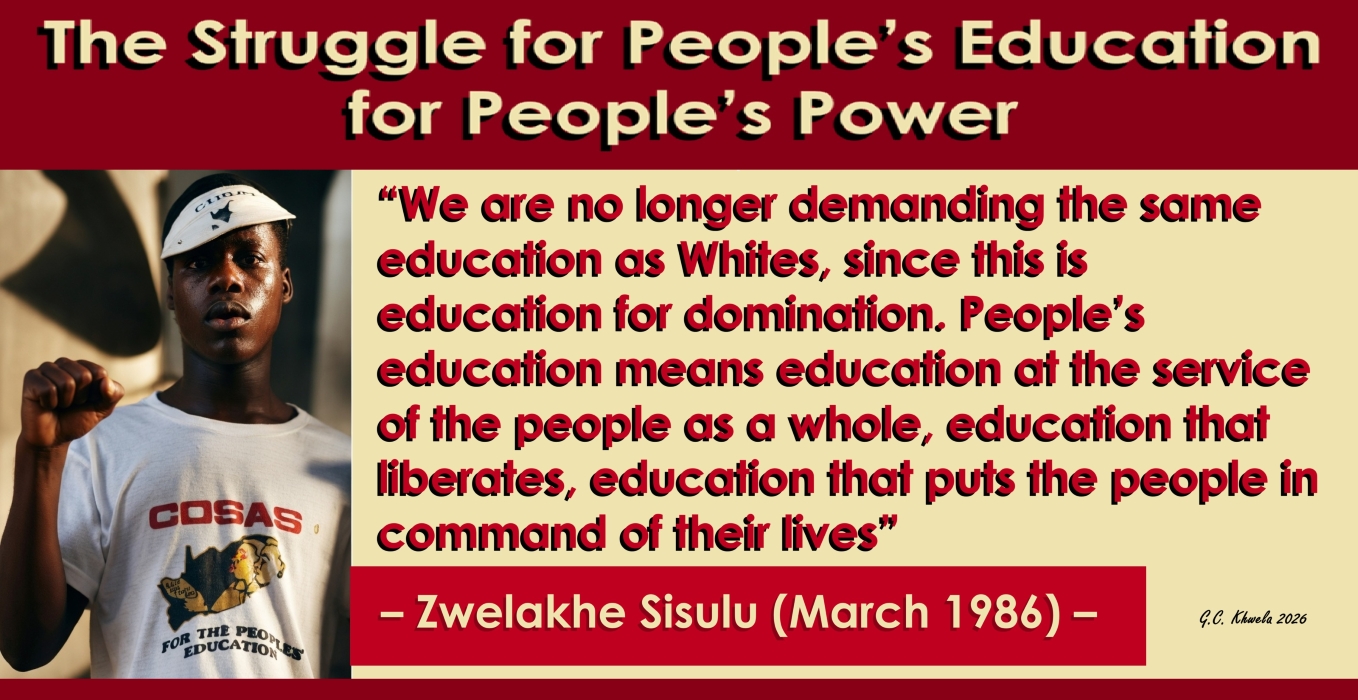
On 7 July 1986, a document was developed on “The Struggle for People’s Education” that was often framed around the slogan “People’s Education for People’s Power”, which was ultimately published in the September issue of Sechaba relating to a prominent anti-apartheid movement in South Africa during the 1980s. The movement emerged out of widespread dissatisfaction with the Bantu Education Act of 1953 and escalating school boycotts, serving as a strategic shift away from total disruptions towards capturing and transforming education into a tool for liberation.
Moving away from the state’s intent of training Black students for manual, subservient labour, the movement was promoting critical analysis, creativity, and active participation in political and cultural spheres, towards eradicating colonialism, apartheid, racist and tribalist conditioning from the school systems. The movement was focused on formulating non-racial educational material via independent subject committees and rebuilding specific curricula, most notably producing “People’s English”, “People’s History” and “People’s Mathematics” to counter government bias.
The intention was also to establish democratic control by transferring authority over schools from the apartheid state’s Department of Education and Training (DET) to local communities. This included the setting up structured, democratic school committees comprising parents, teachers and students working collectively as well as fighting for and defending democratically elected Student Representative Councils (SRCs) in schools. Furthermore, the objective was to shift the youth’s focus away from the volatile “Liberation Now, Education Later” mindset towards “Education for Liberation”. This implied replacing complete school abandonments with a return to classrooms, aiming to challenge and reshape the system internally while using knowledge to fight apartheid.
The People’s Education movement expected to achieve “Total Human Liberation” by transforming Black South Africans from subjugated, low-skilled workers into critical, self-aware citizens ready to govern a democratic society. Rather than viewing education purely as an academic exercise, the movement intended to use the classroom as a direct launching pad to dismantle the apartheid regime. The core objectives expected to be achieved were structured across political, social, and academic dimensions. Politically the intention was to shift governance and power by using schools to foster broader political awareness, uniting communities to fight against state-imposed rent hikes, consumer issues and segregation.
Socially the objective was to achieve decolonial and psychological transformation by erasing subservient mindsets through overturning the intentional psychological conditioning of Bantu Education, which was designed by the apartheid state to train Black students strictly to accept white supremacy as a given. People’s education was pursued to train students to be creative, to analyse information critically and consciously identify social and economic levers of oppression and to build a singular, democratic identity that eliminated the racist and tribal divisions enforced by apartheid legislation.
The academic goals were towards curriculum re-engineering through correcting biased historical narratives by implementing “People’s History”, which highlighted the true stories of pre-colonial African societies, local wars of resistance, working-class struggles and efforts towards national liberation in the continent, the global South and international solidarity. Efforts were also undertaken towards contextualised language and logic through teaching “People’s English” as a tool towards decolonisation and “People’s Mathematics” to empower everyday communication and practical, real-world problem-solving. People’s education was also aimed at re-defining the “Teacher’s Role”, by transforming teachers from strict, state-enforced compliance figures into active community leaders and facilitators of democratic thought.
However, there were several challenges and successes for the People’s Education movement, as it achieved its short-term tactical goals but failed to realise its long-term systemic objectives. While it successfully mobilised the masses, defeated the state’s educational narrative, and helped collapse the apartheid regime, its radical vision of shifting structural educational power directly to local communities was ultimately diluted and sidelined during South Africa’s post-1994 democratic transition. The movement’s outcomes can be evaluated by separating its distinct tactical victories from its structural failures.
The National Education Crisis Committee (NECC), for example, successfully convinced a volatile generation of striking students to return to classrooms. It reframed school as a site of struggle rather than a target for destruction. The movement completely shattered the ideological authority of the apartheid government’s Department of Education and Training (DET). It proved that Black communities would no longer accept state-sponsored, subservient schooling. Independent subject committees successfully created and distributed pioneering educational materials for “People’s Education”, which proved that democratic, non-racial educational design was possible.
The NECC and its allies in the Mass Democratic Movement played a pivotal role in the early 1990s negotiation process, laying down the fundamental principles of non-racial, universal access to education that shaped South Africa’s Bill of Rights. However, the primary objective of “People’s Power” – where local tripartite alliances of parents, teachers and students would govern schools – was replaced by a highly centralised, bureaucratic state administration. The modern School Governing Body (SGB) framework that emerged, was not what was envisaged, as critics argued that it favoured wealthier schools and resulted in democratic elitism.
The dream of using classrooms to cultivate a continuous, people-oriented critical consciousness gave way to a neo-liberal, market-driven economic framework. The new government opted for Outcomes-Based Education (OBE) and subsequent standardised curricula rather than the localised, revolutionary content envisioned by the People’s Education movement. Widespread crackdowns, States of Emergency, and the mass detention of student leaders by the apartheid state prevented the movement from fully testing or embedding its alternative curricula nationwide during the 1980s.
The movement expected to achieve absolute educational equality. However, modern South Africa continues to struggle with an ongoing education poly-crisis, where under-resourced public township and rural schools face severe infrastructure shortages compared to their affluent counterparts. Perhaps for achieving a completely decolonised and a people-oriented education curriculum, comparisons can be done with the type of education that was undertaken at Solomon Mahlangu Freedom College (SOMAFCO), which was provided within completely free albeit limited conditions.
While both People’s Education and the SOMAFCO education system were revolutionary anti-apartheid educational movements that rejected Bantu Education, they differed fundamentally in their geographic execution, institutional governance, ideological focus and target audiences. The primary differences between the two models are structured across several key dimensions. While People’s Education was an internal mass movement operating under severe state repression within South Africa, it had to navigate, resist and infiltrate the existing government-controlled infrastructure and township schools. SOMAFCO, on the other hand, was a centralised, physically isolated institution completely run by the African National Congress (ANC) in Mazimbu near Morogoro, Tanzania. It was built on land donated by the Tanzanian government and operated as an autonomous, self-sustaining community hub.
People’s Education promoted broad-based, democratic community control. Power was shared horizontally across the National Education Crisis Committee (NECC) via tripartite alliances of local parents, teachers and student representatives. Whereas SOMAFCO was governed and managed strictly via hierarchical, political party structures under the ANC in exile. Decision-making was heavily directed by the ANC’s Education Structures in exile.
People’s Education was focused heavily on ideological, critical and academic rewriting to counter state bias in core subjects, creating frameworks like “People’s History” to foster a revolutionary consciousness inside township classrooms. SOMAFCO was focused on a well-established ideological, critical and academic curriculum. Because it was a physical campus, it combined academic rigor with extensive revolutionary cultural training, preparing exiles to practically fit into and run a post-apartheid state.
Therefore, People’s Education was aimed at the entire domestic student population remaining inside apartheid South Africa, designed to prevent student dropouts and transform the ongoing school boycotts into constructive internal political resistance. On the other hand, SOMAFCO was built specifically to cater to refugees and political exiles – mainly the thousands of young freedom fighters who fled South Africa after the 1976 Soweto Uprising and the children of existing ANC exiles.
Merging the People’s Education model with the SOMAFCO framework is highly feasible, since blending them creates a robust, forward-looking paradigm that balances critical thinking, technical competency and community governance. By integrating these historically grounded South African philosophies with modern, globally validated educational benchmarks, creates a unique Hybrid Transformation Model, structured around several primary pillars. The Curriculum “Critical Thought Meets Production” pillar synthesises the socio-political awareness of People’s Education with the pragmatic revolutionary cultural and vocational focus of SOMAFCO.
People’s Education, which emphasises decolonial, critical history and contextualised problem-solving, synthesises with SOMAFCO’s core principle of “Education with Production” that dignifies manual labour and linking academic subjects directly to industry). This maps directly to the Finnish Phenomenon-Based Learning and STEM/STEAM frameworks. Rather than teaching mathematics or science in isolation, students use mathematical modelling and scientific principles to solve tangible, local challenges – such as designing renewable energy grids for local townships or developing sustainable urban agriculture systems.
With reference to governance, focusing primarily on “Democratic Decentralisation”, updates the local oversight of People’s Education into a globally compliant administrative structure. It revives the People’s Education model of localised, horizontal governance through collective tripartite alliances of parents, teachers and students. It moves away from the rigid, centralised state bureaucracies that SOMAFCO had to implement while operating in exile and adopts the Charter School and Decoupled School Board Frameworks seen in progressive schools’ public networks. Schools would function as autonomous community hubs, wherein local boards have a direct, legislative say in tailoring 20% of the school’s curriculum to local economic and historical contexts, ensuring that schools serve the immediate spatial realities of the neighbourhoods they inhabit.
The pedagogy aims at an “Experiential Agency”, which transitions classrooms from routine learning to active, industry-aligned skill building. This combines the activist spirit of People’s Education, shaping students into highly analytical, socially conscious civic leaders with SOMAFCO’s self-reliance model, training students to physically construct and manage community institutions). By integrating Project-Based Learning (PBL) and the International Baccalaureate (IB) Learner Profile, specifically focusing on being reflective, principled and open-minded, routine memorisation is abandoned.
Assessment would be heavily weighted toward continuous, portfolio-based practical projects. Students must demonstrate competency by collaborating on communal initiatives, presenting defences of their research, and undergoing mandatory, credit-bearing vocational apprenticeships before graduation. This leads to “The Micro-Society School” that expands the school environment beyond the traditional classroom walls. It emulates SOMAFCO’s Mazimbu design, where the school was not just a collection of classrooms but a self-sustaining miniature ecosystem complete with a working farm, a hospital and maintenance workshops.
This pillar aligns with the UN Sustainable Development Goal 4 (Quality Education) and modern technical high school models globally. Schools are physically designed to feature green enterprise zones, technical workshop bays, and community health or digital access centres. The school building and grounds act as a living laboratory and a cultural site where students actively participate in maintaining the school’s digital infrastructure, urban gardens and community outreach software.
Scaling this hybrid model to the tertiary level provides a direct antidote to the historic separation between “academic” universities and “vocational” Technical and Vocational Education and Training (TVET) colleges. By applying the combined principles of People’s Education that emphasise critical consciousness and community governance and SOMAFCO’s education with production, higher education institutions can transition away from detached theory into engines of local regional development. At the tertiary level, the model integrates with global systems to restructure both paths where colleges operate their own commercial micro-enterprises, such as green energy installation, civil construction, agro-processing and software development. Students spend 50% of their credits executing paid, real-world public works contracts within local municipalities.
This model follows People’s Education by transforming TVET boards to be not just corporate committees, but to be composed of local labour unions, community leaders and industry guilds. This ensures that the trades taught directly answer the immediate structural deficits of the surrounding district. The model borrows directly from the German Dual VET System (structured work-study rotation) and the Swiss Apprenticeship Model, where businesses and schools share the financial and pedagogical responsibility of training the workforce. Purely theoretical dissertations are abandoned and every academic degree introduces a mandatory Participatory Action Research (PAR) component.
Engineering, law and medical students must co-design their final theses alongside community stakeholders to resolve real systemic failures, such as designing decentralised water purification grids or creating free localised paralegal clinics). This rewrites the university’s relationship with society. Rather than academic elitism determining research agendas, research funding is directed by regional transformation boards. These boards include community representatives who vote on which localised challenges the university’s intellectual capital should prioritise solving and aligns with the “Mind and Hand” philosophy, combining abstract scholarship with industrial application. It adapts the Design Thinking for Social Impact methodology to address structural inequality.
In conclusion, the divide between academic and vocational education is artificial. Forcing a separation between cognitive “white-collar” study and manual “blue-collar” labour is a historical flaw of colonial and apartheid education. Blending People’s Education critical thought with education with production proves that high-level academic theory becomes more robust when applied directly to physical manufacturing, agriculture, revolutionary culture and infrastructure development. Relying solely on centralised state funding creates permanent deficits in historical public systems. By implementing SOMAFCO’s model of campus-led enterprises alongside global dual-VET systems, institutions transition from passive financial consumers into self-sustaining economic entities that produce food, energy and localised technology.
Top-down, highly centralised educational curricula fail to adapt to the fluid, spatial realities of marginalised localities. Merging broad community governance with progressive international frameworks confirms that schools perform at their peak when local parents, trade unions and students hold a legislative stake in directing the institution’s localised research and development. Teaching purely technical or digital skills without social context creates a compliant, narrow workforce. However, infusing global benchmarks, such as Finland’s Phenomenon-Based Learning) with decolonial, critical pedagogy ensures that graduates are not just passive cogs in a global economy, but agile, civic-minded innovators equipped to structurally redesign their immediate societies.
That is perhaps the current meaning of “PEOPLE’S EDUCATION FOR PEOPLE’S POWER!”
Sources:
Wikipedia.
South African History Archives (SAHA).
South African History Online (SAHO).
Zwelakhe Sisulu, “People’s Education for People’s Power: Keynote Address, National Education Crisis Committee, Transformation 1, 29 March 1986.
Elaine Unterhalter, “The Struggle for People’s Education”, Sechaba, September Issue, 1986.
Pethu Serote, “Solomon Mahlangu Freedom College: A Unique South African Educational Experience in Tanzania”, Transformation 20, 1992.
Rehana Muhammad, “The People’s Education Movement in South Africa: A Historical Perspective”, Master of Education Dissertation: Rand Afrikaans University, April 1996.
Thokozani Mathebula, “People’s Education (for People’s Power) – A Promise Unfulfilled”, South African Journal of Education, Vol. 33 No.1, January 2013.
Martin Giles Prew, “‘People’s Education for People’s Power’: The Rise and Fall of an Idea in Southern Africa”, in Tom G. Griffiths and Zsuzsa Mille (Ed.s), “Logics of Socialist Education: Engaging with Crisis, Insecurity and Uncertainty”, Springer, January 2013.
Janet Cherry, “Successes and Failures of South Africa’s Student Movement”, Waging Nonviolence, 29 June 2017.
Michelle Paxton and Craig Paxton, “Peoples Education for Peoples Power”, Axium Education, 27 April 2018.
Clever Ndebele, et, al., “Reconceptualising Initial Teacher Education in South Africa: A Quest for Transformative and Sustainable Alternatives”, Interdisciplinary Journal of Education Research, Vol. 6, 2024.
Vashna Jagarnath, “Lessons from South Africa’s Past for a Future of Collective Empowerment”, Mail & Guardian, 7 November 2024.
Linda Chisholm, “Political, ‘Refugee’ and Peoples’ Education in South African Exile Politics 1978–1995”, Paedagogica Historica: International Journal of the History of Education”, Vol. 61, Issue 4, 2025.
Monument Thulani Bongani Makhanya, “Community Engagement Ecosystems in South African Higher Education: A Bibliometric Analysis of Scholarship Advancing Social Justice, Inclusion, and Institutional Strategy”, Teaching, Learning and HEI Ecosystem, Vol. 8, No. 2, April 2026.
Castro Khwela
Good morning fellow Compatriots!🙏🏾✊🏾👊🏾
Discover more from CASTRO KHWELA
Subscribe to get the latest posts sent to your email.