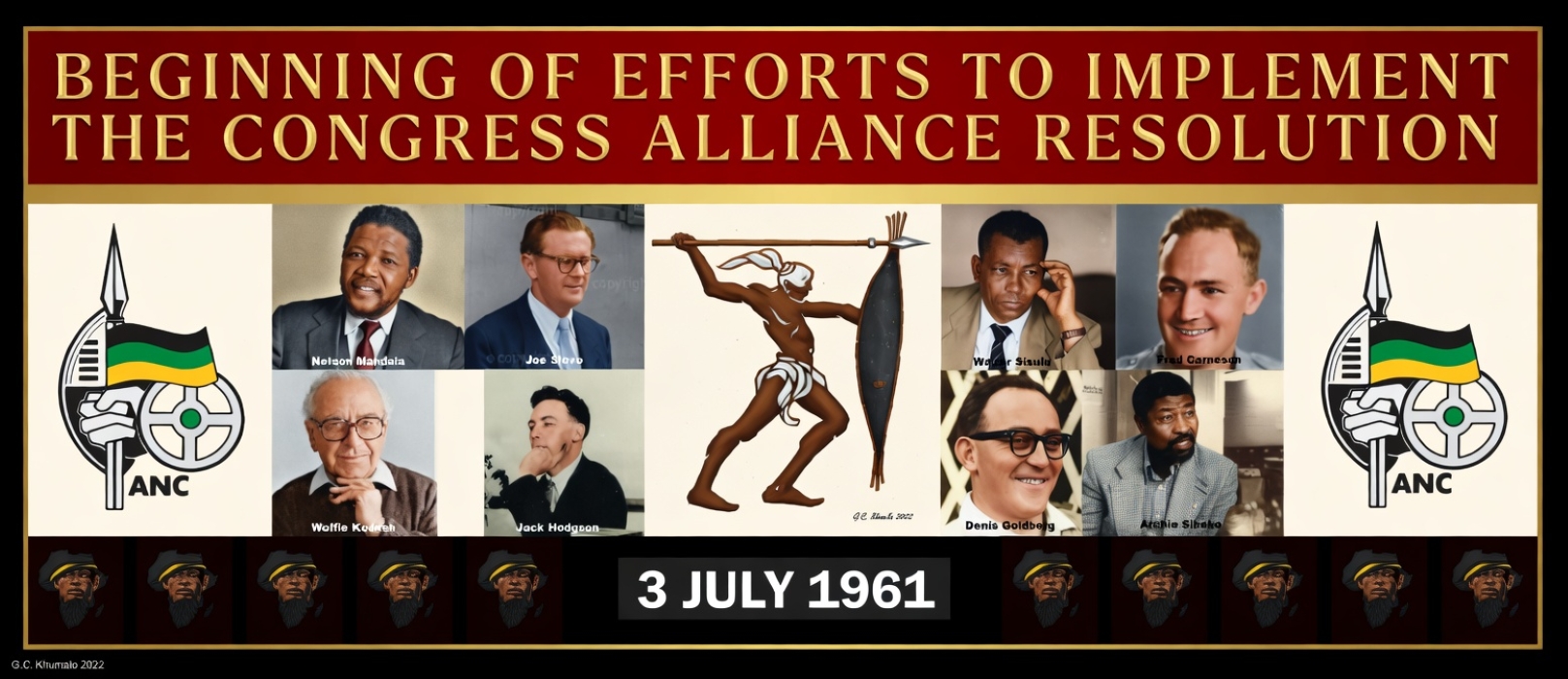
Efforts to Implement the Congress Alliance Resolution
On 3 July 1961, following discussions between Nelson Mandela, Walter Sisulu and Joe Slovo on who would join them on the “High Command” of the new military wing, as well as how they would organise regional commands and urban units, Mandela resigned himself to building the new command structure. He had accepted the fact that his work on the M-Plan was ignored, meaning that the use of the African national Congress (ANC) in deploying forces was postponed. The ANC National Executive Committee (NEC) had resolved that a national conference was required to adopt or reject the proposal he had made to the Congress Alliance.
As the Congress Alliance had resolved, Mandela’s new structure, would be a separate and independent entity from the South African Communist Party (SACP) and the ANC. Accordingly, his operatives were no longer to attend any Communist Party meetings, and Mandela, through Joe Slovo, immediately moved to enlist the efforts of white Communists. These included mainly dedicated cadres who had resolved on a course of violence and had already executed acts of sabotage, such as cutting government telephone and communication lines.
Among those they recruited was Jack Hodgson, a Second World War military veteran of the Springbok Legion, and Lionel “Rusty” Bernstein, who had served in the South African Army during the Second World War as a gunner (artillery) in North Africa and Italy. Jack was to become the new structure’s demolition expert, and the intention was to begin with what was least violent to individuals but most damaging to the state. Consequently, Jack Hodgson visited Ronald Press in Springs, who was Hodgson’s colleague in the SA Congress of Democrats (COD), a former Treason Trialist and a Wits University chemical engineering graduate. Hodgson wanted Press to assist with devices that could be used to detonate explosives, which Press was willing to do.
The second task was to get men appropriately trained militarily, a six-person military command that was to reinforce the “High Command”, which included Raymond Mhlaba, as a the pioneer of the M-Plan; Wilton “Bri Bri” Mkwayi, a trade union field organiser; Joe Gqabi, the photojournalist for the “New Age” newspaper, and a militant organiser; Abel Patrick Mthembu, a World War II military veteran from Johannesburg; Andrew “Robot” Mlangeni, a trade union organiser from the Orange Free State; and Nandhagopaul (Nandha) “Steve” Naidoo, who had already been trained in the technical field.
All these men, who were instrumental in the organisational implementation of the M-Plan, were to be trained in the People’s Republic of China to become military commanders, and were anticipated to connect with cell and zone stewards as key officers in a future fighting force and in executing appropriate operations. In addition to the establishment of a High Command, the new structure had to create a dedicated central headquarters, which was purchased for £30 000 by the SACP, through Mick Harmel and Vivien Ezra, a property in Rivonia, north of Johannesburg, called Liliesleaf Farm.
Meanwhile, in the gardens next to the Cape Town Art Gallery, Fred Carneson was meeting with Denis Goldberg, where they were feeding peanuts to some squirrels and doves under the winter sunshine. Carneson asked Goldberg if he would be willing to join the Western Cape Regional Command of a newly formed military organ of the Movement. Since Goldberg was an engineer, Carneson considered that he would be valuable in providing technical skills that were needed. While Carneson was attempting to outline the risks involved in the initiative, Goldberg stopped him short, saying that he was willing to join. Goldberg went further telling Carneson that he had “been arguing for at least a year for adding armed actions to our struggle”.
In the following week, Wolfie Kodesh was driving a 1948 Chevrolet with passengers including Jack Hodgson, Nelson Mandela and a pharmacist, Ronald Press, to an unpopulated area between the suburbs of Primrose, Kempton Park and Edenvale in the East Rand. The area was an approximately twenty-acre site that included a small wood and two brickworks structure, next to which Kodesh parked, where there were derelict buildings and several pits.
As they were parking, a Black Watchman emerged from the galvanised iron buildings and strode toward the car. Immediately, Mandela signalled that they should go and fetch the equipment from the car. He then engaged the man, who was Zulu speaking fellow, in a conversation out of earshot of the others, while having his arm around the man’s shoulders. After a while, the Watchman began nodding his head vigorously, before walking away, accepting their presence.
One of the derelict buildings was used to test Molotov cocktails (petrol bombs), making Mandela to shake his head gleefully as the bottles burst into flames. After dousing the last remaining flames, the four moved from the building to one of the open pits outside, which they used to place a paraffin tin with a tube of a ballpoint pen inserted into the spout. After waiting for a few seconds, a mighty bang occurred from the pit, sending a huge dust cloud into the air and mounds of earth into the ground, completely submerging the tin.
Afterwards, the four ran back to the car, wherein on their way home, Mandela recommended that as soon as they were certain that the problems with the timing devices had been resolved, they were to report to the High Command, so that every unit could be trained on the correct use of the bomb. Later on, towards the end of July, Denis Goldberg, Fred Carneson and Archie Sibeko met in Tolly Bennun’s flat in Port Elizabeth, wherein Harold Strachan began a demonstration with glycerine and permanganate of potash. Bennun informed Goldberg that he discovered the mixture working through texts on World War II explosive in the University Cape Town library.
These were the beginnings of a new army, a People’s Army, which was named “Umkhonto we Sizwe” (The Spear of the Nation) – or MK for short. According to Mandela, “The symbol of the spear was chosen because with this simple weapon Africans had resisted the incursions of whites for centuries.” MK was not constrained from enlisting and placing at Executive level white members, as was the case with the African National Congress (ANC). Mandela and Slovo began recruiting Walter Sisulu to be part of the High Command, and through Slovo they enlisted members of the Communist Party (SACP), who were not reluctant to pursue the violent course, of which some were already undertaking acts of sabotage.
Efforts were absolutely being made in other cities and towns across South Africa, even though Johannesburg and Cape Town were the initial focus of formal organisation in early July 1961. The launch of Umkhonto we Sizwe (MK) was designed as a national campaign, and regional commands in other major areas were rapidly mobilised and formalised shortly after those initial discussions. The expansion and regional organisation developed rapidly across other areas of the country between July and December 1961. In Natal (Durban) Regional Command was led by figures like Curnick Ndlovu, Ronnie Kasrils, and Billy Nair. This became one of the most active units in the country. They successfully coordinated and executed multiple synchronised bomb blasts in Durban on the official launch night of 16 December 1961.
In the Eastern Cape (Port Elizabeth) Regional Command the structure was coordinated by prominent trade unionists and political leaders, including Vuyisile Mini, Wilson Khayingo and Zinakele Mkhaba. This region possessed a deeply entrenched underground network due to strong local trade union structures. Operatives in Port Elizabeth successfully manufactured homemade devices and struck government infrastructure alongside Johannesburg and Durban on 16 December 1961. The Border Regional Command (East London & Surrounds) was organised under the guidance of regional leadership connected to Eastern Cape networks, utilising tight-knit local cells. Underground units were established to connect the urban sabotage networks with rural areas in the Transkei and Ciskei, establishing crucial logistics corridors that would later handle recruits moving out of the country.
The Evolution of the High Command’s Strategy was that the initial emphasis on Johannesburg and Cape Town during the 3 July 1961 discussions was purely logistical. Johannesburg housed the core “National High Command”, later operating out of Liliesleaf Farm in Rivonia, while Cape Town offered established underground networks through the South African Communist Party (SACP) and trade unions. Rather than ignoring other areas, Nelson Mandela spent the months following July 1961 traveling secretly across South Africa – a period that earned him the nickname “The Black Pimpernel” – specifically to recruit members, establish these missing regional commands, and to ensure that the 16 December launch was a unified, nationwide campaign rather than a localised flashpoint.
Sources:
South African History Online (SAHO).
A. Lerumo, “Forms and Methods of Struggle the South African Democratic Revolution”, The African Communist, No. 9, April/May 1962.
Nelson Mandela, “Long Walk to Freedom”, Abacus, 1994.
Rocky Williams, “The Other Armies: A Brief Historical Overview of Umkhonto We Sizwe (MK), 1961-1994”, Military History Journal, Vol. 11, No. 5, June 2000.
Stephen Ellis, “External Mission: The ANC in Exile”, Jonathan Ball, 2012.
Thula Simpson, “Umkhonto we Sizwe: The ANC’s Armed Struggle”, Penguin, 2016.
Paul S. Landau, “Spear: Mandela and the Revolutionaries”, Jacana, 2022.
Padraig O’Malley, “History of Umkhonto we Sizwe”, O”Malley: The Heart of Hope, Nelson Mandela Foundation Archive, accessed 3 July 2026.
Castro Khwela
Good evening fellow Compatriots!🙏🏾✊🏾👊🏾
Discover more from CASTRO KHWELA
Subscribe to get the latest posts sent to your email.