UN Committee on SWA Denied Entry with Serious Repercussions
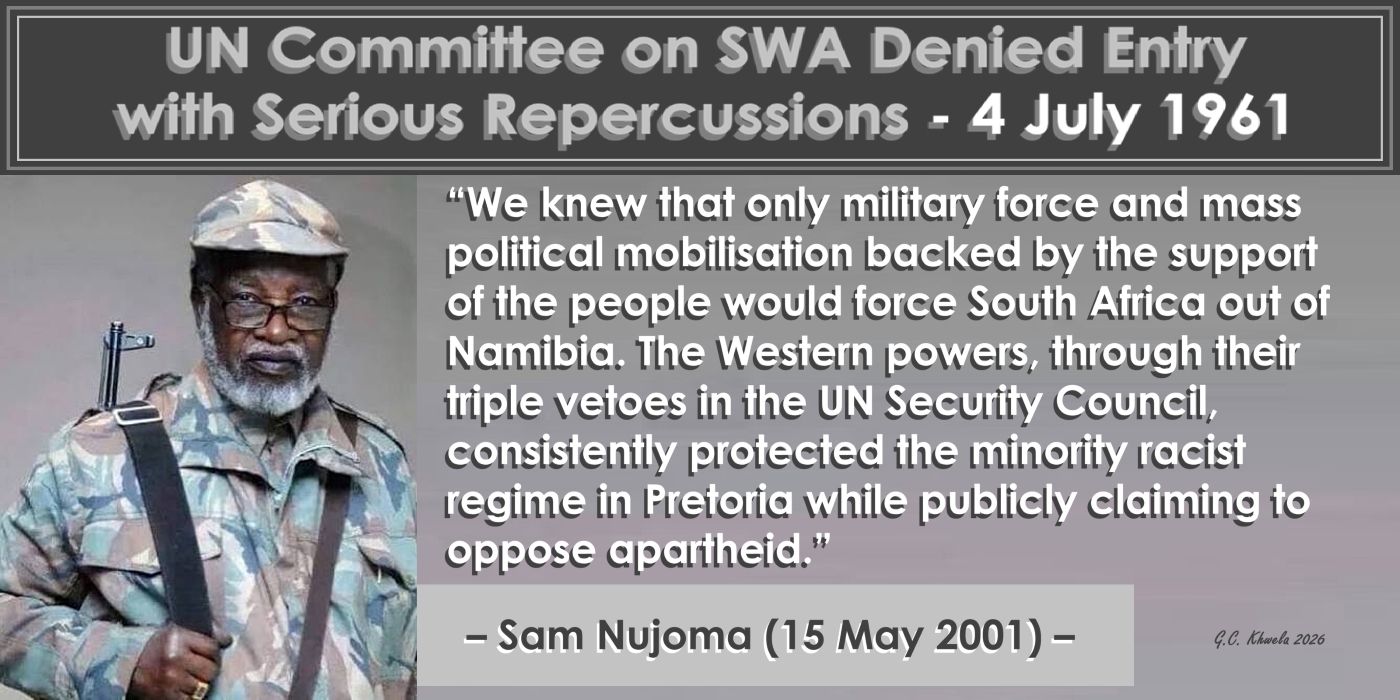
On 4 July 1961, a United Nations (UN) committee consisting of eight, with instructions to investigate conditions in the Mandated Territory of South Africa, was refused permission to enter South-West Africa (now Namibia). The United Nations General Assembly was the UN body that instructed the Committee on South West Africa to investigate conditions in the territory as an oversight committee. However, on 4 July 1961, the South African government refused the eight-member committee entry into South-West Africa. Apartheid South Africa’s Minister of Foreign/External Affairs, Eric Louw, declared that if the committee attempted to enter the territory without state permission, they would be detained and deported. He added that any unauthorised entry would be treated as an act of aggression against South Africa.
The apartheid government refused the eight-member Committee on South West Africa entry due to a combination of ideological, legal, and political factors rooted in the defence of its racist and colonial regime. The ruling National Party government, led by Prime Minister Hendrik Verwoerd, was aggressively implementing and expanding its apartheid policies into South-West Africa, treating it essentially as a fifth province of South Africa. Minister of Foreign Affairs Eric Louw maintained a strict, unyielding stance that the UN had absolutely no right to interfere in South Africa’s “internal matters” or to investigate its domestic racial policies.
In the early to mid-1960s, Liberia and Ethiopia had launched a formal legal challenge against South Africa at the International Court of Justice (ICJ), arguing that South Africa had violated its mandate by failing to promote the well-being of the territory’s inhabitants. The South African government used this ongoing lawsuit as a shield, claiming the entire matter was sub judice – under judicial consideration – and that any UN investigation while the court case was active was unconstitutional and illegal.
South Africa argued that its mandate over the territory had been granted by the defunct League of Nations after World War I, and it explicitly rejected the premise that the United Nations was the legal successor to the League. Because they did not recognise the UN’s supervisory authority over the mandate, they refused to issue the necessary visas or allow the committee entry.
Nonetheless, the UN committee had been instructed by General Assembly Resolution 1596 (XV) to consult directly with the local indigenous population regarding self-determination. The racist South African government feared that a high-profile UN presence would validate and energise local liberation movements – such as the newly formed SWAPO (South West Africa People’s Organisation) – and expose the harsh realities of apartheid to the international press.
The United Nations committee backed down in July 1961 primarily because Western colonial powers withdrew critical logistical and diplomatic support, stripping the committee of its only physical route into the territory. While the UN General Assembly had given the eight-member committee a bold mandate to enter South-West Africa with or without South African consent, the UN as an organisation lacked the legal mechanism and physical military backing to force its way across international borders without the cooperation of its member states.
This retreat was forced by several key geopolitical realities. Because South Africa controlled all direct ports and airways into South-West Africa, the UN committee planned to enter the territory by land via Bechuanaland (now Botswana), which was a British Protectorate at the time. Britain originally granted the UN delegation visas to enter Bechuanaland. However, when South Africa threatened that entry would be treated as an “act of aggression” and result in detention, Britain panicked. In order to protect its relationship with Pretoria, the British Government abruptly suspended the UN visas and withdrew all logistical facilities on 9 July 1961. Britain demanded a written guarantee that the committee would not attempt to cross the border into South-West Africa. When the committee refused to give this assurance, they were effectively stranded and legally blocked by a Western UN member state.
The directive to investigate came from the UN General Assembly through Resolution 1596. Under the UN Charter, General Assembly resolutions are non-binding recommendations. The General Assembly does not command troops or enforcement mechanisms. To force entry into a resisting state, a directive must come from the UN Security Council under Chapter VII – threats to international peace. At this point in the Cold War, Western permanent members of the Security Council, the United States, United Kingdom and France, heavily resisted enforcing radical measures or economic sanctions against South Africa.
Therefore, the UN was internally divided on how to handle South Africa’s defiance. A massive ongoing legal battle had just been launched at the International Court of Justice (ICJ) by Ethiopia and Liberia against South Africa. Many legalistic UN members argued that pushing a physical confrontation while the case was still under judicial review, would damage the UN’s credibility and compromise the court case.
Unable to enter the country physically, the committee did not abandon its mission entirely. They instead pivoted to Dar es Salaam (Tanganyika) and Leopoldville (Congo), where they interviewed exiled Namibian refugees and political leaders who had escaped the apartheid regime. Their subsequent report exposed the severe human rights violations happening inside the territory, which ultimately built the international momentum that led the UN to completely revoke South Africa’s mandate in 1966.
The alternative efforts undertaken by the UN Committee on South West Africa in Tanganyika (Dar es Salaam), Leopoldville (Congo) and Ghana (Accra) in July and August 1961 yielded profound results. While the committee was physically blocked from entering the territory, their mission completely changed the international playbook on Namibia. Crucially, the resulting 1961 Report to the General Assembly (Document A/4926) became a devastating weapon that stripped away the diplomatic cover of Western powers, exposing their complicity and two-faced approach toward the apartheid regime.
The specific impacts and the exposure of Western double standards unfolded across several key areas. Firstly, by interviewing exiled leaders – such as Sam Nujoma, the president of SWAPO, Mburumba Kerina (a foundational Namibian politician, academic and liberation icon best known for coining the name “Namibia”) and Jariretundu Kozonguizi (a prominent Namibian lawyer, diplomat and nationalist politician who co-founded and served as the first president of the South West Africa National Union or SWANU) – the committee achieved what apartheid South Africa had tried to prevent through its border blockade. The committee gathered meticulous first-hand evidence on the violent forced removal of Black residents from the Old Location in Windhoek, the enforcement of pass laws and the illegal militarisation of South West Africa.
For the first time, the committee used this testimony to formally conclude that South Africa was completely unfit to govern South West Africa. Their final report officially recommended that South Africa’s mandate be terminated and replaced by a direct UN trusteeship. This laid the direct legal and political foundation for the General Assembly to strip South Africa of its mandate five years later, in 1966. The report and the surrounding diplomatic fallout put an unavoidable spotlight on the hypocrisy of major Western nations – specifically the United Kingdom, the United States and France – who championed human rights globally while actively shielding Pretoria.
The committee’s findings exposed this duplicity in three ways. Firstly, the report laid bare how the United Kingdom had sabotaged the UN mission by cancelling the committee’s travel visas to Bechuanaland (Botswana) under pressure from South Africa. This proved that Britain prioritised its economic and military ties with white minority regimes over its legal obligations to the UN. Secondly, the testimonies highlighted how Western multinational corporations (primarily British and American) were reaping massive profits from South West Africa’s diamonds and base metals via cheap, segregated contract labour.
The report made it clear that while Western politicians condemned apartheid in speeches, Western capital was actively financing and sustaining it. Thirdly, the committee’s findings forced a public recognition that Western powers were using their veto power in the UN Security Council to block economic sanctions or arms embargoes against South Africa. The West argued that South Africa was a stable, anti-communist bulwark in Africa, effectively revealing that they valued Cold War alliances more than the liberation of Black Africans. By exposing this Western double standard, the 1961 committee’s report triggered a permanent shift in the power balance of the United Nations.
Empowered by the report’s harrowing findings, newly independent African and Asian nations bypassed Western resistance in the General Assembly. In October 1961, directly leveraging the anger from the committee’s blocked trip, the UN General Assembly voted 67 to 1 to formally censure South African Foreign Minister Eric Louw for his pro-apartheid speech. Notably, frustrated by the exposure of their double standards, the United States and the United Kingdom chose to abstain rather than vote with South Africa, marking the beginning of the West’s slow, reluctant diplomatic retreat from defending Pretoria openly.
The Afro-Asian bloc successfully exploited the West’s diplomatic retreat by leveraging their overwhelming numerical majority in the UN General Assembly to bypass Western Security Council vetoes and systematically institutionalise South Africa’s isolation. By framing apartheid not merely as a domestic issue but as a direct threat to international peace and security, they forced the Western powers into a corner where defending Pretoria became morally and politically untenable. The bloc achieved this through a series of highly coordinated escalation strategies, such as weaponising the “Uniting for Peace” Dynamic.
Because the Western powers repeatedly used their vetoes in the UN Security Council to block binding economic sanctions, the Afro-Asian bloc turned the UN General Assembly into their primary arena. Under UN rules, no single country holds a veto in the General Assembly. Armed with dozens of newly independent African nations entering the UN in the early 1960s, the bloc effectively dictated the assembly’s agenda, shifting the global focus away from standard Cold War optics and squarely onto decolonisation and anti-racism.
On 6 November 1962, the bloc successfully pushed through General Assembly Resolution 1761 (XVII). This was a historic turning point that established concrete mechanisms to penalise the apartheid regime. The resolution explicitly requested member states to break off diplomatic relations with South Africa, close their ports to South African vessels, boycott all South African goods, and halt exports (specifically arms and ammunition) to the country. Moreover, it established the UN Special Committee against Apartheid. This permanent body served as a continuous global watchdog that constantly researched, exposed and kept South Africa’s human rights abuses at the forefront of international media.
The Afro-Asian bloc deliberately structured votes to force Western nations to reveal their true priorities on the public stage. When Western nations voted against or abstained from anti-apartheid resolutions, the bloc used the UN floor to openly label them as accomplices who valued South African gold, diamonds and anti-communist alignment over human lives. This constant public shaming eroded the West’s moral authority, particularly as the global Civil Rights movement gained traction in the United States.
Following the 1961 committee blockade, the bloc refused to let the legal status of South West Africa (Namibia) remain in limbo. They steadily built the legislative momentum that culminated in Resolution 2145 (XXI) in 1966, where the General Assembly officially revoked South Africa’s mandate. By doing so, they officially transformed South Africa’s presence in Namibia from a disputed administrative mandate into “an illegal military occupation under international law”. With South Africa structurally condemned by the General Assembly, the Afro-Asian bloc began systematically driving Pretoria out of international forums.
They successfully suspended or forced South Africa’s withdrawal from the International Labour Organisation (ILO); the World Health Organisation (WHO); the United Nations Educational, Scientific and Cultural Organisation (UNESCO) framework; and the international sporting bodies, building the foundation for South Africa’s eventual total exclusion from the Olympic Games. Through these methods, the Afro-Asian bloc successfully transformed South Africa from a wealthy, well-connected Western ally into an international pariah state, ensuring that the high political and economic cost of maintaining apartheid would eventually become completely unsustainable.
Sources:
Wikipedia.
South African History Online (SAHO).
African National Congress, “General Assembly Resolution: Question of Race Conflict in South Africa Resulting from the Policies of Apartheid of the Government of the Union of South Africa”, Resolutions: African National Congress (ANC), 13 April 1961.
Committee on Africa, “Communist Penetration in Africa”, North Atlantic Council: NATO Secret Document C-M(62)112, 23 November 1961.
United Nations General Assembly, “Report of the Committee on South West Africa and Assistance of the Specialised Agencies and – of the United Nations Children’s Fund in the Economic, Social and Educational Development of South West Africa: Reports of the Agencies and of the Fund”, United Nations General Assembly Official Records, 27 November 1961.
United Nations General Assembly, “Report of the Committee on South West Africa Concerning the Implementation of General Assembly Resolutions 1568 (XV) and 1596 (XV)”, United Nations General Assembly Official Records, 12 March 1962.
HISTORY.com Editors, “UN Condemns Apartheid in South Africa”, This Day in History, History.com, 6 November 1962.
South West Africa (Ethiopia v. South Africa), “Counter-Memorial Filed by the Government of the Republic of South Africa”, International Court of Justice (ICJ), 10 January 1964.
South West Africa (Liberia v. South Africa), “Minutes of the Public Hearings held from 15 March to 14 July, 20 September to 15 November and 29 November 1965, 21 March and on 18 July 1966”, International Court of Justice (ICJ), 15 March 1965.
Bland Addison, “United Nations Revokes South African Mandate over South-West Africa”, EBSCO, 27 October 1966.
Marinus Wiechers, “South West Africa: The Background, Content and Significance of the Opinion of the World Court of 21 June 1971”, The Comparative and International Law Journal of Southern Africa, July 1972.
Tor Sellström, “Hammarskjöld and Apartheid South Africa: Mission Unaccomplished”, Accord, 27 March 2011.
Nadia Joseph, “Activity Against Apartheid: International”, Anti-Apartheid Legacy, July 2022.
Anti-Apartheid Movement, “Namibia”, Forward to Freedom: The History of the British Anti-Apartheid Movement, 1959 – 1994”, AAM Archives Committee, 2000 – 2026.
Castro Khwela
Good evening fellow Compatriots!🙏🏾✊🏾👊🏾
Discover more from CASTRO KHWELA
Subscribe to get the latest posts sent to your email.