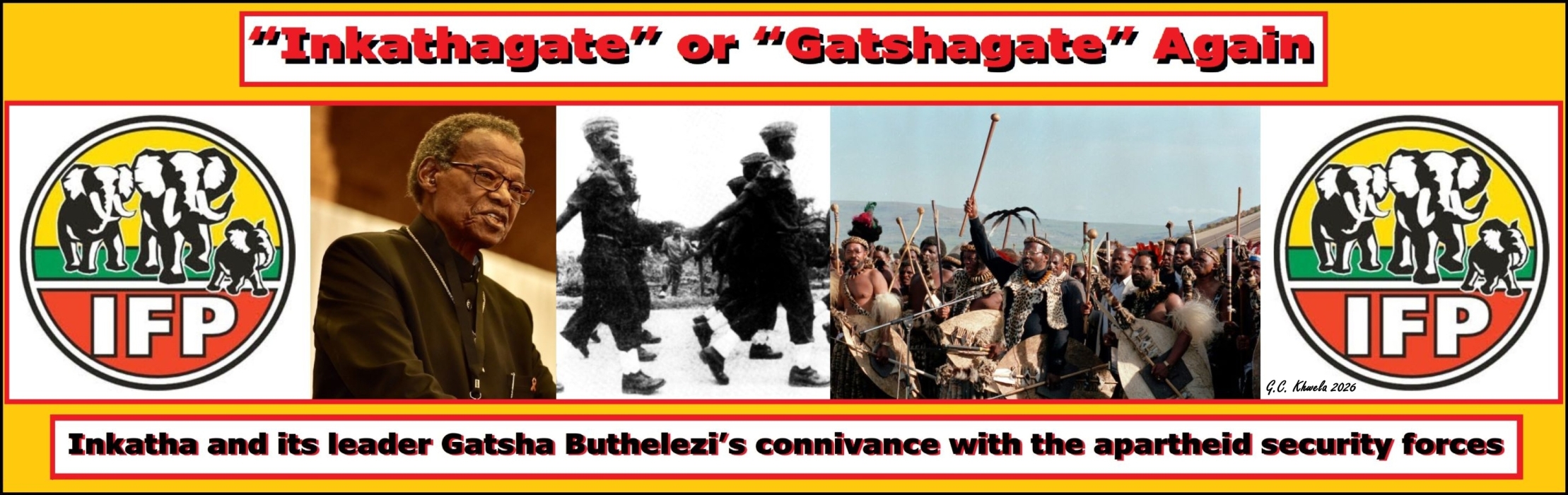
“Inkathagate” or “Gatshagate” Again
On 25 July 1991, the ‘Weekly Mail’ newspaper claimed it had obtained copies of Security Branch documents from Brian Morrow, a former Warrant Officer in the Security Branch, relating to extensive discussions between Inkatha Freedom Party (IFP) President Mangosuthu Gatsha Buthelezi and Major Louis Botha, who was a senior apartheid Security Branch officer in Durban, about how the African National Congress (ANC) could be prevented from eroding Inkatha’s support in Natal. This was the essence of the second “Inkathagate” scandal, which exposed the IFP’s collaboration with the apartheid Security Branch in fighting against the liberation forces led by the African National Congress (ANC).
The documents referred to Buthelezi’s concerns about Inkatha’s declining membership figures in Natal following Nelson Mandela’s release and it alleged that at least R250 000 was paid by the Security Branch into an Inkatha-owned bank account for the purposes of organising rallies and other anti-ANC activities shortly after Mandela’s release. This second “Inkathagate” or “Gatshagate” scandal offered sufficient ground for the ANC’s view that Inkatha was a “hidden force” within the state apparatus that was ultimately responsible for the violence.
This was a second submission to the mainstream media of Inkatha and its leader Gatsha Buthelezi’s connivance with the apartheid security forces in the efforts to destabilise the ANC and its associated organisations within a period of less than two months. On 10 June the same year, a retired army Major, Mr Nico Basson, had overtly exposed to the media covert military assistance provided by the apartheid South African Defence Force (SADF) to the IFP, which included weapons, such as AK-47 rifles, in order to weaken the ANC.
Furthermore, Inkatha Youth Brigade members were provided with training in urban and rural guerrilla warfare in the Caprivi Strip in northern Namibia, and directed to assassinate anti-apartheid activists, contrary to President de Klerk’s bland assurance that this was merely training in “VIP protection”. Moreover, a former SADF Sergeant, a Mozambican, Felix Isaias Ndimene, revealed that members of the apartheid Five Reconnaissance Regiment (5 Recce), in support of the IFP, had executed several indiscriminate attacks on township residents, including the 1990 September assault on a Soweto commuter train in which 26 people died.
A former apartheid intelligence operative, Martin Dolinchek, revealed that the defunct Bureau of State Security (BOSS) played an integral role in promoting Inkatha and its leader Buthelezi from the party inception in the mid-1970s. In addition, the apartheid regime donated $525 000 over five years to build the Inkatha-aligned United Workers Union of South Africa (UWUSA) as a rival to the Congress of South African Trade Unions (COSATU). UWUSA’s formation – set up with the help of the security police under “Project Omega” in the manner of the Zubatov unions in tsarist Russia – was accompanied by attacks on COSATU members and functions.
In addition, government funds were utilised and the apartheid government’s Auditor-General later acknowledged that President de Klerk had signed the audit authorising the transfer of these funds to Inkatha, out of a secret ‘slush fund’ held by the Department of Foreign Affairs. According to the finding of the Truth and Reconciliation Commission (TRC), the IFP made no pretence of co-operating with the Commission. Its submission to the Commission contained a muted apology, in little more than a sentence, for any hurt that Inkatha members may have caused others in the political conflict.
Considering the overwhelming evidence that Inkatha (IFP) was the primary non-state perpetrator, and that it was responsible for approximately 33 per cent of all the violations reported to the Commission, its submission was singularly unforthcoming, evasive and defensive. It became obvious that the state was not acting alone in its strategies involving gross human rights violations. It had the active and passive support of numerous other elements in society. One of these was the homeland or Bantustan system, which gave rise to a set of semi-autonomous security and law-enforcement structures and such political groupings as the Inkatha Freedom Party (IFP).
Facing immense international and domestic pressure, President F.W. de Klerk was forced to publicly admit the covert operations. He stripped two of his most powerful ministers – Minister of Law and Order Adriaan Vlok and Minister of Defence Magnus Malan – of their portfolios. The ANC temporarily halted all constitutional negotiations with the government, citing a complete breach of trust. The exposure heavily compromised Chief Buthelezi’s reputation as an independent liberation leader, branding him globally as a collaborator with the apartheid state. The crisis accelerated demands for a thoroughly purged, politically neutral state security system, paving the way for further investigations like the Goldstone Commission into state-sponsored violence.
The Inkathagate scandal profoundly validated the anti-apartheid liberation movement’s core argument that Inkatha was acting as a state sponsored “Third Force” to violently undermine the liberation struggle. However, historical consensus rejected the claim that Inkatha was an apartheid project from its inception. The reality of the disclosure reveals a complex evolution of co-optation rather than a conspiracy designed by the state from day one. For years, the ANC and its allies argued that the so-called “black-on-black” township violence was being orchestrated by a hidden hand within the state.
Inkathagate provided the irrefutable evidence that activists had long demanded. It proved that Mangosuthu Gatsha Buthelezi and Inkatha were operating in deep, clandestine collusion with the white-minority regime. It confirmed that the state was intentionally weaponising Inkatha to divide Black South Africans, weaken the ANC, and protect white minority interests during constitutional negotiations. To activists, the funding proved that Buthelezi had fully transitioned from an independent leader into an institutional tool of the apartheid state.
While Inkathagate exposed a deeply compromised organisation by 1991, historians point out that Inkatha’s origin in 1975 was not an apartheid blueprint. When Buthelezi founded Inkatha in 1975, he did so with the tacit blessing of exiled ANC leader Oliver Tambo. The original intent was to fill the political vacuum left by the banning of liberation movements and to mobilise internal opposition against apartheid. Although Buthelezi operated within the framework of the KwaZulu Bantustan “homeland” system, he consistently refused the Pretoria government’s offers of full “independence” for KwaZulu. Doing so would have stripped millions of Zulus of their South African citizenship, actively frustrating an ultimate goal of the apartheid grand strategy.
The relationship between Inkatha and the ANC only fractured irrevocably in October 1979 after a London meeting. Buthelezi explicitly rejected the ANC’s shift toward armed struggle and international economic sanctions. He argued that sanctions disproportionately harmed Black workers. Ultimately, Inkathagate scandal did not prove that Inkatha was created by the apartheid government. Instead, it proved that as the liberation struggle intensified in the 1980s, Buthelezi’s fierce rivalry with the ANC and his dependency on state structures made him highly vulnerable to manipulation. The apartheid regime successfully exploited this ideological split, covertly funding and transforming Inkatha into the counter-revolutionary force that anti-apartheid activists had warned against.
Writing under the underground pen name Mzala, Jabulani Nobleman Nxumalo, argued against this sanitation of history in his groundbreaking 1988 book, “Gatsha Buthelezi: Chief with a Double Agenda”. Mzala’s core thesis was that Mangosuthu Gatsha Buthelezi had compromised himself from the very beginning by willingly operating within the structural confines of the apartheid state. Mzala asserted that Buthelezi’s dual persona – posing as a liberation leader while running an apartheid administrative structure – was an inherent contradiction that inherently served counter-revolutionary ends.
Mzala’s analysis focuses heavily on Buthelezi’s participation in the Bantu Authorities Act of 1951 and the subsequent creation of the KwaZulu Bantustan “homeland”. Mzala argued that by accepting the leadership of the KwaZulu Territorial Authority in 1970 and becoming Chief Minister in 1976, Buthelezi lent structural and political legitimacy to the National Party’s strategy of ethnic balkanization. While other activists were banned, jailed or driven into exile for fighting the system externally, Buthelezi chose to build a political base on the apartheid state’s payroll. Buthelezi frequently claimed he was fighting apartheid “from within” to block complete homeland independence.
Mzala exposed this as a “double agenda”, showing that you cannot effectively dismantle an oppressive system while simultaneously relying on its police, budgets and legal frameworks to maintain your own local power. According to Mzala, the establishment of Inkatha Yenkululeko yeSizwe in 1975 was less about genuine national liberation and more about containing radicalism among Black South Africans. Mzala argued that Inkatha was used to enforce regional political conformity. It acted as a buffer to prevent the radical, anti-capitalist and revolutionary politics of the Black Consciousness Movement and the ANC from taking root in KwaZulu and in the Natal province.
As an astute Marxist intellectual, Mzala argued that Buthelezi manipulated Zulu cultural identity and monarchical history to build a conservative, ethnically chauvinistic movement that divided the broader national liberation front. Since his book stripped away Buthelezi’s carefully crafted image as a “moderate man of peace”, it was heavily suppressed by the apartheid state machinery and Buthelezi’s own connections globally. Buthelezi’s lawyers threatened litigation, ensuring the book was effectively banned from commercial distribution within South Africa.
Despite the ban, the text became a prized political text – a “samizdat” – self-publishing, the secret system used in the former Soviet Union to copy and pass around banned books and papers by hand. Umkhonto we Sizwe (MK) soldiers smuggled copies into the country in their backpacks to politically educate domestic activists. The exposure created an intense, lifelong bitterness. Even decades later, Buthelezi fiercely denounced Mzala as an ANC “propagandist”.
However, when the Inkathagate scandal broke three years after the book’s publication, it served as the ultimate empirical proof of Mzala’s written warnings. What Mzala had deduced through political and structural analysis in 1988 – that Buthelezi’s position inherently made him a tool of the regime – was confirmed as a literal, financial, and military reality via leaked top-secret state documents in 1991.
During the 1970s, for instance, the Black Consciousness Movement (BCM) reacted to Mangosuthu Gatsha Buthelezi with vehement opposition, ideological contempt and direct political confrontation. Led by intellectuals like Steve Biko, the BCM viewed Buthelezi not as a moderate anti-apartheid voice, but as a dangerous collaborator who was legitimising the white-minority regime from within. The core friction stemmed from the BCM’s absolute rejection of the apartheid government’s Bantustan “homeland” policy. Steve Biko famously called the Bantustan “homelands, the greatest single fraud ever invented by white politicians”.
Biko argued that Black leaders who accepted administrative power within these state-created structures, like Buthelezi did as Chief Minister of KwaZulu, had “already sold their souls to the white man”. The BCM accused Buthelezi of helping the National Party divide Black South Africans along ethnic lines, directly undermining the BCM goal of a united Black identity transcending tribal divisions. Their rallying cry was “Black man, you are on your own”. They preached absolute non-cooperation with state apparatuses. To BCM student groups like the South African Students’ Organisation (SASO), Buthelezi’s belief that he could “work within the system to destroy it” was a lethal delusion.
BCM activists asserted that the apartheid state tolerated and funded leaders like Buthelezi precisely because they functioned as a safety valve to siphon away radical, revolutionary energy from the Black youth. As the 1970s progressed, the rhetorical warfare spilled over into physical hostility. The definitive climax of this tension occurred in March 1978 at the funeral of Pan Africanist Congress (PAC) leader Robert Sobukwe. When Gatsha Buthelezi arrived, young, militant BCM followers jeered, hooted and stoned him, forcing him to flee under armed guard.
Following the 1976 Soweto Uprising, thousands of radicalised BC youth fled into KwaZulu or universities like Ngoye (University of Zululand), where they faced severe crackdowns. The KwaZulu government eventually banned BCM-aligned student groups like the Azanian Students’ Organisation (AZASO) from campus. While Buthelezi spent the 1970s portraying himself as a pragmatic internal liberator, the Black Consciousness Movement thoroughly rejected him. To Biko and his peers, Buthelezi was the prominent face of institutional collaboration – a leader whose compromise with the Bantu Authorities system ultimately laid the groundwork for the brutal state collusion later exposed in the Inkathagate scandal.
Ultimately, the October 1979 London meeting was the definitive turning point that permanently ruptured the relationship between the ANC and Mangosuthu Gatsha Buthelezi’s Inkatha. Held in secret at the Royal Garden Hotel, in London, the multi-day conference was meant to unify the anti-apartheid struggle but instead exposed irreconcilable ideological differences. The meeting was arranged at the behest of Buthelezi, who travelled with a large Inkatha delegation. The ANC delegation was led by its exiled President, Oliver Tambo. The ANC sought to bring Inkatha under its umbrella, hoping to utilise Inkatha’s massive internal legal structures to mobilise millions of Black South Africans inside the country.
Awkwardly, Buthelezi wanted the ANC to officially endorse Inkatha as the primary internal, legal mass-movement of the liberation struggle. However, the discussions quickly deteriorated over two fundamental pillars of the ANC’s strategy, as it insisted that armed action was vital to overthrowing the apartheid regime. Buthelezi vehemently rejected violence, arguing that a guerrilla war would result in the slaughter of Black civilians and achieve nothing. Moreover, the ANC advocated for absolute global disinvestment and economic boycotts to cripple the Pretoria regime. Again, Buthelezi strongly opposed sanctions, asserting they would cause immediate job losses and starvation for Black workers while doing little to hurt white elites.
A major flashpoint was Buthelezi’s appropriation of ANC imagery. When Inkatha was founded in 1975, it adopted the ANC’s traditional colours (black, green and gold) and sang its anthems. Tambo and the ANC executive demanded that Buthelezi stop using ANC heritage to build what they viewed as a regional, ethnically exclusive Zulu power base. Buthelezi countered that Inkatha was the true custodian of the original, non-violent 1912 ANC mandate, claiming the exiled ANC had been corrupted by Marxist influences.
The ultimate breakdown occurred due to a breach of trust regarding the secrecy of the meeting. The ANC had insisted that the talks remain strictly confidential until a joint strategy was finalised. However, upon returning to South Africa, Buthelezi immediately called a press conference and weaponised the meeting for political gain. He claimed the ANC had flown to London to consult him as an equal, effectively using Oliver Tambo’s stature to legitimise his status back home. The ANC felt deeply betrayed and insulted by Buthelezi’s media campaign. By 1980, the ANC publicly distanced itself from Inkatha, labelling Buthelezi a collaborator and a counter revolutionary.
Eventually, Gatsha Buthelezi was completely isolated from the mainstream liberation movement. Being exposed by the Black Consciousness Movement (BCM) and the African National Congress (ANC) for what he truly was, a “Chief with a double agenda”, Buthelezi increasingly relied on the resources of the KwaZulu Bantustan administration and, ultimately, secret funding and military aid from the apartheid security forces – a trajectory that culminated directly in the Inkathagate scandal a decade later.
Sources:
Wikipedia.
South African History Online (SAHO).
Mzala, “Gatsha Buthelezi: Chief with a Double Agenda”, Zed Books, 1988.
Grant Moloto, “In Lieu of a Book Review: A Book by One of Us”, Dawn – Journal of Umkhonto we Sizwe, Vol. 12, No. 1, January 1988.
CIA Report, “South Africa: Inkatha Scandal May Accelerate Police Restructuring”, Central Intelligence Agency (CIA) Redacted Secret Report, 2 August 1991.
UPI Archives, “South Africa’s ‘Inkathagate’ Scandal Rears Its Head Again”, United Press International, 29 November 1991.
Daniel Scher, “Managing Spoilers at the Bargaining Table: Inkatha and the Talks to End Apartheid, 1990-1994”, Trustees of Princeton University, 2010.
Staff Reporter, “Inkathagate: How Buthelezi’s Cover was Blown”, Mail & Guardian, 21 April 2010.
Christopher Merrett, “The Ongoing Saga of Mzala’s ‘Chief with a Double Agenda’”, ANFASA, 16 November 2021.
Cyril Madlala, “Prince Mangosuthu Buthelezi: SA Bids Farewell to a Divisive Leader Whose Resilience and Contention Helped Forge a Nation”, Daily Maverick, 9 September 2023.
Richard Lyster, “Buthelezi: The Warlord Who Tried to Conceal the Blood on His Hands”, Mail & Guardian, 15 September 2023.
Zukiswa Pikoli, “The Vastly Different Legacies of Buthelezi and Biko”, Daily Maverick, 19 September 2023.
Mandla Radebe, “Chief with a Double Agenda: Unravelling the Puzzle to Buthelezi’s Animosity Towards Mzala Nxumalo”, Southern Journal for Contemporary History, Vol. 49, No. 2, 31 December 2024.
Nco Dube, “The Contested Legacy of Inkatha: Mangosuthu Buthelezi and the IFP’s 50 Year Through SA’s Turbulent History”, Sunday Tribune, 26 March 2025.
Christopher, “Mzala and Buthelezi”, From the Thornveld, 25 July 2025.
Castro Khwela
Good morning fellow Compatriots!🙏🏾✊🏾👊🏾
Discover more from CASTRO KHWELA
Subscribe to get the latest posts sent to your email.