The Rabkin-Cronin Case: The Underground Propaganda Machinery
During the evening of 27 July 1976, at approximately 22:40, a squad of apartheid Security Branch policemen took up positions outside a house in Wynberg, Cape Town. After knocking on the door, Anthony Holiday opened, and apartheid police Major van Tonder told him that he had information that Holiday had been engaged in communist, in fact terrorist, activities. Anthony Holiday was then arrested.
At around 07:30, the following morning, David and Sue Rabkin were arrested at their flat in Victoria Road, Clifton. Later on, Lieutenant Colonel J.C. Broodryk accompanied David Rabkin to a garage at Upton Villa, which was on Main Road, in Green Point. Several items were confiscated in the garage, including two duplicators, 200 audio cassettes, a bucket containing piping, six packets of fire crackers, two batteries, reams of blank paper, numerous envelopes and several copies of ‘The African Communist’ publication.
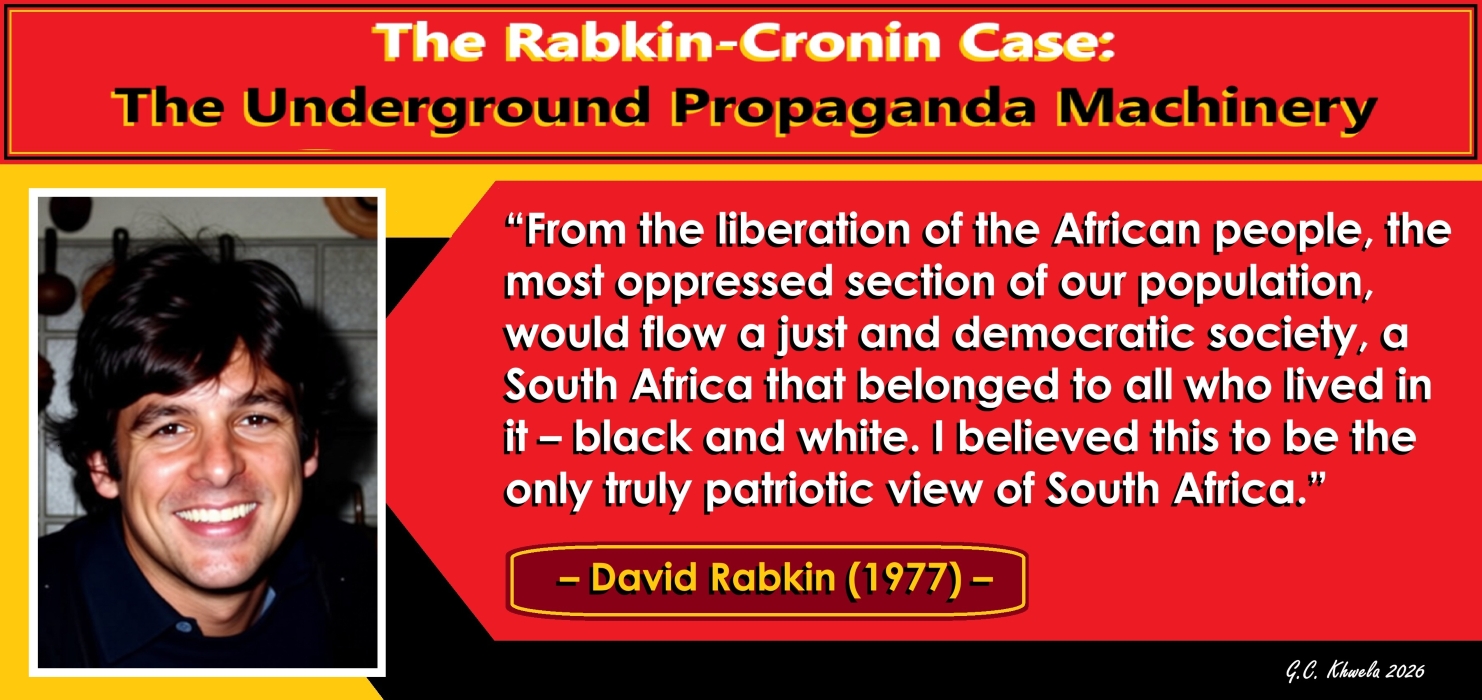
In 1972, David Rabkin, who was born in Cape Town, returned to the Cape with his English-born wife, Sue. He soon found a job on the ‘Cape Argus’ newspaper, as a reporter. On the surface David and Sue appeared to be innocent enough, yet for over three years they led a complicated double life, working in secret to produce and distribute leaflets and other literature for the African National Congress (ANC) and the South African Communist Party (SACP). This required great courage, nerve and practical ability as well as skills in writing.
Operatives of all backgrounds were recruited and became part of the underground network which was meticulously developed between 1965 and 1975. Those studying abroad who were recruited were given training and tasks. They were trained in the art of living double lives, working normally by day and carrying out subversive activities at night, mainly in the propaganda field. Among other underground operatives who were apprehended in this period and sentenced to long terms of imprisonment were Raymond Suttner, Jeremy Cronin, David and Sue Rabkin, Anthony Holiday, Tim Jenkin and Steve Lee. Those arrested were mainly journalists and university lecturers.
The Rabkins arrived in Cape Town in 1972, where they worked in the underground, and after operating independently for about two years they linked up with political journalist Anthony Holiday of the ‘Cape Times’ newspaper, and university lecturer, Jeremy Cronin. Cronin joined the underground in Cape Town in 1973, while studying at the University of Cape Town. In the same year, 1973 he went to study in Paris, where he also established contact with the ANC and the SACP. After joining the SACP and receiving training in underground propaganda work, he returned to South Africa, where Ronnie Kasrils linked him up with Sue and David Rabkin in Cape Town.
Their task was to produce underground pamphlets and distribute “them partly through bucket bombs, and partly through the mail”. With the Rabkins, he distributed copies of around 14 different leaflets until 1976. David Rabkin and Cronin would often use disguises to place bucket bombs at public places to avoid being recognised. Eventually they produced the newspaper “Vukani” and all three contributed sections on current affairs and a political analysis of the South African situation, Marxist theory and military combat work (MCW). When they were arrested, they had produced and distributed quite a number of leaflets.
It took four years before they were discovered, arrested and appeared in a widely publicised court case “The Rabkin-Cronin case” in 1976. David Rabkin was given 10 years, Jeremy Cronin got 8 years, and Anthony Holiday got six years. Sue was pregnant at the time of the trial and gave birth to a little daughter in Pollsmoor Prison in 1976. Subsequently Sue Rabkin arrived in Maputo Airport in January 1978, and later David Rabkin got out of prison in 1984 and joined them in Maputo for some years. He then left to undergo military training in Angola in 1985 and was sadly killed in a training incident in an Umkhonto we Sizwe (MK) camp, Pango, the same year.
Returning to the Rabkin-Cronin case, which remains one of the most prominent legal trials in history, involving white anti-apartheid activists in South Africa during the 1970s. They were charged under the Internal Security Act, which had been amended in the same year, and the Terrorism Act for distributing banned literature and manufacturing “pamphlet bombs” on behalf of the ANC and the SACP. The “pamphlet bomb” (also known as a leaflet bomb or bucket bomb) was a non-lethal propaganda tool engineered by the ANC and SACP underground. It aimed to safely distribute banned liberation literature to crowds before the security police could intervene.
Because the devices were used in crowded public spaces like train stations, bus terminals and city streets, they were specifically designed not to cause physical harm to bystanders. The mechanics relied on basic, easily acquired household items paired with a small pyrotechnic charge. Activists usually used ordinary household plastic buckets, large coffee tins, or supermarket plastic bags to camouflage the device. This allowed them to place it discreetly in a trash bin, on a sidewalk, or at a bus stop. A small quantity of low-grade explosive, typically black gunpowder, was placed at the very bottom. High explosive devices or material, such as TNT, were strictly avoided because they would shred the paper and injure nearby civilians.
A heavy circular piece of thick cardboard or wood was placed directly above the powder charge. This acted as a piston, shielding the paper from the flash of fire while pushing the leaflets upward. Hundreds of tightly packed, double-sided political tracts were stacked neatly on top of the blast shield. To give underground operators like David Rabkin and Jeremy Cronin enough time to safely walk away and establish an alibi, the devices required a reliable time-delay trigger. Early or simple versions used corrosive acid that took a predetermined number of minutes to eat through a wire constraint, eventually releasing a spring-loaded firing pin to spark the powder.
Later, more sophisticated versions integrated basic kitchen clocks, modified pocket watches, or capacitor circuits wired to a small battery. Once the countdown hit zero, the electrical circuit closed, sending a current to an electric match or detonator to ignite the gunpowder. When the timer expired, the system functioned similarly to a commercial firework or mortar. The black powder deflagrated (burned rapidly), building up sudden gas pressure inside the bottom of the container. The pressure forced the cardboard blast shield rapidly upward and the violent kinetic energy propelled the entire stack of leaflets 12 to 15 metres straight up into the air. At the apex of the blast, the wind caught the unconstrained papers, creating a sudden “rain” of hundreds of banned pamphlets drifting over a wide radius.
The underground unit frequently paired these pamphlet bombs with automated audio setups. A cassette player wired to a high-powered car amplifier would be hidden nearby (such as in an abandoned bicycle basket or car boot). The exact moment the pamphlets exploded into the air, the audio device would trigger, blasting a pre-recorded broadcast that began: “This is the Voice of the African National Congress”, followed by freedom songs and political speeches. By the time the state security police arrived at the scene, the activists were long gone, leaving the authorities to scramble to collect the papers before the public could read them.
This propaganda effort was highly effective as a psychological weapon, acting as a vital lifeline for the liberation movement during a period when the state had nearly silenced internal dissent. While it did not directly disrupt the day-to-day operations of the apartheid state, its strategic value lay in keeping the ANC and the SACP visible and relevant inside the country.
By the early 1970s, the apartheid government had successfully crushed the top tier of internal resistance through the Rivonia Trial and widespread bannings. The state claimed it had total control. The sudden, simultaneous detonation of pamphlet bombs across major transport hubs in cities like Cape Town, Durban and Johannesburg completely shattered this illusion. It proved to ordinary citizens – and to the regime – that a disciplined, organised liberation underground was alive, active and functioning right under the noses of the Security Branch.
Under apartheid laws, it was a severe criminal offense to possess, print, or distribute literature from banned organisations. The media was heavily censored, and school curricula were tightly controlled. Pamphlet bombs were a masterclass in guerrilla distribution. They bypassed police checkpoints and delivered uncensored political education directly into the hands of the working-class majority at train stations and bus terminals. People could snatch a drifting paper, slip it into a pocket, and read it in secret, allowing the ANC to continually articulate its policies, goals and responses to state violence.
The specific effectiveness of the Rabkin-Cronin unit relied heavily on the racial dynamics of the time. Because they were white, team members could move freely through restricted areas, hire cars, and carry large packages without triggering the automatic suspicion, pass-law checks, or police harassment that Black activists faced daily. This allowed the unit to operate undetected for four years (1972–1976), successfully manufacturing and deploying dozens of devices before intelligence networks finally closed in. The timing of these campaigns provided a massive psychological counterweight to state oppression.
For oppressed communities, hearing the automated broadcast of “This is the Voice of the African National Congress” echoing across a city square was an immense morale booster. It sent a clear signal that they were not fighting alone. This baseline work laid the essential groundwork for the explosive growth of mass democratic movements and internal trade unions in the late 1970s and 1980s.
While the unit was a triumph of political messaging and psychological warfare, its main limitation was physical scale. A single pamphlet bomb could only distribute a few hundred leaflets at a time to a localised crowd. Ultimately, its true success was measured not in the sheer volume of paper distributed, but in its ability to sustain hope, provoke the state and inspire the next generation of activists who would eventually bring down the regime.
The propaganda unit was ultimately exposed to the apartheid Security Branch through a combination of intercepted underground communications, sophisticated forensic technology and meticulous detective work. Unlike many other anti-apartheid cells of the era, their downfall was not caused by a direct human informant or physical infiltration of their immediate group, but rather by their communications being systematically compromised.
The unit was an underground cell answering directly to the exiled leadership of the SACP and ANC in London. To coordinate their operations and receive political directives, members wrote letters using invisible ink embedded inside ordinary, run-of-the-mill postal mail sent internationally. The Security Branch, which routinely monitored international mail targeting suspected left-wing academics and journalists, intercepted these letters. For a long time, the cell successfully evaded detection because standard police testing did not reveal the secret writing. However, the Security Branch eventually closed the technical gap.
According to later testimony by Jeremy Cronin, the Security Branch received specialised technical intelligence assistance from the United States, specifically the CIA, to crack the chemical composition of their invisible ink. With this technical support, the police successfully developed the secret ink on the intercepted letters. This allowed them to read the underground communications in plain text, completely exposing the operational details, logistics, and names of the network.
The interception of these communications also tied them directly to Anthony Holiday, a senior political journalist at the “Cape Times” newspaper. Holiday was operating a separate, highly covert propaganda and information-gathering cell in Cape Town. Because their secret correspondence overlapped or passed through similar channels, the Security Branch was able to map out the entire network and realise both cells were linked to the same broader underground apparatus.
Once the Security Branch could read the messages, they did not move immediately. They used “good detective work” and physical surveillance to monitor the targets, gathering enough hard evidence – such as tracking the acquisition of printing materials and the timing of leaflet bomb explosions – to secure a conviction. On 27 July 1976, the security police launched synchronised raids, arresting Anthony Holiday, David and Susan Rabkin, and subsequently Jeremy Cronin, effectively shutting down the SACP’s Western Cape propaganda pipeline.
In one of the leaflets that the Rabkin-Cronin unit produced, titled, “True Liberation Needs a Strong Working Class”, which was a message to the workers from the South African Communist Party, it said:
“Workers! Comrades! We are the backbone of the struggle for national liberation. It is only our collective strength which will ensure that the mass of the people will benefit from liberation and not just the few who want to step into the shoes of the white exploiters. It is your vigilance in the revolution which will help to put an end to economic exploitation which is the foundation of racism. It is under our leadership that our country will move towards a socialist society in which all the factories, mines and farms are owned by the people and are run in the interests of all our people.”
Sources:
Wikipedia.
South African History Online (SAHO).
SACP, “True Liberation Needs A Strong Working Class”, The African Communist, No. 67 Fourth Quarter 1976.
The New York Times Archives, “South Africa Sentences Journalist To 10 Years”, The New York Times, 30 September 1976.
Documents, “Statements from the Dock by David Rabkin and Jeremy Cronin”, The African Communist, No. 68 First Quarter 1977.
Obituary, “Hamba Kahle Comrade David Rabkin”, Sechaba, March 1986.
Gregory Houston, “Chapter 8: The ANC Political Underground in the 1970s”, The Road to Democracy In South Africa – Vol. 2 (1970-1980), UNISA Press, March 2006.
Grocott’s Mail Contributors, “My Father, David Rabkin”, Grocott’s Mail, 26 July 2010.
Bob Newland, “I Was a Leaflet Bomber”, London Recruits: The Secret War Against Apartheid, February 2012.
Andrew Boyd, “Clandestine Leafletting”, Beautiful Trouble, 2012.
Stuart Jeffries, “The Leaflet Bombers: The London Recruits Who Fought Apartheid from Within”, The Guardian, 6 December 2015.
Maricelle, “Film Highlights Drama Behind Pamphlet Bombs”, Bloemfontein Courant, 30 November 2016.
Davi Ottenheimer, “RSAC TV Interview with Tim Jenkin”, RSAC Conference, 17 April 2018.
Michal Singer, “Images of Power: South African Political Posters in the Struggle”, Memory@UCT, University of Cape Town, 14 September 2020.
News24 Wire, “Imam Haron Inquest: Apartheid-Era Cop Denies Any Knowledge of Security Branch Activities”, Polity, 15 November 2022.
Padraig O’Malley, “Cronin, Jeremy [Second Interview]”, O’Malley: The Heart of Hope, Nelson Mandela Foundation, https://omalley.nelsonmandela.org/index.php/site/q/03lv03445/04lv04015/05lv04154/06lv04159/07lv04163.htm (accessed 27 July 2026).
Padraig O’Malley, “25 Mar 2002: Jenkin, Tim”, O’Malley: The Heart of Hope, Nelson Mandela Foundation, https://omalley.nelsonmandela.org/index.php/site/q/03lv03445/04lv03833/05lv03858/06lv03871.htm (accessed 27 July 2026).
Castro Khwela
Good morning fellow Compatriots!🙏🏾✊🏾👊🏾
Discover more from CASTRO KHWELA
Subscribe to get the latest posts sent to your email.