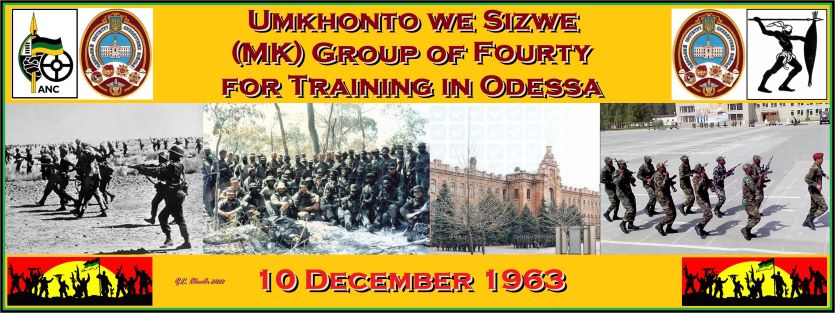
On 10 December 1963, a group of forty Umkhonto we Sizwe (MK) recruits landed in Odessa, in the Ukraine part of the Soviet Union for military training. The youngsters were taken in a big Morris truck driven alternatively by Mzewu Ntsele, Johannes Tau-Tau and Joe Modise from Dar es Salaam through Nairobi, Kenya, and on to Juba in the Sudan.
From Juba they were escorted by riverboat along the Nile to Khartoum. On the afternoon of their sixth day in Khartoum, the forty recruits were flown by the Russian carrier Aeroflot to Cairo, Egypt, and from there to Odessa, Ukraine.
When their plane landed in Ukraine, they were then driven to the camp of the Military Academy of the Soviet Union, the Red Banner Combined Arms Command School, approximately 8 km east of Odessa’s Black Sea Harbour. At the Academy, there were two sections: the Red Army Soviet officers section; and the other section, which held freedom fighters from various parts of the world.
The following day they were addressed by the Camp Commandant, Colonel Zscizserin, and his Lieutenant Colonel Pronibrakiz, that they were going to be trained for nine in months in guerrilla warfare and return to South Africa to fight.
The MK trainees were commanded by Joe Modise (aka “Thabo More”, with the Commissar being Moses Mabhida, who had been honourably recalled by the Movement from being the representative of the South African Congress of Trade Unions (SACTU) at the World Federation of Trade Unions in Prague, Czechoslovakia. Among the trainees there was only one white person, Ronnie Kasrils, whose presence was sometimes questioned, “Pochemy byeli chelovek?” (Why a white person?)
They were then divided into three groups, those with education below Standard Six were assigned to the Infantry, those with qualifications up to a junior certificate or Standard Eight, were to be trained in radiology, engineering and the manufacture, use and identification of explosives, while the last group with qualifications above Standard 8 were to be trained as Commanders.
The training was to be done with the assistance of interpreters from Russian to English, who were conscripted and sent to Odessa in October 1963 in anticipation of the arrival of the MK contingent. Moreover, translations were done by an African National Congress (ANC) member, Eleazor Maboya, translating from English to IsiZulu. Ultimately, most of the MK trainees were able to converse in the local language as they engaged with the community during passouts over the weekends.
The experience of traveling to the Soviet Union, where would-be “freedom fighters” acquired the mysterious knowledge of warfare from seasoned World War II veterans, boosted the morale and hopes of MK’s young guerrillas. They were largely optimistic as they expected to return to South Africa after completing their training and were confident in their prognosis of a temporary exile followed by quick victory.
Most Soviet instructors were World War II veterans, who based their lessons on the Soviet experience of the Great Patriotic War, which shaped their perceptions of the sort of combat MK recruits might face in South Africa. Although military training adapted over time, the first generation of MK recruits were trained as soldiers, not as guerrillas, as they studied reconnaissance in warfare, engineering, communication, infantry, heavy artillery and so forth.
Odessa was deliberately chosen for various reasons, including the availability of training facilities at the local military college. Secondly, Odessa was famous for its history to the German invasion in 1941; and from 1941 to 1944 the mausoleums were used as hideouts by guerrillas. The third reason was climatic, since the military and academic training of Africans was generally organised in regions where, in terms of Soviet standards, the climate was mild.
After completing their training in Odessa, they were taken to Chabanka, approximately 50 km from Odessa, where they were taught to apply the theory they learned at the Military Academy. Chabanka was nestled in the picturesque region of Chornomorske, boasting a sandy stretch of the beach, which spanned a moderate length. It became an ideal place for military exercises, where they camped in tents, engaged in mock battles, raids and ambushes.
In 1962, the Deputy President and Head of the External Mission, Oliver Tambo, and MK’s Commander-in-Chief, Nelson Mandela, had visited a number of independent African countries. They secured military training facilities for ANC cadres in Egypt, Algeria, Tunisia and Morocco, but it soon became apparent that their training was inadequate because of a realisation that there was a need to train people in urban guerrilla warfare. The groups that had trained in those countries would do well in combat, but they didn’t really obtain that urban dimension of guerrilla warfare training.
Then, around August 1963, two groups were selected, on the basis of their having passed matric, or who really could write, read and understand instructions, for training in the Soviet Union, particularly on urban guerrilla warfare – from pistols up to machine guns, as well as in the making of homemade explosives.
By 1964, about 300 MK recruits had left South Africa for military training in various newly independent African states, China, the USSR, Czechoslovakia and elsewhere in Eastern Europe. These were increased to around 500 well-trained combatants by the mid-1960s, which were at the disposal of the MK High Command.
The main challenge was finding a suitable way back home for these fighters, as a wide belt of territories were under the control of Portuguese and British imperialists, which insulated South Africa from those states that were willing and able to harbour MK combatants.
Castro Khwela
Good day fellow Compatriots!
Discover more from CASTRO KHWELA
Subscribe to get the latest posts sent to your email.