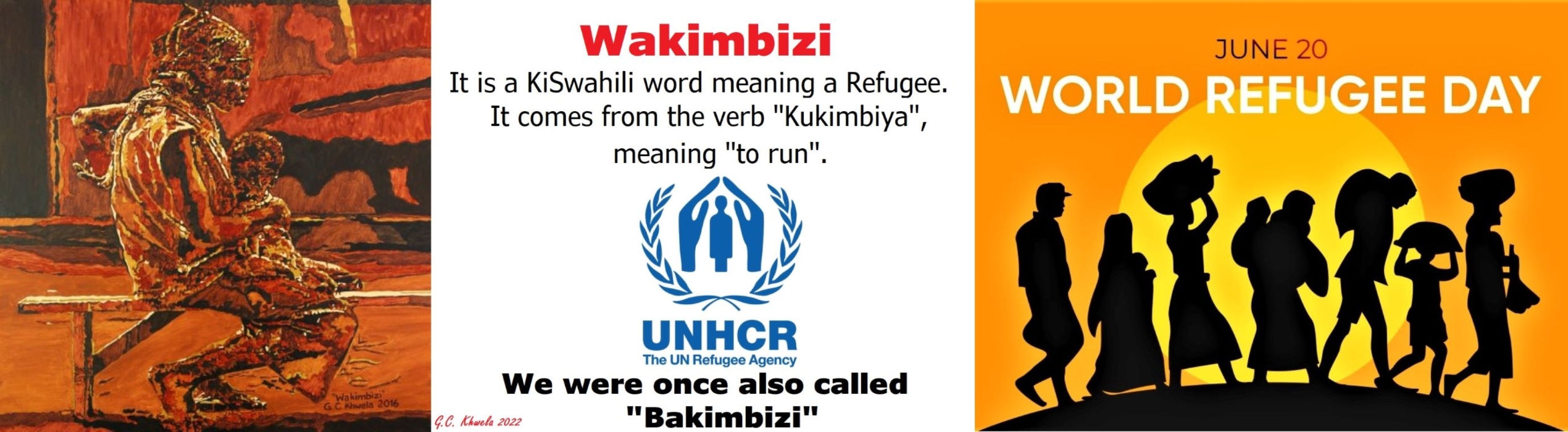
World Refugee Day and the Years of Exile
June 20 is recognized as “World Refugee Day”, a day designated by the United Nations (UN) Refugee Agency, the United Nations High Commissioner for Refugees (UNHCR), to focus global attention on the plight of people fleeing conflict or persecution. It is an international day designated to honour refugees around the globe. It celebrates the strength and courage of people who have been forced to flee their home country to escape conflict or persecution.
Nearly 21 years ago, the United Nations founded World Refugee Day as an opportunity for everyone to experience, understand and recognise the strength of the refugees who had fled the conflict and persecution of their country with the hope of finding sanctuary and living a better life. World Refugee Day was first observed on June 20, 2001, to recognise the 50th anniversary of the 1951 Convention Relating to the Status of Refugees.
It was adopted by the United Nations Conference of Plenipotentiaries on the Status of Refugees and Stateless Persons on July 28, 1951, and entered into force on April 22, 1954. The convention, along with its 1967 Protocol, forms the cornerstone of international refugee protection. The 1951 Refugee Convention acknowledges a refugee as an individual who is unable to return to their country of origin owing to the founded fear of being affected by their race, religion, participation of a social group or in different political opinions. The 1967 Protocol, on the other hand, broadens the applicability of the 1951 Convention by removing the geographical and time limits that were part of the Convention. These limits initially restricted the 1951 Convention to persons who became refugees due to events occurring in Europe before 1 January 1951.
Refugees are people who have fled war, violence, conflict or persecution and have crossed an international border to find safety in another country. They often have had to flee with little more than the clothes on their back, leaving behind homes, possessions, jobs and loved ones. Globally, there are five types of refugees: Refugees, Migrants, Asylum seekers, Internally-displaced persons (IDP) and Stateless persons.
A refugee is legally often defined as an individual who left their country due to the ramifications of war, conflict persecutions and violence that they had faced within their home country and cannot return due to fear of persecution and has been given refugee status. Through undertaking the process of crossing international borders, some refugees are often found to leave everything behind carrying only the minimal clothing and possessions; with the plan to find safety and haven in a different country.
Refugees play a role in the globe as when they are positioned to have access to the legal employment opportunities in their host country, they are able to utilise their knowledge to assist in filling the gaps of a country’s labour market. The majority of the refugees come from backgrounds where they have been formally employed and can assist their new country in contributing to the wellbeing and security of the host country as well as generating its revenue. Statistics show significant disparities in how countries approach refugee protection. The countries with the most refugees often are not the wealthiest but are instead neighbours to conflict zones. According to the United Nations High Commissioner for Refugees (UNHCR), countries like Turkey, Pakistan, Iran, Colombia and Germany rank among the top countries hosting the most refugees.
The extent of legal protections and rights afforded to refugees also differs. Some nations are celebrated as the best countries for refugees due to their comprehensive support systems, including the right to work, access to healthcare, and education. In contrast, others may impose restrictive policies that limit refugees’ ability to integrate and live dignified lives. Those known to have the most robust support systems and development-friendly policies for refugees are New Zealand, Norway, Australia, Canada, Sweden and Germany.
The number of refugees accepted by each country also showcases a range of policies, from open-door approaches to more restrictive quotas. The countries taking in refugees do so based on various factors, including international obligations, domestic policy, and public opinion. Despite the legal framework established by the 1951 Refugee Convention, refugees face numerous challenges, from navigating complex asylum processes to living precarious conditions in refugee camps. Even if a country has ratified the 1951 Refugee Convention, they may still turn away refugees and asylum seekers due to their own policies, even though they are required to assist under international law.
The legal status of refugees is a multifaceted issue that varies widely from country to country. While the 1951 Refugee Convention provides a universal definition and sets standards for the treatment of refugees, the reality on the ground can differ significantly. As global displacement continues to rise, the need for comprehensive and compassionate responses to refugee protection becomes increasingly urgent.
During the colonial and apartheid periods in Africa, increasing numbers of South Africans, fleeing turmoil and sporadic violence in their own country, began seeking refuge in exile either internally within the country or externally beyond its borders, due to political persecution, violence, and forced removals. The exodus was a direct result of the apartheid regime’s policies aimed at maintaining white minority rule, which included the suppression of dissent and the forced relocation of Black South Africans to designated “homelands” or Bantustans. Figures were hard to come by, but what information is available suggests that at least 2,000 South Africans, black and white, left the country each year, joining several thousand earlier arrivals that had been trickling into various countries in southern Africa, the continent and the rest of the world.
Most black Africans, in particular, were fleeing apartheid or seeking to avoid arrest or harassment for political activities. Escape brought them enormous new freedom – but, often, not very much happiness. They had trouble getting good jobs in host countries, and trouble with their immigration status. They were beset by the race discrimination borne by other black people globally, although they had little in common with them. They hoped for majority rule in South Africa so they could eventually go home.
With regard to the liberation war combatants, as was the case with most colonised countries in Africa, the primary goal was always to obtain military capabilities to overthrow the colonial regimes in their home countries. When they left their own country into the neighbouring countries, they would often state the reason for leaving and be provided with temporary asylum seeker status by the UNHCR. Efforts would then be made by the host country to connect them to the representatives of the liberation movement they intended joining. The liberation movements will then make arrangements for them to be taken to countries where they would be processed, trained and armed for the revolutionary effort.
Lest we forget, we were once referred to as “Wakimbizi” (Refugees).
Sources:
Wikipedia.
South African History Online (SAHO).
Castro Khwela
Good evening fellow Compatriots!
Discover more from CASTRO KHWELA
Subscribe to get the latest posts sent to your email.