Amandla Cultural Ensemble: Promoting SA Liberation Cultural Heritage
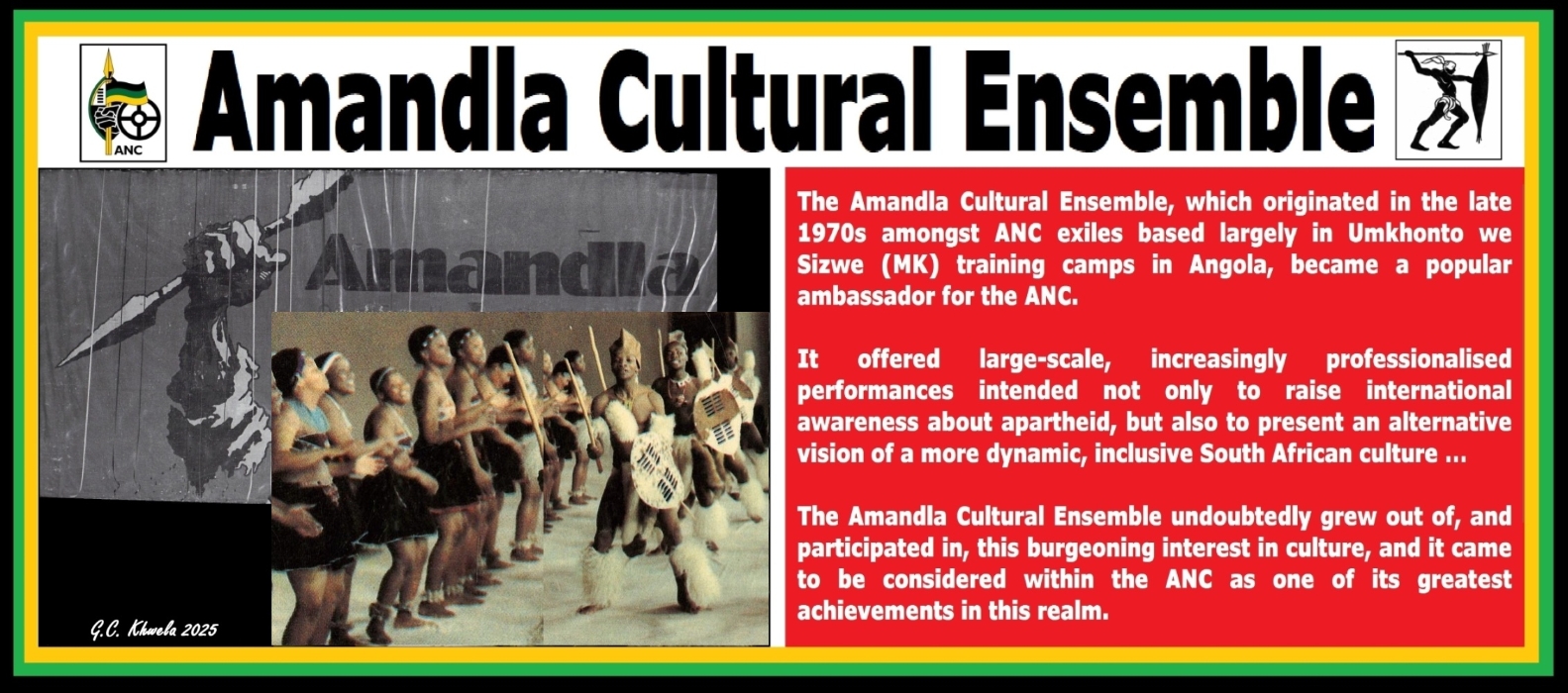
At the end of the weekend of 29 April 1979, the leadership of the African National Congress (ANC), taking the cue from the Cuban successes – following the September 1978 International Festival of Youth and Students that took place in Havana, Cuba – took a decision to have a permanent cultural group, the Amandla Cultural Ensemble, to promote the anti-apartheid struggle globally and ensure the international isolation of the racist regime.
At the International Festival in Cuba, South Africa was represented by a group of youths who were members of the ANC studying in various countries in Europe, Africa and America. They also included seven members of MK based in Angola. These groups had to combine and perform as one united group of the ANC. The success of their performances so reverberated throughout the world such that the British Broadcasting Corporation (BBC) had to remark ever favourably about the beautiful performance of the South African delegation.
The ANC leadership also took a decision that the membership of the group should be members of Umkhonto we Sizwe (MK) because of the military discipline factor. Naming the group “Amandla” denoted “power” in the Zulu language, which was also a symbol in itself, since “Amandla” whose political content was “Power to the People” was one of the most popular fighting slogans of the South African revolution. The group started with those seven MK members of the band and a recruitment drive was conducted to increase the group to about 40 members. All members had to multitask as musicians, dancers, and actors.
South Africa’s struggle for liberation rested on four pillars, with international mobilisation being important in promoting the anti-apartheid struggle globally and ensuring the international isolation of the racist regime. In this regard, the Amandla cultural group’s main tasks were the mobilisation of the international community. ANC President Oliver Reginald Tambo, after seeing an Amandla show in London, said that it took him 20 years to do what Amandla did in two hours – to promote South Africa and the struggle for freedom. It became a kind of “political theatre” where dances and songs were the main means what helped increase its value. The Amandla group was a powerful instrument to showcase cultural heritage and its diversity after a long period of colonial oppression which was accompanied by cultural oppression to destroy national pride.
The show of Amandla was a chronology of important events starting with a peaceful era before the colonisers came to South Africa. It continued with colonisation and subsequent industrialisation of the country down to the formation and the consciousness of the working-class population to events of 16 June 1976. Amandla offered large-scale, increasingly professionalised performances incorporating choral singing, jazz, theatre and dance. Its performances were intended not only to raise international awareness about apartheid but also to present an alternative vision of a more dynamic, inclusive South African culture.
Under the leadership of the legendary South African musician, Jonas Gwangwa, after being persuaded by ANC President Oliver Tambo to lead the group, Amandla travelled to more than 60 countries, educating people all over the world about South Africa and was invited repeatedly in several countries. Jonas Gwangwa, a renowned trombonist and a musician of international class, helped transform “Amandla” into a performance that resembled a theatre-type show, with a clearly expressed political content, and thus acquired the style that earned it a well-deserved reputation.
According to Gwangwa, the idea of Amandla was born during his impromptu ensemble’s concerts that became successful at the World Black Festival of Arts and Culture (FESTAC), held in Lagos, Nigeria in 1977., and after the festival it accepted invitations to tour Tanzania and Zambia. Participating in the festival were artists, poets and musicians from all over Africa, Europe and the United States, many appearing under the banner of the ANC. Inspired by the diversity of talent represented at the festival, Gwangwa was motivated to put together a temporary ensemble that he called “Amandla”, which included musicians such as Dudu Pukwana and Julian Bahula. Key figures in the ANC supported the idea of a permanent cultural group, and Gwangwa was called on to draft a memorandum for the formation of a cultural department.
What the band offered were strongly emotive songs encompassing the broad sweep of styles that trickled with tears and pride out of the townships and villages of South Africa. Countries like Holland and those in the Scandinavian region invited the group over and over, with some people in Europe following the group from city to city and country to country. The Amandla Cultural Ensemble would find wide reception and hospitality in countries such as Sweden, Norway, and Finland throughout the 1980s, soliciting financial support through anti-apartheid solidarity movements.
Though “Amandla” was playing mostly modern music, its members represented various nationalities of South Africa — Zulu, Xhosa, Shangaan, Venda, Pedi, Sotho and others – displayed great respect for traditions of peoples’ art. The strength of “Amandla” was built on solid foundation of cultural traditions, on songs and dances created during several centuries of struggle against colonialism. This defined creative outlook of the group as a mouthpiece of ideals and aspirations of oppressed peoples of South Africa, whose liberation struggle was led by a recognised, tried and tested vanguard — the ANC of South Africa.
Plans to relocate Amandla in an organised way after the advent of democracy never bore any fruits, although the group managed to converge and did a few performances. All other efforts of trying to revive the group were not that successful. It still remains a wish for most who knew this group to see the Amandla Cultural Ensemble taking to the stage again in whatever form, for there is still a big role that a cultural group like them can play in educating people about the importance of cultural artistry and liberation heritage. Both audiences and experts highly appreciated the art of the group, such that a musician of world fame, a famous Soviet conductor, Niyazi Zulfugar oghlu Taghizade Hajibeyov, called “Amandla”, “a unique phenomenon”.
In 2012, Amandla Cultural Ensemble was awarded The Order of Ikhamanga in Gold by the South African Presidency for: “Their contribution to the struggle against apartheid through their cultural performances and for spreading the message all over the world about South Africa’s rich and diverse cultural heritage.” “Amandla” was full of creative plans and those who saw and heard its performances were assured that it was “Amandla” that would create a core of the National theatre of a free South Africa.
Indeed, Gwangwa confirmed this, “… we don’t have a catalogue of grievances in Amandla! We also have songs and dramatic act that are showing our aspirations and the plight of our people, what they are looking forward to, I mean a free and democratic South Africa. We show what we envisage to be a free and democratic South Africa. We show what we envisage to be a free and democratic South Africa at the end of the show so that we don’t end up with a tragedy. We have hope and our songs also have that hope and that light showing.”
“ARTISTS HAVE A ROLE IN THE REVOLUTION!”
Sources:
Wikipedia.
South African History Online (SAHO).
Lufuno Lerato Monguni, “A reflection on the use of Amandla!: A Revolution in Four-Part Harmony and South African music produced in the 1950s to 1990s in the history classroom”, Jakes Gerwel Fellowship, 2023.
SA Presidency, “Amandla Cultural Ensemble: The Order of Ikhamanga in Gold”, Presidency South Africa, 2012.
Jack Barow, “‘Amandla’ Review: Blood, Tears and Music of the Struggle”, Mail & Guardian, 29 January 2021.
Uhuru Phalafala, “Festac, the ANC and the Arts”, Mail & Guardian, 28 May 2020.
Shirli Gilbert, “Singing Against Apartheid: ANC Cultural Groups and the International Anti-Apartheid Struggle”, Journal of Southern African Studies, Vol. 33, No. 2, June 2007.
Keanan Christine Jaftha. “Mapping Liberation Through Song: The Impact of Anti-Apartheid Popular Music and Protest/Liberation Songs in South Africa and the Diaspora, 1950-1994”, MA History – University of the Free State, November 2021.
Francis Meli, “Artists Have a Moral Responsibility: Jonas Gwangwa Speaks to Francis Meli”, Sechaba, July 1986.
Moira Levy, “Zabalaza Festival: The Voice of South Africans in Exile”, Sechaba, September 1990.
Castro Khwela
Good day fellow Compatriots!
Discover more from CASTRO KHWELA
Subscribe to get the latest posts sent to your email.