
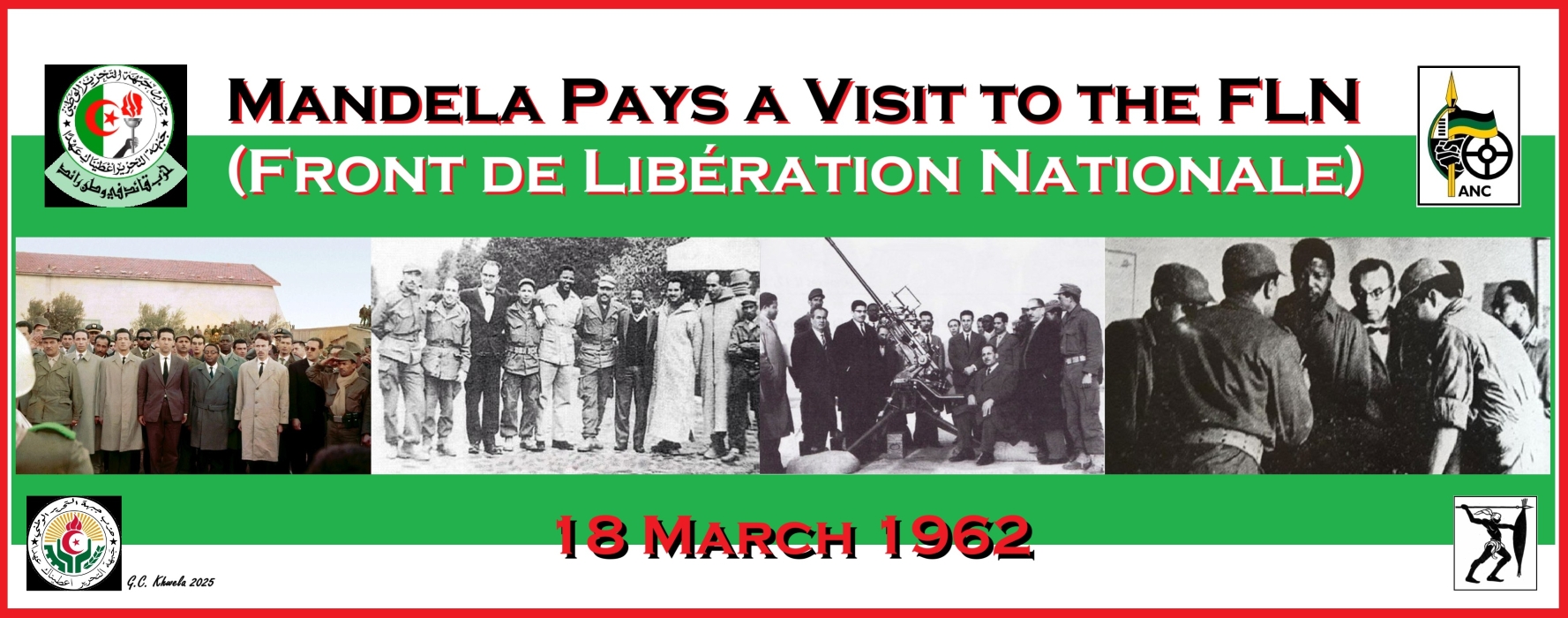
Mandela Pays a Visit to the FLN (Front de Libération Nationale)
On 18 March 1962, Nelson Mandela and Robert Resha departed from Rabat in Morocco by train, heading for Oudja, in Morocco, which was the headquarters of the Algerian ALN (Armée de Libération Nationale), the armed wing of the Algerian Liberation Front (Front de Libération Nationale – FLN). They travelled in the company of Ahmed Ben Bella, the leader of the FLN, an Algerian guerrilla fighter and socialist revolutionary who played a central role during the Algerian national liberation war against France, as well as Colonel Parmidian.
On the same day, 18 March 1962, was the signing of the Évian Accords, a treaty signed in Évian-les-Bains, in France, between France and the Provisional Government of the Algerian Republic, the government-in-exile of FLN. The Accords ended the 1954 – 1962 Algerian War with a formal cease-fire proclaimed for 19 March 1962, and formalised the idea of a cooperative exchange between the two countries, as well as the full independence of Algeria from France. The Algerian War, also known as the Algerian Revolution or the Algerian War of Independence, was an important decolonisation war, a complex conflict characterised by sophisticated guerrilla warfare, which also became a civil war that took place mainly on the territory of Algeria, with repercussions in metropolitan France.
While still in Rabat before 18 March 1962, Mandela and Resha had spent several days with Dr Mustafa, the head of the Algerian mission in Morocco, who briefed them on the history of the Algerian resistance and guerrilla war against the French. The situation in Algeria was the closest model to South Africa’s one in that the freedom fighters faced a large white settler community that ruled over the indigenous majority. Dr Mustafa related how the FLN had begun their armed struggle with a handful of guerrilla attacks in 1954, having been heartened by the defeat of the French at Dien Bien Phu, in Vietnam.
At first, the FLN believed they could defeat the French militarily, and later realised that a purely military victory was impossible. They then resorted to guerrilla warfare, which was not designed to win a military victory so much as to unleash political and economic forces that would bring down one of the most formidable enemies globally. Dr Mustafa advised them not to neglect the political side of war while planning the military effort, since international public opinion was “sometimes worth more than a fleet of jet fighters” (Mandela).
At the end of the three days, Nelson Mandela, Robert Resha, Ahmed Ben Bella and Colonel Parmidian, went to Oudja, a dusty little town just across the border from Algeria. On the morning of 19 March 1962, they were received by Si Abdelhanna, the head of the ALN’s political section. Later they were introduced to a number of ALN leaders and in their company an intensive discussion of the South African situation commenced.
When asked by a senior Algerian Commander how he envisioned the future of the military struggle in South Africa, Mandela answered that he was most impressed by the Cuban example, twelve men landing in a boat, hiding in the mountains and conquering the country. The Algerian asked if he had looked at a map of South Africa, and where would they hide. In the end there would only be the mountains of Lesotho and what would they do from there? There was not a population centre or key area of the country within reach, and South Africa being such a huge country, with the military and air power of the apartheid regime, much greater than that of Batista, Cuba therefore could not be used as an appropriate example.
A day later, Mandela and Resha were guests at a military parade in honour of Ahmed Ben Bella, who was to become the first Prime Minister of independent Algeria and who had recently emerged from a French prison. This, according to Mandela, was a parade of a “guerrilla force … soldiers who had won their stripes in the fire of battle, who cared more about fighting and tactics than dress uniform and parades” (Mandela).
For Mandela, this parade was “a far cry from the military parade I had witnessed in Addis Ababa”, it was not “the crisp, well-drilled, handsomely uniformed force of Ethiopia but a kind of walking history of the guerrilla movement in Algeria. At its head sauntered proud, battle-hardened veterans in turbans, long tunics and sandals, who had started the struggle many years before. They carried the weapons they had used: sabres, old flintlock rifles, battle-axes and assegais. They were followed in turn by younger soldiers, all carrying modern arms and equally proud. Some held heavy anti-tank and anti-aircraft guns. But even these soldiers did not march with the smartness and precision of the Ethiopians … Inspired as I was by the troops in Addis, I knew that our own force would be more like these troops here in Oujda, and I could only hope they would fight as valiantly.”
Sources:
Wikipedia.
Thula Simpson, “Umkhonto we Sizwe: The ANC’s Armed Struggle”, Penguin, 2016.
Nelson Mandela, “Long Walk to Freedom”, Abacus, 1994.
Castro Khwela
Good morning fellow Compatriots!
Discover more from CASTRO KHWELA
Subscribe to get the latest posts sent to your email.
Incisive