Oliver Tambo: Church and Our Struggle
(Extracts from a Statement by the President of the African National Congress of South Africa, O.R. Tambo, at the World Consultation of the World Council of Churches, Holland, 16 – 21 June 1980)
“Racism in South Africa is also a product of the colonisation of our people by European powers. In all the phases of its development, from the settlement of our country by Dutch mercantile interests, through the stage of direct British colonial rule to the post-1910 period of administration of our country by a white settler minority, racism has served three principal purposes.”
“The first was to justify the seizure of our country, our land and wealth by the colonisers. The second was to establish the basis for the transformation of the dispossessed millions of our people into instruments of labour for the enrichment of the colonisers. The third was to legitimise the exclusive concentration of political power in the hands of the colonial and settler oligarchy.”
“The system has allowed of no overlapping between the coloniser and the colonised. The owners of wealth, the exploiters of our labour and the governors of our country are drawn exclusively from among the colonisers. The colonised constitute the masses of the impoverished, the exploited and the voiceless. The colonisers are of course white and the colonised, black. This system is unique in world politics in the clarity and rigour of its racist demarcations, its pursuit as consistent and deliberate state policy and the brutality of both the conception, its implementation and results.”
“What was arrogantly described as a civilising mission in South Africa was in fact the genocidal destruction of the Khoi and the San people, the land expropriation of the rest of the indigenous people, the obliteration of their culture in all its forms, the application of a consistent policy for the impoverishment of the black people and their transformation into labour units for the enrichment of the coloniser and the political domination of the majority by a white settler minority.”
“It is this brutal reality of colonialism and racism which the Christian church in South Africa and the metropolitan countries accepted as a civilising mission. Pursuing its purely evangelical mission, the Christian church continued to hold out the promise of the good life to the poor, the suffering and the despised, but only after death. By refusing by and large to do anything about the life of these poor masses before death, it got itself further involved in what looked increasingly like a conspiracy to convince our people to bear their earthly tribulations patiently and submissively in the hope of a better future in the world to come.”
“In the midst of the great upheavals that the process of colonisation brought about, with centuries-old social system destroyed overnight, it was inevitable that many of our people would reach out towards whatever seemed to offer them peace, stability and human fulfilment in the new conditions. Of all the institutions that came with colonial rule, the Christian church seemed the only one that offered peace, stability and human fulfilment. Our people in good numbers therefore place their faith in the Christian church.”
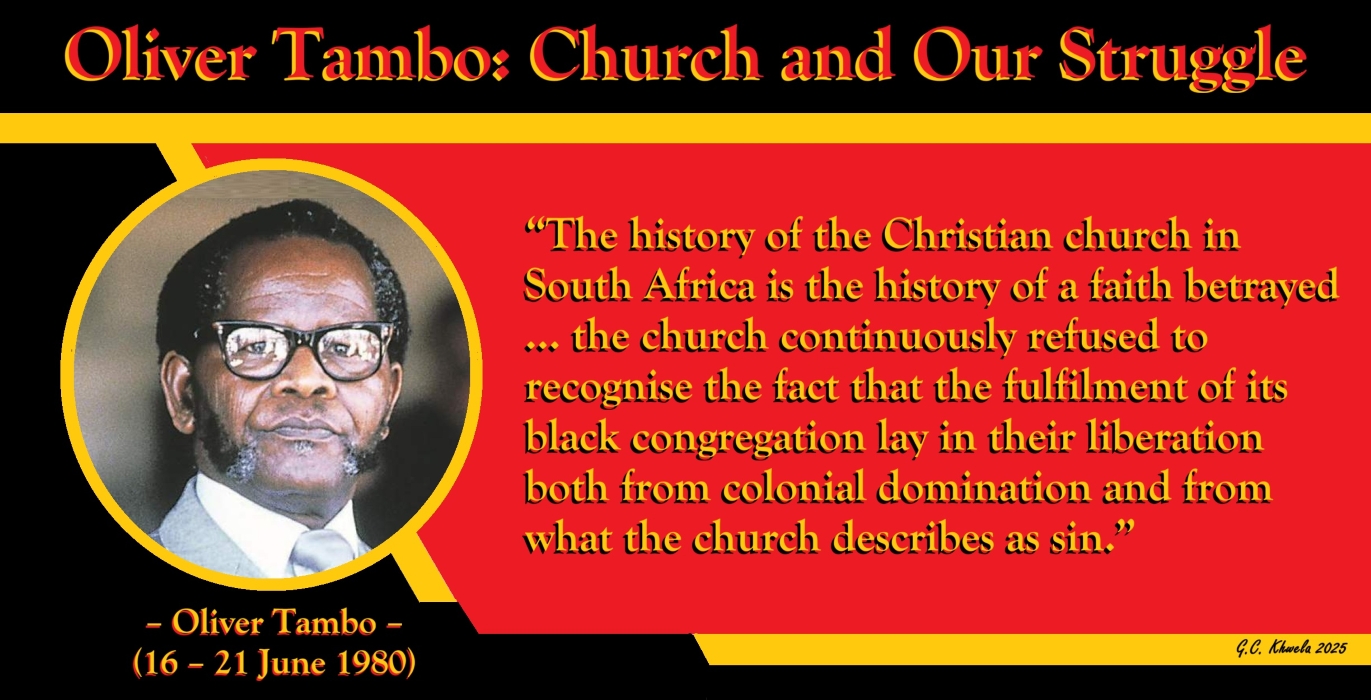
“From this moment onwards and again almost inevitably, the history of the Christian church in South Africa is the history of a faith betrayed. We say almost inevitably because the church continuously refused to recognise the fact that the fulfilment of its black congregation lay in their liberation both from colonial domination and from what the church describes as sin.”
“While denouncing as sinful the coveting of their white neighbour’s possessions by the black people, the church did not condemn as sinful the reduction of the black by the white into homeless and propertyless beggars. While issuing injunctions of forbearance to the black, urging them to eschew violence, it avoided condemning colonial state violence against the black people.”
“The more the church avoided placing on its agenda the uprooting of this system as an inalienable component part of its divine mission, the more justified the conclusion seemed that the Christian church was ineluctably doomed to betray the very faith which it professed. To their credit, there were a few among the Christian leadership in South Africa who refused to take this path. These are men and women who read in the Scriptures a clear message that it was impermissible that he who had been made in the image of God should be debased and enslaved.”
“The church that the oppressed people of our country demand is one that openly, publicly and actively fights for the political, economic and social liberation of man, as part of the world forces engaged in the process of bringing into being a new world order for those who are discriminated against, for justice, peace and social progress.”
“Only thus can the Church be true to its profound ideals, tend to all the needs of its flock, both material and spiritual and once more claim with justification to personify the body of Christ the Liberator. When those who worship Christ shall have, in pursuit of a just peace taken up arms against those who hold the majority in subjection by force of arms, then shall it be truly said of such worshippers also: ‘blessed are the peacemakers for they shall be called the sons of God’.”
– Oliver Tambo (16 – 21 June 1980) –
Source:
Oliver Tambo, “Church and Our Struggle”, Sechaba, November 1980, pp. 20 – 26.
Castro Khwela
Good morning fellow Compatriots!🙏🏾✊🏾👊🏾
Discover more from CASTRO KHWELA
Subscribe to get the latest posts sent to your email.