Oliver Tambo Visits the Soviet Union
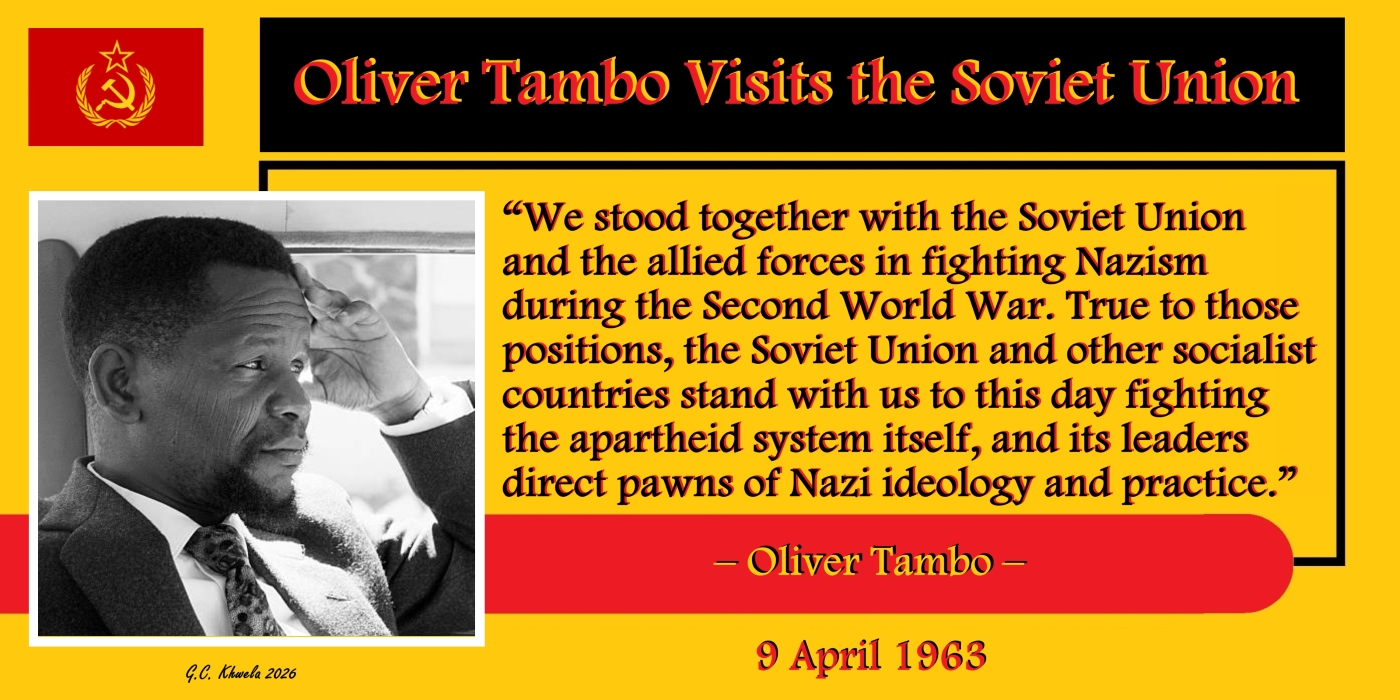
On 9 April 1963, returning from a trip to the Soviet Union, based on the invitation of the Soviet Afro-Asian Solidarity Committee, Deputy President of the African National Congress (ANC), Oliver Tambo, described 5 April 1963, the day of his discussions with the Communist Party of the Soviet Union (CPSU) in their Headquarters, as a historic day in the life of the South African people.
On that day, 5 April 1963, direct contact between the CPSU and the ANC leadership was established. Tambo had briefed members of the CPSU on the South African situation and the Movement’s needs arising from it. This was the first meeting between the Soviets and the leadership of the ANC, as opposed to the South African Communist Party (SACP), a close ally of the ANC, with whom the Soviets had longstanding relations.
Foundations in building regular relations between the Soviet Union and the SACP and the Congress Alliance were laid when official representatives of the South African communists went to Moscow in July 1960 and had meeting in the CPSU Headquarters. The SACP members were Yusuf Dadoo (Chairman of the SACP), who played an outstanding role in the Congress Alliance for many years, and Vella Pillay, who was the Party representative in Western Europe.
The visit in July 1960 was followed by another later in the year when an SACP delegation, headed again by Yusuf Dadoo and including Michael Harmel, Joe Matthews and Vella Pillay, travelled to Moscow to participate in the International Meeting of the Communist and Workers’ Parties, which was held from 30 November to 5 December 1960. Steps that had been taken by the Soviet Union to curtail economic ties with South Africa before the passing of the relevant UN Resolution in 1962 allowed the SACP to state that the USSR “imposed a full trade embargo at the request of the South African liberation movement”, including to stop dealing with De Beers and to find alternative ways of selling Soviet diamonds.
Yusuf Dadoo visited Moscow again in October 1961, this time together with Moses Kotane, and the South African communists were invited to attend the 22nd CPSU Congress, which had special significance, since for the first time the South Africans alluded to the possibility of using an armed form of struggle. They said that the SACP, together with ANC representatives, had to elaborate the practical steps necessary to train cadres and to prepare for sabotage.
In December 1962, the SACP requested a meeting in Moscow to discuss practical assistance for Umkhonto we Sizwe (MK), with representatives being Arthur Goldreich and Vella Pillay. The Soviets were told that MK Commander-in-Chief Nelson Mandela’s trip to African countries in 1962 had shown that the large-scale training of cadres in Africa would be difficult to organise. Accordingly, they proposed that the MK High Command should seek assistance from the socialist countries. Though political support was provided (or at least promised) by a number of African governments, practical assistance was rather limited.
Regarding the ANC and the struggle in South Africa, Tambo indicated that the apartheid government had failed to heed the limited violence of the first MK actions as a warning of the need for change. The ANC leadership consequently had to alter its plans and commence immediate preparations for guerrilla warfare. Tambo insisted that the ANC had recognised earlier that this would be necessary but hesitated because it realised that a civil war in a country polarised along racial lines would be particularly dangerous.
Arising from this decision, the urgent task was to obtain training abroad for activists. Large-scale training of fighters inside South Africa had proven impossible, despite the many efforts that had been initiated. It was in connection with obtaining such large-scale and sophisticated training that Tambo was visiting the Soviets. Tambo first visited the USSR on his way to and from a visit to Beijing to celebrate the 24th anniversary of the People’s Republic of China. Tambo arrived in Moscow, significantly, accompanied by Moses Kotane, the ANC’s Treasurer-General (and Inkosi Albert Luthuli’s favourite member of the communist party), and was offered considerate hospitality.
He was particularly concerned to secure funding and training facilities for the ANC in its own right and reported that the South African government’s unduly repressive response to Umkhonto’s limited sabotage was a clear indication that urgent changes were needed. Years later, Tambo recalled how he “was in no hurry to visit Moscow”, since his priority had been to procure support for MK from the West.
However, “it had become patently clear, though, that material support for armed struggle would not be forthcoming from the sympathisers in Africa, or from the West. The independent African states and PAFMECSA’s (the Pan African Freedom Movement for East, Central and Southern Africa) Liberation Committee, though warmly supportive, were unable to summon up the resources, while the Western countries baulked at providing direct assistance to armed struggle. The financial support given to the ANC from Africa was limited” (Callinicos).
The ANC statement issued in April 1963 connected the organisation with the armed struggle for the first time. “In the changed South African conditions of struggle, we have the mass political wing, spearheaded by the ANC on the one hand, and the specialised military wing, represented by Umkhonto, on the other … The political front gives substance to military operations” (Shubin). At this point in time the ANC was confident of solid support from the Soviet Union, since the CPSU was willing to provide backing to foreign-based movements that were close to it. For the ANC, its connection with the SACP guaranteed unconditional financial assistance in large sums and support for the training of Umkhonto combatants, as compared to other national liberation movements in the African continent.
Sources:
South African History Online (SAHO).
Africa Report, “Interview with Africa Report by Oliver Tambo”, New York, 01 March 1981.
Sifiso Mxolisi Ndlovu, “The ANC and the World”, The Road to Democracy in South Africa, South African Democracy Education Trust (SADET), Vol. 1, Chapter 13, 2004.
Vladimir Shubin, “ANC: A View from Moscow”, Jacana, 2008.
Luli Callinicos, “Oliver Tambo: Beyond the Engeli Mountains”, David Philip, 2004.
Castro Khwela
Good day fellow Compatriots!
Discover more from CASTRO KHWELA
Subscribe to get the latest posts sent to your email.