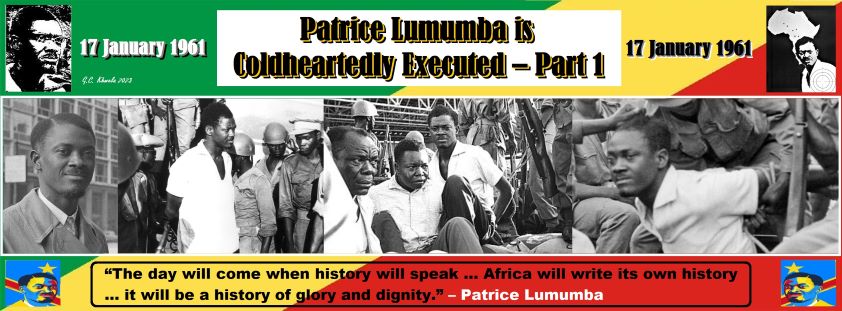
On the night of 17 January 1961, between 21:40 and 21:43, Patrice Émery Lumumba, the first and only elected Prime Minister of the Congo Republic, was put in a line-up (a firing squad) and shot.
Lumumba had been forcibly restrained on the flight to Elisabethville on the same day, 17 January 1961. On arrival, he and his associates were conducted under arrest to the Brouwez House, where they were brutally beaten and tortured by Katangese forces (a group looking to be a separate state of the newly independent Congo Republic) and Belgian officers. This occurred while President Moïse Tshombe and his cabinet, of the state of Katanga, were deciding what to do with him.
Later that night, Lumumba was driven to an isolated spot where three firing squads had been assembled. A Belgian Commission of Inquiry found that the execution was carried out by Katanga’s authorities. It reported that President Tshombe and two other ministers were present with four Belgian officers, under the command of Katangese authorities.
The Belgians and their counterparts later wished to get rid of the bodies, and did so by digging up and dismembering the corpses, then dissolving them in sulphuric acid while the bones were ground and scattered. In later years, it became clear that the assassination was sanctioned by the Belgian government and the Dwight Eisenhower administration, the President of the United States at the time. All these parties were acting through the local agents of the Central Intelligence Agency (CIA) in the Congo, and were funded and advised by Brussels and Washington.
Staunch enemies of Lumumba, President Tshombe, who was President of Katanga, an independent Congo province, and Mobuto Sese Seko, who became Prime Minister after the death of Lumumba, took part in the plot.
Patrice Émery Lumumba was born on 2 July 1925, at Onalua village, near the Katako-Kombe Town in the Sankuru district of north-eastern Kasai, Congo. This is part of the Batetela (Tetela), which is a dynamic branch of the Mongo-Nkutshu family of central Congo. The Congo was a colony of Belgium and, as such, Lumumba attended both Protestant and Catholic schools run by white Belgian missionaries.
His first employment was at the Postal Office as a postal clerk in Stanleyville City in 1954. However, Lumumba was accused of embezzlement and was jailed in 1955. Due to an extensive interview with King Baudouin, when he visited the Congo in 1955, Lumumba’s sentence was reduced in 1956.
In 1957, after working for almost three years, Lumumba was appointed as the sales director for a brewery company in Léopoldville (Kinshasa). This is how Lumumba left Stanleyville (currently known as Kisangani) for the Congo’s capital city, Kinshasa. While Lumumba was working in Stanleyville, he joined the Belgian Liberal Political Party.
When he relocated to Léopoldville to work at the brewery, he helped to find the Movement National Congolais (MNC) political party and while in prison in 1955, Lumumba reconsidered his status as a revolutionary and made a major shift towards Pan-Africanism and Congolese nationalism. The notion of nationalism enabled different ethnic groups that made up the Congolese society to come together and fight against colonial economic exploitation, political repression and cultural oppression.
In 1959, the Belgian-led colonial government announced that Congolese local elections should take place within five years to full Congolese independence. At the subsequent Luluabourg Congress meeting in April 1959, various political groups and some members of MNC who favoured a unitary form of government for the Congo chose Lumumba to lead them. However, within the MNC, there were other leaders that considered Lumumba’s views as radical and not good for the nation.
As a result of this difference of opinion, a split occurred in the MNC party in July 1959 with a majority of the members following Albert Kalonji. Even though Lumumba had left Stanleyville, he was briefly detained by the colonial authorities on charges of encouraging the outbreak of riots in Stanleyville in November 1959 (to be continued).
Castro Khwela
Good day fellow Compatriots!
Discover more from CASTRO KHWELA
Subscribe to get the latest posts sent to your email.