Robert Mangaliso Sobukwe: The Suppressed African Revolutionary
On 27 February 1978, Robert Mangaliso Sobukwe passed on in the Kimberley General Hospital because of lung complications after having been hospitalised in 1977. His medical doctors requested that he should be granted freedom of movement on humanitarian grounds, as he was banned to Galeshewe Township, in Kimberley. However, this request was turned down by the apartheid authorities.
Sobukwe was born in Graaff-Reinet in the Cape Province on 5 December 1924. He attended a Methodist college at Healdtown and later went to study at Fort Hare University. At Fort Hare, where generations of young Black South Africans were exposed to politics, he joined the African National Congress Youth League (ANCYL) in 1948. The organisation had been established on the university campus by Godfrey Pitje, who later became its president. In 1949, Sobukwe was elected as the first president of the Fort Hare Students’ Representative Council (SRC), where he proved himself to be an effective orator.
After completing his studies at Fort Hare University Sobukwe was appointed as a teacher at a high school in Standerton in 1950, a position he lost two years later when he spoke out in favour of the Defiance Campaign in 1952. He was, however, reinstated, when insufficient grounds for his dismissal were established. During this period, he was not directly involved with mainstream ANC activities, but still held the position of secretary of the organisation’s branch in Standerton.
Following his moving to Johannesburg in 1954, Sobukwe became a lecturer of African Studies at the University of the Witwatersrand. During this time in Johannesburg he edited “The Africanist” newspaper and soon began to criticise the ANC for allowing itself to be dominated by what he termed “liberal-left-multi-racialists”. He strongly believed in non-racialism. He was an ardent supporter of Africanist views about liberation in South Africa and rejected the idea of working with Whites.
According to Sobukwe at the time, “The structure of the body of man provides evidence to prove the biological unity of the human species. All scientists agree that there is no ‘race’ that is superior to another, and there is no ‘race’ that is inferior to others. The Africanists take the view that there is only one race to which we all belong, and that is the human race. In our vocabulary therefore, the word ‘race’, as applied to man, has no plural form.”
For Sobukwe, “Against multi-racialism we have this objection, that the history of South Africa has fostered group prejudices and antagonisms, and if we have to maintain the same group exclusiveness, parading under the term of multiracialism, we shall be transporting to the new Africa these very antagonisms and conflicts. Further, multiracialism is in fact a pandering to European bigotry and arrogance. It is a method of safeguarding white interests, implying as it does, proportional representation irrespective of population figures. In that sense it is a complete negation of democracy.”
Sobukwe identified with the Africanists within the ANC and in 1957 he left the ANC, as the Africanists later formed the Pan Africanist Congress (PAC), and was elected its first President in 1959. On 21 March 1960, the PAC led a nationwide protest against the hated Pass Law which required black people to carry a pass book at all times. Sobukwe led a march to the local police station at Orlando, Soweto, in order to openly defy the laws. He was joined en route by a few followers and, after presenting his pass to a police officer, he purposely made himself guilty under the terms of the Pass Law of being present in a region/area other than that allowed as per his papers. In a similar protest on the same day in Sharpeville, police opened fire on a crowd of PAC supporters, killing 69 in the legendary Sharpeville Massacre.
Following his arrest, Sobukwe was charged with and convicted of incitement, and was sentenced to three years in prison. After serving his sentence, he was interned on Robben Island. The new General Law Amendment Act was passed, allowing his imprisonment to be renewed annually at the discretion of the Minister of Justice. This procedure became known as the “Sobukwe clause” and kept Sobukwe in prison for a further six years.
Sobukwe was the only person imprisoned under this clause. He was kept in solitary confinement but permitted certain privileges including books, newspapers, civilian clothes, bread, etc. He lived in a separate area on the island where he was strictly prohibited from contact with other prisoners. Sobukwe studied during this time and received (among others) a degree in economics from the University of London.
Sobukwe was released in 1969 and was allowed to live in Kimberley with his family, but remained under house arrest, where he could easily be monitored by the state. He was also restricted through a banning order, which disallowed political activities. Sobukwe completed his law degree and he then started his own practice in 1975 in Kimberley. Due to lung cancer, Sobukwe was hospitalised in 1977. He died on 27 February 1978, and was buried in Graaf-Reinet on 11 March 1978. The day, 27 February, is now celebrated by the PAC and related movements as “Sobukwe Day”.
According to Brown Bavusile Maaba, “Sobukwe was regarded as a strong proponent of an Africanist future for South Africa and opposed political collaboration with anyone other than Africans, defining ‘African’ as anyone who lives in and pays allegiance to Africa and who is prepared to subject themselves to African majority rule” (quoted in Wikipedia). Benjamin Pogrund, author of “Robert Sobukwe: How Can Man Die Better”, writing in 2015, noted: “South Africa has not been kind to Robert Sobukwe. The magnitude of his deeds and beliefs is largely ignored. The African National Congress in government has done much to airbrush him out of the freedom struggle. He is seldom referred to” (quoted in Nick Dall, Al Jazeera).
In his own words, Sobukwe said, “For the lasting peace of Afrika and the solution of the economic, social and political problems of the continent, there needs be a democratic principle. This means that White supremacy, under whatever guise it manifests itself, must be destroyed. And that is what the nationalists on the continent are setting out to do. They all are agreed that the African majority must rule. In the African context, it is the overwhelming African majority that will mould and shape the content of democracy” (Sobukwe speech, 1959).
It is very sad that the ideas and writings of Sobukwe cannot be easily shared generally and towards the reconfiguration of the South African and the continental discourses. It is obvious that what Sobukwe advocated was essentially feared by the racist apartheid regime, to such an extent that his ideas were suppressed by all means necessary, including isolating him from other prisoners in Robben Island and subjecting him to various banning orders and house arrests. It is critical that his writings in publications, such as “The Africanist” newspaper, should be revisited and be put together as his collected works.
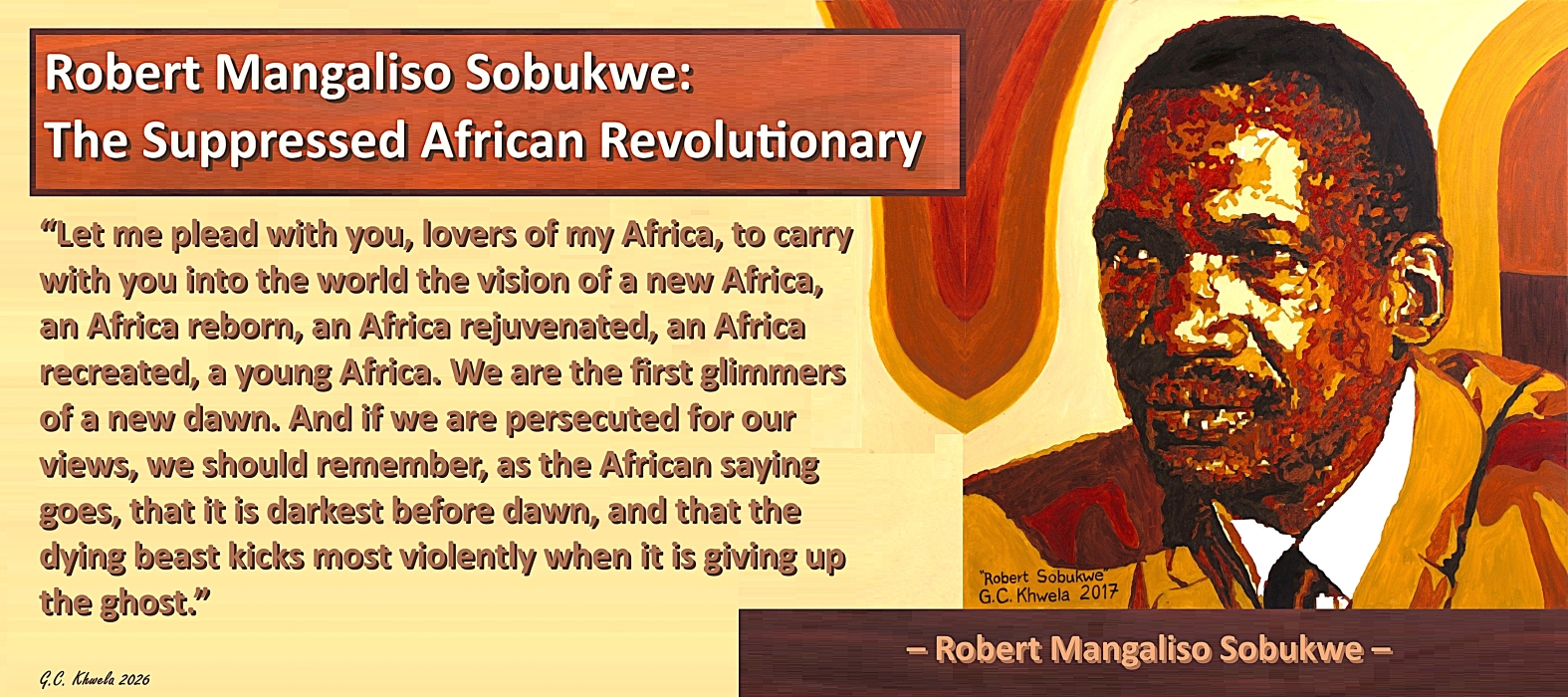
Sobukwe was an ardent Africanist, and one of his most quoted sayings regarding this love of Africa was, “Let me plead with you, lovers of my Africa, to carry with you into the world the vision of a new Africa, an Africa reborn, an Africa rejuvenated, an Africa recreated, a young Africa. We are the first glimmers of a new dawn. And if we are persecuted for our views, we should remember, as the African saying goes, that it is darkest before dawn, and that the dying beast kicks most violently when it is giving up the ghost.”
Sources:
Wikipedia.
South African History Online (SAHO).
Baruch Hirson, “Review Article: Sobukwe and the PAC”, Searchlight South Africa, Vol. 2, No. 3, July 1991.
Robert Sobukwe, “Robert Sobukwe Inaugural Speech April 1959”, South African History Online Archives, 18 April 2012.
Nick Dall, “Robert Sobukwe, the South African leader once as revered as Mandela”, Al Jazeera, 30 November 2024.
Grahame Hayes, “In Search of the Missing Robert Mangaliso Sobukwe”, Research Gate, 22 October 2024.
Wits University, “Robert Mangaliso Sobukwe Citation”, Wits University: https://www.wits.ac.za/media/wits-university/alumni/documents/honorary-degree-citations/Robert%20Mangaliso%20Sobukwe%20citation.pdf
Mary Alexander, “Robert Sobukwe: ‘There is only one race. The human race’”, South Africa Gateway, 5 March 2025.
Castro Khwela
Good evening fellow Compatriots!
Discover more from CASTRO KHWELA
Subscribe to get the latest posts sent to your email.