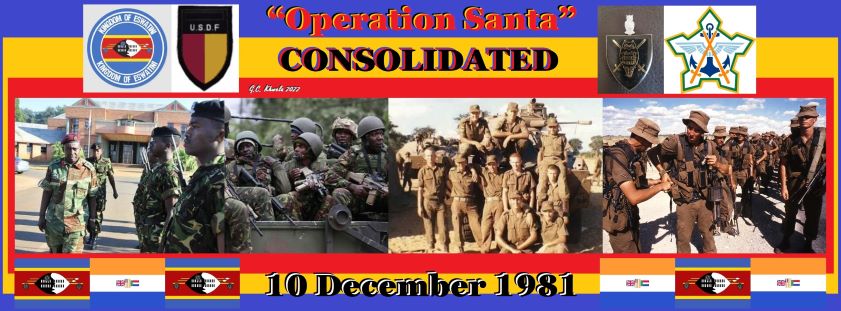
On 10 December 1981, in Swaziland (now Eswatini), Swazi Police Commissioner Titus Msibi, his Deputy E. Hilary, Secretary A. Dlamini, Lieutenant Colonel Dube, Lieutenant Colonel J. Ndzimandze and Captain S. Dlamini met their apartheid South African counterparts, which consisted of Major General Earp of Army Special Operations, Brigadier du Preez from the Security Branch, and Colonels de Bruyn and Saaiman from the Directorate Military Intelligence.
Commissioner Msibi welcomed all present and informed them that the meeting was based on South Africa’s request to discuss the common enemy that the two countries shared. He also mentioned to the meeting that the Swazi Minister of Foreign Affairs had been in Cape Town, where he was given briefings about the African National Congress (ANC).
According to Msibi, politicians in Swaziland were holding the belief that voters in the kingdom were going to put pressure on the security forces if they did not act, and as a consequence, the Swazi Security Council had convinced the government that ANC members in the kingdom had to be detained in a refugee camp under armed guard.
Furthermore, Msibi stated that Swaziland was willing to make an agreement with apartheid South Africa to cope with the ANC, and a special task force was already in place to be utilised for that objective. He then suggested to their racist South African counterparts to raise a task force that could be used for joint actions. Msibi further declared that Swaziland and South Africa were brothers and neighbours, and this had the blessing of King Sobhuza II, who would freely consent to joint South African-Swazi actions against the ANC.
In response, General Earp maintained that apartheid South African security forces had an interest in advancing peace and stability in Swaziland. Therefore, both countries’ security forces were under pressure from their governments to control the threat posed by the ANC. He then proposed several methods that apartheid South Africa could employ to support Swaziland.
These, for example, included the possibility that ANC elements released by the Swazi security forces could be intercepted by apartheid forces outside Swaziland, in Mozambique. Other proposals could be discussed later in detail, but in the nearer term cooperation would have to be placed on a more formal basis. This implied that the two countries security forces had to seek permission from higher authorities for their consent to undertake further steps.
Based on Earp’s assessment, actions by the various police and military elements from low to high level could then be established under such an arrangement. A formal agreement between the two could be pre-empted by an initial informal arrangement that would ensure that such cooperation was achieved.
When Mozambique gained independence in 1975 the number of Umkhonto we Sizwe (MK) cadres passing through Swaziland to Mozambique, and then to other countries, increased. Swaziland was used as transit point for MK recruits on their way to military training in other countries.
In commemoration of the Year of Isandlwana and 25 years of the Freedom Charter, the years 1979 and 1980 were respectively geared towards building morale for increased ANC activity inside South Africa. Swaziland played an important role as a transit point for MK cadres moving in and out of South Africa.
King Sobhuza II was initially sympathetic to the ANC and generally turned a blind eye to its activities, but as MK began using Swaziland as a transit point for weapons headed for South Africa, there was a change of attitude. A number of raids were conducted by the Swazis, resulting in the confiscation of ANC weapons in transit.
Serious problems arose when confrontations occurred with the Swazi police who in turn informed the apartheid South African government. The racist government responded to the presence of MK in Swaziland by piling pressure on the Swazi government to deal with ANC and MK, based on the Military Intelligence’s “Operation Santa”.
“Operation Santa” was initiated by the apartheid SADF’s Military Intelligence Directorate on 18 October 1979, following successive meetings between them and the Royal Swazi Defence Force (RSDF), wherein the concept of a “common enemy” was discussed. According to their analysis, the geopolitical changes in the 1980s and the increased radicalisation of the South African domestic scene, apartheid South Africa was led to view the entire southern African region as an operational area. This meant that the struggle for change in South Africa became a regional war.
For the racist regime in South Africa, the balance of political forces had been altered in the region with the independence of Angola and Mozambique. Accordingly, South Africa could no longer rely exclusively on its economic power or even its diplomatic leverage, but had to resort to military means, to protect the apartheid system. The immediate manifestation of this campaign was to punish those who gave assistance to the ANC and to dissuade those governments that might be tempted to do so.
Swaziland was thus put under pressure to conclude a non-aggression pact (“Operation Santa”) with the racist apartheid regime that the two governments would undertake to combat terrorism, insurgency and subversion individually and collectively, as well as call lupon each other whenever possible for assistance. The agreement was intended to be of more significance for apartheid South Africa than it was for Swaziland.
Castro Khwela
Good evening fellow Compatriots!
Discover more from CASTRO KHWELA
Subscribe to get the latest posts sent to your email.