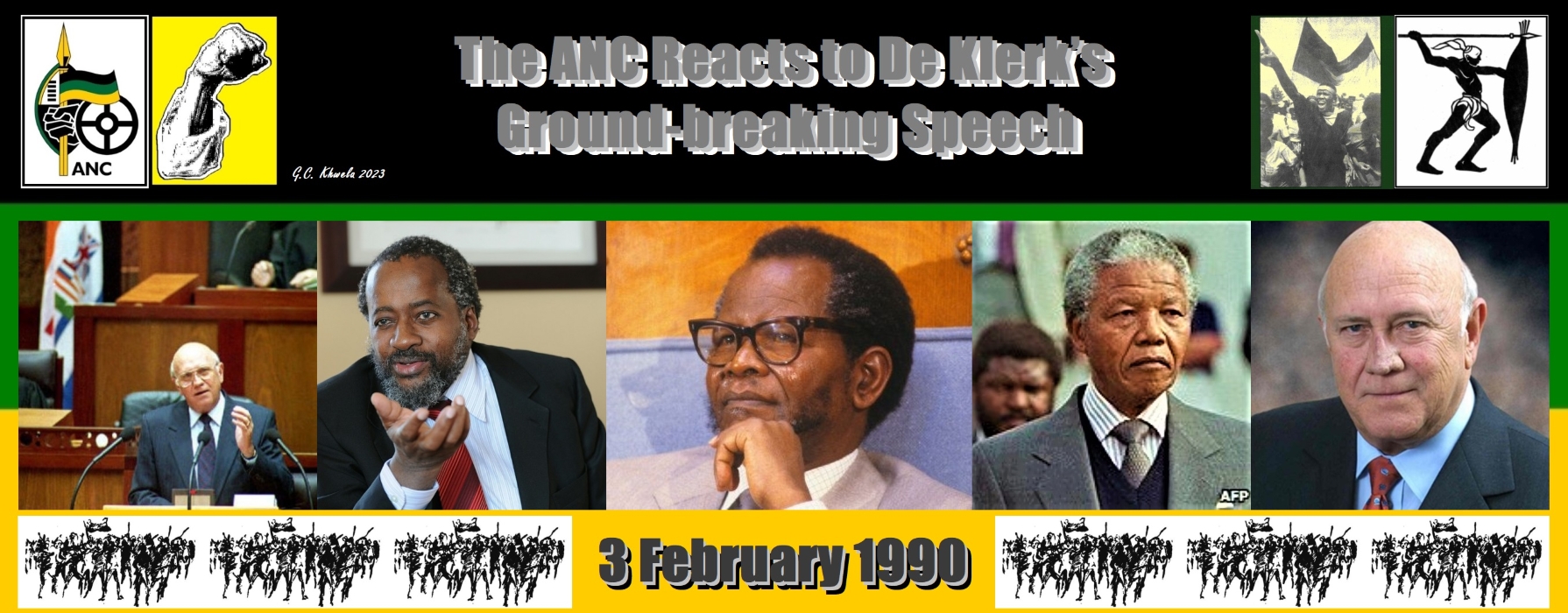
On 3 February 1990, speaking in Lusaka on behalf of the African National Congress (ANC) President Oliver Tambo, member of the National Executive Committee (NEC), Pallo Jordan, mentioned that “the notion of the ANC unilaterally abandoning the armed struggle is out of the question”, which was a reiteration of the stance the Movement had adopted in line with the Harare Declaration. Based on the Harare Declaration, “any ceasing of hostilities will have to be negotiated and will arise out of a mutually binding cease-fire” (“ANC Vows to Continue the Armed Struggle”, United Press International, 3 February 1990).
Jordan further declared that the ANC acknowledged that De Klerk had gone a long way towards “creating a climate conducive to negotiations”, however the Movement was still “gravely concerned that the Pretoria regime had taken the decision that some political prisoners will not be released, that the State of Emergency is not lifted and the practice of detention without trial will continue” (“On First Legal Day, ANC Reassesses Strategy”, Associated Press, 3 February 1990). Pallo Jordan was reacting to apartheid President F.W. de Klerk’s address opening South Africa’s Parliament on 2 February 1990, wherein De Klerk reminded his audience that he had committed his government during his inauguration to give active attention to the critical obstacles in the way of reaching a negotiated arrangement.
The decision, according to De Klerk, followed consultation with senior officials, including members of the security community, who said it posed no threat to public safety and as such the agenda was at that time opened for negotiations that were to lead to a democratic constitution. De Klerk added that it was in that connection that Nelson Mandela could play an important part, since the apartheid government had noted that “he had declared himself to be willing to make a constructive contribution to the peaceful political process in South Africa” (“De Klerk’s Peace Offer”, Independent, 3 February 1990).
Sceptical of De Klerk’s motives, the Editorial of Sechaba (Vol. 24, No. 2, February 1990) maintained that “the De Klerk regime, has no intention of losing the loose grip it still has on the political power in the country. On the contrary, it is doing everything to try to ensure that our offensive to bring peace and democracy to South Africa meets with obstacles wherever it is launched. Its diplomatic emissaries abroad shuttle from capital to capital and to the United Nations pleading for the voice of the ANC and the MDM (Mass Democratic Movement) not to be heard, for its racist policies to be the only ones accepted in the ‘group’-complicated South Africa.”
“Clearly”, the ANC had deduced that, “it (the De Klerk regime) is not committed to the transformation of our country into a genuine democracy and this means we must ourselves fight even more determinedly for this transformation”. The ANC had earlier on in the Editorial (Sechaba, Vol. 24, No. 2, February 1990) resolved that what this meant, was that “our objectives remain the same. What we have done is to enrich our struggle by opening up new areas of struggle.”
Similarly, the Central Committee of the South African Communist Party (SACP), a strong ally of the ANC, shared the same sentiments in a Statement it issued following De Klerk’s speech. The SACP Statement (The African Communist, No. 120, First Quarter, 1990), titled “Advance and Avoid the Traps”, argued that “The situation is full of promise for a major advance. But it is also full of traps. And the key question facing all of us is how to guide the advance without falling into the traps. In general, there are two extreme positions which spell danger for the future of our struggle. The one is to maintain that nothing has really changed. This would close our minds to certain tactical readjustments needed to build on the victories already scored.”
“The other”, the Statement continued, “is to exaggerate the meaning of these changes. This could lead to an abandonment or toning down of those aspects of our strategy which made those victories possible and which will lay the basis for the ultimate victory.” Accordingly, “It is plain that the regime’s tactical approach has shifted. It is responding to mounting internal struggle and external pressures and its failure to contain and reverse the people’s militancy. There is, however, no doubt that, in all essential respects, de Klerk’s shift is designed to continue old policies by other means.”
In the Editorial Notes of the subsequent issue of The African Communist (No. 121, Second Quarter, 1990), the SACP cynically acknowledged De Klerk’s ground-breaking announcements: “Let us not deny the regime credit for what it has done. Compared with everything that has gone before under Malan, Strijdom, Verwoerd, Vorster and Botha, De Klerk has taken a big step in a different direction, realising that reliance on force alone has, far from demoralising the opposition, only toughened and tempered it into a mighty force for liberation. But let us also assure De Klerk that, in our view, he is wrong to expect that what he has done so far is enough to ensure peace and security in South Africa.”
Castro Khwela
Good day fellow Compatriots!
Discover more from CASTRO KHWELA
Subscribe to get the latest posts sent to your email.