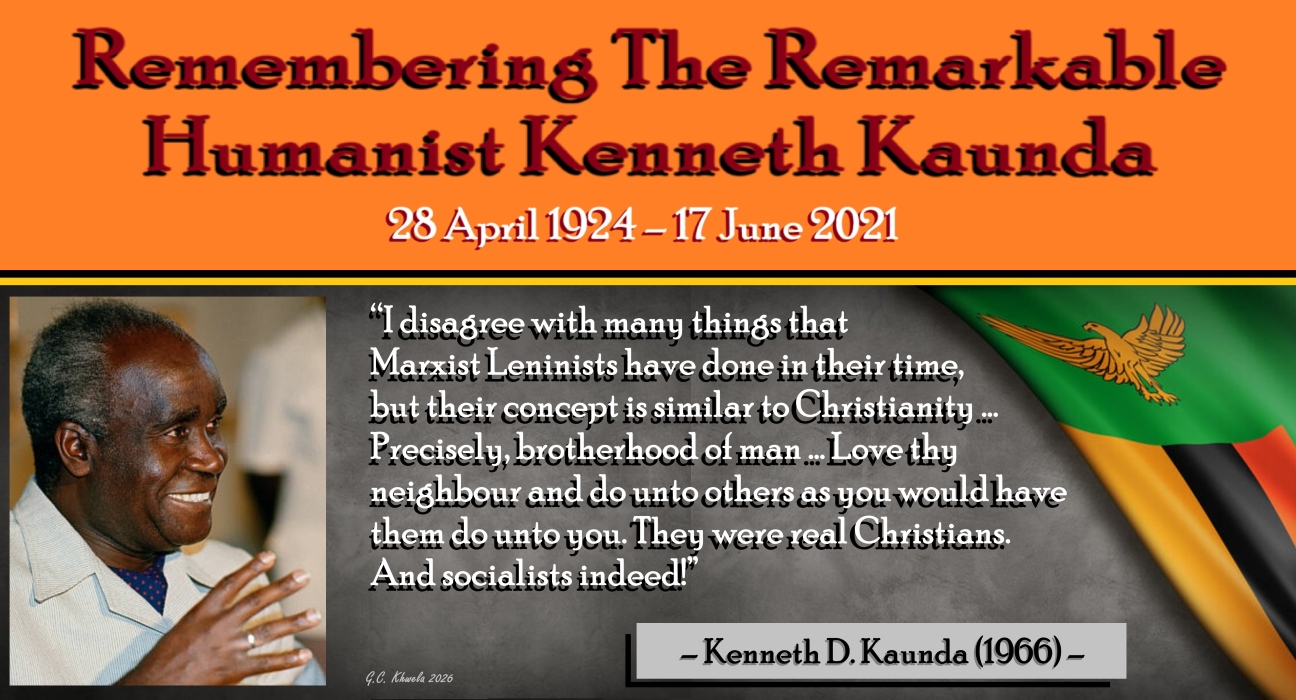
Remembering The Remarkable Humanist Kenneth Kaunda
On this day, on 28 April 1924, Kenneth David Kaunda, fondly known as KK, was born at Lubwa Mission in Chinsali, which was then part of Northern Rhodesia, now Zambia. Kenneth was the youngest of eight children, he was christened Buchizya, “the unexpected one”, whose father, the Reverend David Kaunda, was an ordained priest of the Church of Scotland. His father also served as a teacher, who had been born in Nyasaland, now Malawi. Reverend Kaunda had moved to Chinsali, to work at Lubwa Mission. His mother, Helen Nyirenda Kaunda, was also a teacher and was the first African woman to teach in colonial Northern Rhodesia. His parents were both teachers among the Bemba ethnic group which is located in northern Zambia.
Kenneth Kaunda received his education at Lubwa Mission until the early 1940s. Unfortunately, his father died when he was still a child and he decided to follow in his parents’ footsteps to become a teacher. He attended the Munali Training Centre in Lusaka between 1941 and 1943 and began to teach initially in Northern Rhodesia, and later, in the middle of the 1940s, in the Territory of Tanganyika, now part of Tanzania. Kenneth Kaunda also worked in Southern Rhodesia, where early in his career, he was fascinated by the writings of Mahatma Gandhi.
Education was his passion, as Kaunda became a teacher, a Boarding Master and then a Headmaster at Lubwa from 1943 to 1945, beginning at the Upper Primary School at Lubwa. Interestingly Kaunda also worked at the Salisbury and Bindura Mine and in early 1948, he became a teacher in Mufulira for the United Missions to the Copperbelt (UMCB). Because of his passion for teaching, he was appointed as an assistant at an African Welfare Centre and Boarding Master of a Mine School in Mufulira. During this period, he was leading a Pathfinder Scout Group and also became a Choirmaster at a Church of Central Africa congregation.
Kaunda became the founding member of the African National Congress (ANC) of Northern Rhodes in 1949, moving to Lusaka on 11 November 1953 to take up the post of Secretary General of the ANC, under the presidency of Harry Nkumbula. Their efforts were to mobilise the African people against the British colonial administration of the Federation of Rhodesia and Nyasaland. As a consequence, Kaunda and Nkumbula were imprisoned in 1955 for two months with hard labour for distributing subversive literature.
Unfortunately, the two leaders became estranged as Nkumbula became increasingly influenced by white liberals and failing to defend indigenous Africans. Kaunda broke away and led a dissident group to Nkumbula that eventually founded another party, the Zambian African National Congress (ZANC) in October 1958, which became banned in March 1959, leading to Kaunda being sentenced to nine months’ imprisonment in Lusaka and later in Salisbury prison, where he met Mainza Chona, with whom they formed the United National Independence Party (UNIP) in October 1959, and Chona becoming the first president.
When Kaunda was released from prison in January 1960, he was elected president of UNIP since Chona did not see himself as the party’s main founder. In 1960 Kaunda visited Reverend Martin Luther King Jr. in Atlanta, in the United States, and afterwards, in July 1961, he organised a civil disobedience campaign in Northern Province, which was called the “Cha-Cha-Cha” campaign. The campaign consisted largely of arson and obstructing significant roads.
Subsequently Kaunda ran as a UNIP candidate during the 1962 elections, resulting in a UNIP–ANC coalition government, with Kaunda as Minister of Local Government and Social Welfare. In January 1964, UNIP won the next major elections, defeating their ANC rivals and securing Kaunda’s position as the Prime Minister. On 24 October 1964, Kaunda became the first president of an independent Zambia.
After independence, Zambia invested heavily in education at all levels, since the educational system was one of the most poorly developed in all of Britain’s former colonies. Kaunda instituted a policy where all children attended school, irrespective of their parents’ ability to pay, wherein they paid a token ‘school fee’ and ensure that the children were in school. This approach included that the best pupils were promoted to achieve their best results, all the way from primary school to university level. Not every child could go to secondary school, for example, but those who did became well educated. In 1966, the University of Zambia was established in Lusaka after Zambians all over the country were encouraged to donate whatever they could afford towards its construction.
In 1979 another campus was established at the Zambia Institute of Technology in Kitwe, which in 1988 was upgraded and renamed the Copperbelt University, offering business studies, industrial studies and environmental studies. Other tertiary-level institutions established during Kaunda’s era were vocationally focused and fell under the aegis of the Department of Technical Education and Vocational Training. These included the Evelyn Hone College and the Natural Resources Development College, both in Lusaka, the Northern Technical College at Ndola, the Livingstone Trades Training Institute in Livingstone, as well as other teacher-training colleges.
The newly independent government under Kaunda, inherited a country with one of the most vibrant economies in sub-Saharan Africa, largely due to its rich mineral deposits. However, the economy was largely under the control of foreign and multinational interests, such as the British South Africa Company (BSAC), which was founded by Cecil John Rhodes. The BSAC retained commercial assets and mineral rights that it had acquired from a concession it had signed with the Litunga of Bulozi in 1890. On the eve of independence Kaunda threatened to expropriate the mining rights, thus managing to get favourable concessions from the BSAC.
The Zambian economy suffered a setback from 1973, when rising oil prices and falling copper prices combined to reduce the state’s income from the nationalised mines. The country fell into debt with the International Monetary Fund (IMF), and the Third National Development Plan had to be abandoned as crisis management replaced long-term planning. Kaunda’s attempts at economic reforms in the 1980s hastened Zambia’s decline, and by 1990 Kaunda was forced into partial privatisation of the state-owned corporations. The country’s economic woes ultimately contributed to his fall from power. Despite having some of the finest farming land in Africa, Kaunda adopted the same socialist agricultural policies as Tanzania, with disastrous results.
Following violence during the 1968 elections, Kaunda banned all parties except UNIP. However, in early 1972, he faced a new threat in the form of his close comrade, Simon Kapwepwe, deciding to leave UNIP to find a rival party, the United Progressive Party (UPP), which Kaunda immediately attempted to suppress. Following this challenge, Kaunda appointed the Chona Commission, under Mainza Chona in February 1972, to make recommendations for a new Zambian constitution which would effectively reduce the nation to a one-party state. Finally, the new constitution was formally promulgated on 25 August of that year, under the new system called “Zambian Humanism”, and the first elections were held that December, with Kaunda as the sole candidate.
Kenneth Kaunda was an outspoken supporter of the anti-apartheid movement and opposed white minority rule in Southern Rhodesia. He also provided logistical support for the national liberation movements against Ian Smith’s Rhodesia, the illegal occupation of South West Africa, as well as Portuguese colonialism in Angola and Mozambique. Kaunda’s administration later attempted to serve the role of a mediator between the entrenched white minority and colonial regimes and the various guerrilla movements which were aimed at overthrowing these respective administrations.
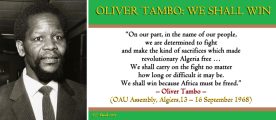
Beginning in the early 1970s, he began permitting the most prominent guerrilla organisations, such as the Rhodesian Zimbabwe African National Union (ZANU) and the African National Congress (ANC) of South Africa, to use Zambia as a base for their operations. The late ANC president Oliver Tambo even spent a significant proportion of his 30-year exile living and working in Zambia. Joshua Nkomo, the leader of Zimbabwe African People’s Union (ZAPU), also established military encampments in Zambia, as did the South West African People’s Organisation (SWAPO) and its military wing, the People’s Liberation Army of Namibia (PLAN).
Up until 1984, Kaunda became the key African leader involved in international diplomacy regarding the conflicts in Angola, Rhodesia (Zimbabwe), South West Africa (Namibia) and South Africa. He hosted Henry Kissinger’s trip to Zambia in 1976, got along very well with United States President Jimmy Carter, and worked closely with President Ronald Reagan’s Assistant Secretary of State for African affairs, Chester Crocker. Despite the disagreements between Kaunda and US leaders (such as when Zambia purchased Soviet MiG fighters or when he accused two American diplomats of being spies), Kaunda generally enjoyed a positive relationship with the United States during these years.
Meanwhile, the anti-white minority insurgency conflicts of southern Africa continued to place a huge economic burden on Zambia as white minority regimes were the country’s main trading partners. On 26 August 1975, Kaunda acted as mediator along with the apartheid Prime Minister B.J. Vorster, at the Victoria Falls Conference to discuss possibilities for an internal settlement in Southern Rhodesia with Ian Smith and the national liberation movements. After the Lancaster House Agreement, Kaunda also attempted to seek a similar agreement in South West Africa (Namibia). The meeting with apartheid Prime Minister P.W. Botha in the border with Botswana in 1982 to discuss this proposal, did not yield any positive results.
Zambia also attempted to reduce its dependence on apartheid South African ports as a landlocked country for external trade, when Kaunda negotiated the TAZARA Railway (Tanzam) linking Kapiri Mposhi in the Zambian Copperbelt with Tanzania’s port of Dar es Salaam on the Indian Ocean. The project was completed in 1975, which became the only route for bulk trade that did not have to transit white-dominated territories. This precarious situation lasted more than 20 years, until the abolition of apartheid in South Africa in 1994.
After leaving office, on 2 November 1991, following his defeat in Zambia’s first multi-party elections, which ended his 27-year rule, Kaunda clashed frequently with Frederick Chiluba’s government led by the Movement for Multiparty Democracy (MMD). Chiluba later attempted to deport Kaunda on the grounds that he was a Malawian, and the government had the constitution amended, barring citizens with foreign parentage from standing for the presidency, to prevent Kaunda from contesting the next elections in 1996, in which he planned to participate.
Following the 1997 coup attempt on Boxing Day in 1997, Kaunda was arrested by paramilitary policemen and was later placed under house arrest until his court date. In 1999 Kaunda was declared stateless by the Ndola High Court but he successfully challenged this decision in the Supreme Court of Zambia, which declared him to be a Zambian.
On 4 June 1998, Kaunda announced that he was resigning as the leader of UNIP and retiring from politics. After retiring in 2000, he was involved in various charitable organisations, with the most notable contribution being his zeal in the fight against the spread of the HIV/AIDS pandemic.
On 10 December 2002, Kenneth David Kaunda was bestowed The Order of the Companions of O.R. Tambo in Gold for Exceptional contribution to the struggle against apartheid and for justice in the Southern African region. Again in 2007 Kaunda received the Ubuntu Award from the post-apartheid government of South Africa for having stood alongside the people of South Africa at the time of their greatest need and was unwavering in his desire for the achievement of the country’s freedom. The aim of the awards was to recognise organisations or individuals who had, through excellence, innovation, creativity, inventiveness, social responsibility or patriotism, distinguished themselves as true ambassadors of South Africa.
Kenneth Kaunda started playing a continental role in 1963 when he became President of the Pan-African Freedom movement for East, Central and Southern Africa (PAFMECSA). He extended his influence to the global level after Zambia’s independence, serving as chairperson of the Organisation of African Unity (OAU) from 1970 to 1971 and from 1987 to 1988. He devoted himself and the Zambian people to supporting national liberation movements around the Southern African region in their quest for independence and freedom. In 1991, he founded the Kenneth Kaunda Peace Foundation dedicated to the establishment of peace and conflict resolution on the continent.
On 17 June 2021 it was confirmed that Kenneth Kaunda had died at the age of 97 after a short illness at Maina Soko Military Hospital. Kaunda also wrote music about the independence he hoped to achieve, although only one song has been known to many Zambians, “Tiyende pamodzi ndi mtima umo”, which literally meant “Let’s walk together with one heart”.
Sources:
Wikipedia.
South African History Online (SAHO).
Kenneth D Kaunda, “A Humanist in Africa: Letters to Colin M Morris”, Longman, 1966.
Luli Callinicos, “Oliver Tambo: Beyond the Engeli Mountains”, David Philip, 2004.
Olusegun Obasanjo, “Kenneth Kaunda: A Great Son of Africa Who Fought for Independence”, Daily Maverick and the Brenthurst Foundation, 17 June 2021.
Nyasha Bhobo and Ray Mwareya, “Kenneth Kaunda: The Flawed Giant Who Squared Up to Colonialism and Aids”, Daily Maverick, 17 June 2021.
Guy Arnold, “Kenneth Kaunda Obituary: Idealistic President of Zambia at the Heart of the Fight for African Independence”, The Guardian, 17 June 2021.
Alex Vines, “Kenneth Kaunda: The Man Behind the Statesman”, Mail & Guardian, 22 June 2021.
Stephen Chan, “Kenneth Kaunda, the Philosopher King Who Fell with Dignity”, African Arguments, 24 June 2021.
Duncan Money, “Remembering Kenneth Kaunda (1924-2021), Africa’s Last Anti-Colonial Leader”, Review of African Political Economy, 01 February 2024.
Castro Khwela
Good morning fellow Compatriots!🙏🏾✊🏾👊🏾
Discover more from CASTRO KHWELA
Subscribe to get the latest posts sent to your email.