The Horrific Execution of Phila Portia Ndwandwe
On the morning of 4 October 1988, Portia Phila Ndwandwe (aka “Zandile” or “Zandie”), was transported by the apartheid Security Branch to a safe house on a Dairy Farm in an area called Elandskop, near Pietermaritzburg, where she was executed and buried, after she refused to become an apartheid agent and an “Askari”.
Phila Ndwandwe had been appointed Acting Commander of Umkhonto we Sizwe (MK) Natal Machinery following the arrest of the Machinery’s Commander, Muziwakhe Ngwenya (aka “Thami Zulu” or “TZ”). She was at that time the most senior female frontline as Acting Machinery Commander in the History of MK and was responsible for the infiltration of ANC cadres into Natal. She was also believed to have given orders for a number of violent MK operations in Natal, including the killing of Durban Security Branch policeman, Warrant Officer Sokhela, in August 1986.
Phila Portia Ndwandwe was born on 6 February 1965, in Umlazi, the largest African township in Durban. She pursued her studies as a Dental Therapy student at the University of Durban-Westville, when she was recruited into the ANC in 1985. She lived with General Ramlakan and his wife, Sandy Afrika, who had turned their house into an Umkhonto we Sizwe (MK) headquarters in KwaZulu-Natal. Ndwandwe joined MK and received her basic training, after which she and others were arrested. She was separated from the other detainees, as she was listed as a state witness after being charged with terrorism.
In 1986, the apartheid Security Branch discovered that the ANC had established an Area Political Military Committee (APMC) in Natal, under the code name Operation Butterfly, that committed a number of guerrilla operations and sabotage in Natal. 54 persons related to Operation Butterfly were arrested on 23 December 1986, the night after the Amanzimtoti bombing. A number of them made statements to the police in terms of Section 29 of the Internal Security Act and were released, some of them to be used as State witnesses. Out of the 54 persons detained, 12 were charged in State vs Buthelezi and 11 others Trial, which was later referred to as the Ramlakan Case (named after Vejaynand “Vejay” Indurjith Ramlakan).
Of the 12 accused, only nine were convicted, because of a lack of evidence, resulting from a last-minute refusal of the State witness, Lulamile Xhate to testify. Three of the accused, including Sipho Stanley Bhila, Phumezo Nxiweni, and … were discharged. Phila Portia Ndwandwe was among the 54 who were originally arrested but were released after having made a statement and was to be called as a State witness and listed number 38 in a list of 72 witnesses. However, she left the country and hence did not testify. The three of them, including Phila Portia Ndwandwe, were all involved in Operation Butterfly. After her arrest, statement and release, Phila Portia Ndwandwe left the country during 1986 and received military training in Angola. She then went to Swaziland where she soon became MK Commander for Natal operations.
The Durban Security Branch continued to receive regular reports about her activities from informers placed in Swaziland. The guerrilla warfare and sabotage activities continued under her command in the area of Port Natal and during October 1988 the Durban Security Branch decided that she had to be neutralised and killed. However, if she could be persuaded to turn and work with the Security Branch, they considered that she could be of immense value to them. It was therefore decided to first abduct her from Swaziland in an effort to recruit her, failing which she would be killed. A plan was devised and put into operation in which two informers that knew Ndwandwe were to engage with her.
On the afternoon of 3 October 1988, she was driven by Richard Jones to the George Hotel, in Manzini, Swaziland, where she met two other “comrades” in a vehicle parked nearby, and was pleased to see them. The two informers had travelled to Onverwacht where they were had “jumped the fence”, meaning that they illegally crossed the border into Swaziland. Meanwhile, as this was happening at the George Hotel, three apartheid Security Branch officers, Andrew Taylor, Hendrik Botha and Jakobus Forster, were observing in a car parked behind the Isuzu bakkie, which had two “askaris” inside that Ndwandwe was excited to see as her “comrades”. The Isuzu was parked behind the Toyota which had other apartheid security policemen, Lawrence Gerald Wassermann and Salmon du Preez, inside.
At around 18:00, Ndwandwe came out of the hotel and entered the Isuzu bakkie with the two “askaris” inside, sitting at the centre between them. The bakkie then headed off in the direction of Big Bend, being followed by the Toyota, while the other vehicle with Taylor trailing further behind. At the Sipho Fanene turnoff, about fifteen kilometres outside Manzini, both the Toyota and the other vehicle driven by Taylor bottlenecked the Isuzu bakkie. Later that evening, Ndwandwe was taken in the Toyota to a police house near the Onverwacht border post, where apartheid Durban Security Branch Commander, Brigadier Johannes Albertus Steyn, was waiting for them.
The whole operation began on 3 October 1988 when members of the apartheid Durban Security Branch, Brigadier Steyn and Jakobus Forster, were driven by Major Andrew Taylor from Durban to Swaziland, where they stopped at a house in the vicinity of the Onverwacht border post. After leaving Brigadier Steyn at the house, they went to the border post, where they were joined by Warrant Officer Lawrence Wassermann and Major Salmon du Preez, from the C-Section of the apartheid Security Branch, based in Vlakplaas, near Pretoria. The Team also included the two former MK askaris, who were then instructed to proceed to jump the fence into Swaziland.
Wassermann and Du Preez were driving in a Toyota van and were accompanied by two former MK operatives, who were at that time askaris, in an Isuzu bakkie. When Ndwandwe was abducted to the apartheid police safe house in Onverwacht, she underwent interrogation by Hendrik Botha. Being unresponsive to Botha, she was tortured until she began to answer some question over time. During the interrogation she admitted that she was aware of the MK Unit commanded by Phumezo Nxiweni, which was responsible for the limpet mine explosion at the Pinetown Post Office on 12 August 1988, as well as other related incidents.
When Botha attempted to find out if she was willing to cooperate as a police informer, she flatly refused. This was when Botha decided to hand her over to the Vlakplaas Unit, which took her for execution and burial at an operational farm in Elandskop, Natal, which was used as an interrogation centre, most notably during the rolling up of MK’s operation to infiltrate Natal directed from Swaziland in the late 1980s. At Camperdown there was a second Security Branch farm housing “askaris” and a third at Bulwer, all of them were leased under false names.
Her interrogation was continued for ten days in Elandskop, and after they had satisfied themselves that she could not be turned, they decide to proceed with the execution. According to Brigadier Johannes Albertus Steyn, she told him that she would not co-operate with them and specifically stated that she would continue her activities should she be released. Steyn then gave them the order to eliminate her and left.
She was then blindfolded and led to the grave some fifty to eighty metres from the house among high trees. Lawrence Gerald Wassermann hit her on the head with a baton which rendered her unconscious. He then shot her in the head, and thereafter she was disrobed and placed in the grave. Lime was sprinkled over the body which was then covered with plastic bags and the grave filled with soil. The exhumation of her remains took place in KwaZulu-Natal on 12 March 1997. The Truth and Reconciliation Commission’s (TRC) Richard Lyster noted that this was one of “the most poignant and saddest” of the exhumations. The remains were found buried in a remote part of the province. When she was exhumed, her pelvic bones were covered with a plastic supermarket packet with which she had tried to protect the dignity of her naked body.
Commissioner Richard Lyster observed that, “She was held in a small concrete chamber on the edge of the small forest in which she was buried. According to information from those that killed her, she was held naked and interrogated in this chamber, for some time before her death. When we exhumed her, she was on her back in a foetal position, because the grave had not been dug long enough, and had a single bullet wound to the top of her head, indicating that she had been kneeling or squatting when she was killed. Her pelvis was clothed in a plastic packet, fashioned into a pair of panties indicating an attempt to protect her modesty.”
Phila Ndwandwe or Zandi was a breastfeeding mother when she was abducted by Apartheid forces in October 1988. Her abduction from Swaziland followed the kidnapping of Emmanuel Mzimela (aka “Dion Cele”) between July and October 1988, and the arrest of Bhekayena Mkhwanazi (aka “Tekere”) while he was en route to Durban. All were murdered at the Elandskop Dairy Farm and their bodies were exhumed on 12 March 1997. Another, MK operative Mxolisi “Mubi” Khumalo (aka “Sthembiso Zola”) was also killed, with a bullet at the back of his head, on 30 July 1988, at Pietermaritzburg, in an incident in which, according to the apartheid police, a hand grenade in Khumalo’s possession exploded.
Mxolisi “Mubi” Khumalo was reportedly killed by police at Magogo football ground, in Sobantu Village, Pietermaritzburg, to which he had been lured. A false name of Thembilile Sithole and inquest number, which was related to a road accident in Edendale, concealed the burial of his body in a pauper’s grave at Mountain Rise cemetery on 8 August 1988. When it was exhumed ten years later the remains showed a gunshot wound to the head, but no evidence that Khumalo’s grenade had exploded as police claimed.
Despite their failure and refusal to identify the informers who were involved in the abduction, the Amnesty Committee of the TRC was satisfied that the Applicants had all made a full disclosure of their acts related to the incident which occurred within the context of the conflicts of the past. The Committee was also content that these acts were associated with a political objective as envisaged in the Act. They were accordingly all granted amnesty for their acts in their various roles in the incident related to the abduction and killing of Phila Ndwandwe, including their illegal use and possession of false passports, the illegal crossing of the border and re-entry and the illegal possession of firearms and ammunition.
Contrary to popular myth based on deliberate misinformation about Phila Ndwandwe being an “askari”, she succumbed to torture but refused to become a collaborator. With neither charge nor release an option, Ndwandwe was forced into a grave and shot. According to the Durban Security Branch, it was never their intention that Ndwandwe would be charged and prosecuted. They could not in any event prosecute following an abduction from Swaziland. On the other hand, there was no way in which she could be released to continue her activities. Furthermore, not only would the two informers’ safety now be compromised, but the exposure of the whole informer network would be at risk. They had no other option, but to kill her.
Ndwandwe’s funeral provided an opportunity for her nine-year-old son, Thabang, to meet his grandparents for the first time. He was only two months old at the time of her abduction and his father, Phila Ndwandwe’s ex-lover and a former MK militant, Bheki Mabuza, had kept him in his care. Her funeral was highly publicised and many high-profile people such as the country’s President Nelson Mandela attended the funeral. Ndwandwe was the only female guerrilla whose body was exhumed not only indicating her importance in the armed struggle, but she heralded as one of the most important female figures in the history of South Africa.
In 2003 Ndwandwe received the Order of Mendi for Bravery in Silver for demonstrating bravery and valour and for sacrificing her life for her comrades in the cause for a non-racial, non-sexist and democratic South Africa.
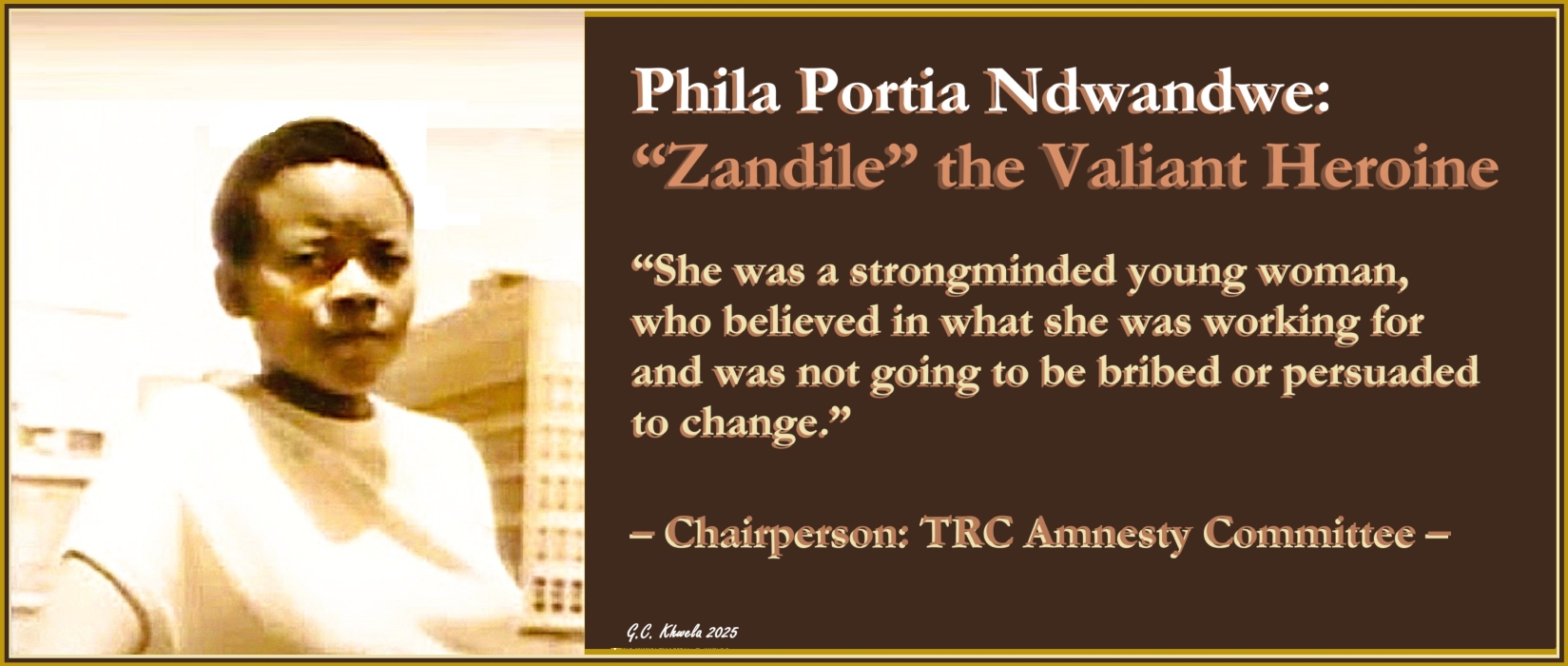
“She was a strong-minded young woman, who believed in what she was working for and was not going to be bribed or persuaded to change”, Chairperson of the TRC Amnesty Committee.
Sources:
Wikipedia.
South African History Online (SAHO).
South African History Archives (SAHA).
Estelle Sinkins, “The Truth Must Be Told”, The Witness, 1 November 2024.
Truth and Reconciliation Commission, “Amnesty Application: Phila Portia Ndwandwe”, Truth and Reconciliation Commission: Amnesty Committee, 11 November 1998.
Truth and Reconciliation Commission, “Truth and Reconciliation Commission of South Africa Report, Vol. 2”, Truth and Reconciliation Commission, 29 October 1998.
Truth and Reconciliation Commission, “Truth and Reconciliation Commission of South Africa Report, Vol. 3”, Truth and Reconciliation Commission, 29 October 1998.
Truth and Reconciliation Commission, “Truth and Reconciliation Commission of South Africa Report, Vol. 5”, Truth and Reconciliation Commission, 29 October 1998.
Truth and Reconciliation Commission, “Truth and Reconciliation Commission of South Africa Report, Vol. 6”, Truth and Reconciliation Commission, 21 March 2003.
Douglas Ainslie, “Art, the TRC and the ‘Truth’: Unstitching the ‘Blue Dress’”, Constitutional Court Art Collection, 2016.
Christopher Merrett, “Born Out of Sorrow: Essays on Pietermaritzburg and the KwaZulu-Natal Midlands under Apartheid, 1948−1994”, Occasional Publications of the Natal Society Foundation, Pietermaritzburg, 2021.
Sapa-AP, “Family Reunited as South Africa Makes Peace with Past”, South African Press Association, 9 May 1997.
Sapa, “Afriforum Lays Complaint Against ANC Bombers”, South African Press Association, 24 January 2014.
Rosemarie Buikema, “Chapter 2: Monumental Dresses: Coming to Terms with Racial Repression” in Brigitte Hipfl and Kristín Loftsdóttir (Ed.s), “Teaching ‘Race’ with a Gendered Edge: Teaching with Gender. European Women’s Studies in International and Interdisciplinary Classrooms”, ATGENDER and Central European University Press, 2012.
The Presidency Republic of South Africa, “Phila Portia Ndwandwe: Order of Mendi for Bravery in Silver”, The Presidency Republic of South Africa, 2003.
Gregory Houston, et. al., “The Liberation Struggle and Liberation Heritage Sites in South Africa”, Report, Democracy, Governance, and Service Delivery (DGSD) Human Sciences Research Council (HSRC), 15 November 2013.
ZamaMdoda, “The South African Freedom Fighter Who Wouldn’t Betray Her Comrades and Lost Her Life For It”, Afropunk, 6 August 2018.
COGTA, “Remains of Mandla Mjwara and Mfaniseni Mdlalose Handed Over to their Families”, Department of Cooperative Governance and Traditional Affairs, 18 August 2018.
Albie Sachs, “The Strange Alchemy of Life and Law”, Oxford University Press, 2009.
Arianna Lissoni, “Umkhonto we Sizwe (MK): The ANC’s Armed Wing, 1961–1993”, Oxford Research Encyclopaedias, 22 December 2021.
Jacob Dlamini, “Askari: A Story of Collaboration and Betrayal in the Anti-Apartheid Struggle”, Jacana, 2014.
Thula Simpson, “Umkhonto we Sizwe: The ANC’s Armed Struggle”, Penguin, 2016.
Vusi Mavimbela, “Time is not the Measure: A Memoir”, Real African, 2018.
Castro Khwela
Good evening fellow Compatriots!
Discover more from CASTRO KHWELA
Subscribe to get the latest posts sent to your email.