The Lion of the North Peter Nchabeleng is Murdered in Detention
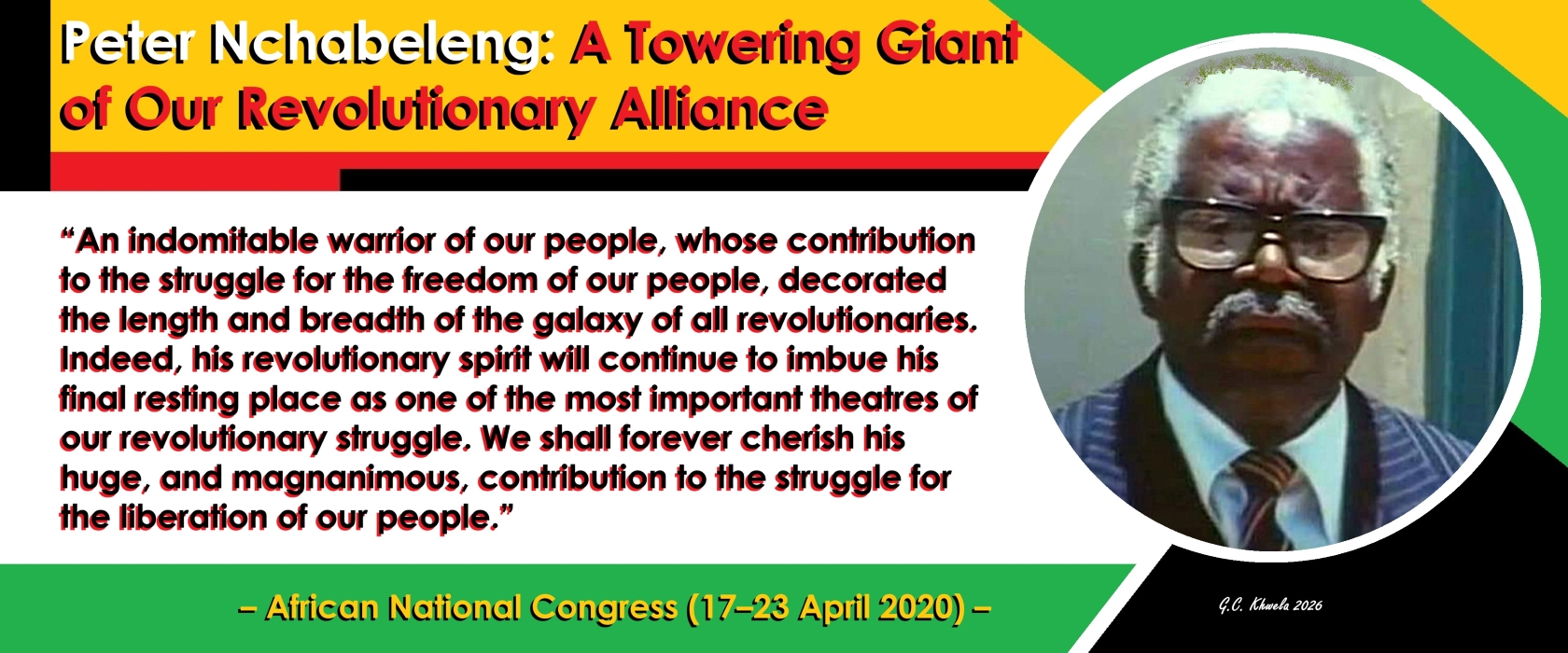
Peter Nchabeleng: A Towering Giant of Our Revolutionary Alliance
“An indomitable warrior of our people, whose contribution to the struggle for the freedom of our people, decorated the length and breadth of the galaxy of all revolutionaries. Indeed, his revolutionary spirit will continue to imbue his final resting place as one of the most important theatres of our revolutionary struggle. We shall forever cherish his huge, and magnanimous, contribution to the struggle for the liberation of our people.” – African National Congress (17–23 April 2020) –
Exactly forty years ago, on 11 April 1986, while on his way home from a United Democratic Front (UDF) meeting in Mankweng, Turfloop, approximately 27 kilometres east of Pietersburg (now Polokwane), Nchabeleng was told that police were looking for him. He continued his journey arguing that if police were looking for him, they would find him at home. When he arrived at home, Lebowa police detained him.
Nchabeleng passed away on 11 April 1986 at the Schoonoordt police station – 13 hours after he was detained by the Lebowa police. His passing sparked protests and condemnation throughout the country and abroad as well as a consumer boycott of white towns in the Northern Transvaal. After his passing, his body was hidden from his family by the police until it was found in a government morgue in Groblersdal. Nine members of the Lebowa police’s Mankweng riot squad were found by the inquest magistrate to be responsible for his passing.
Peter Mampogoane Nchabeleng was born on 03 March 1928, at Apel in Sekhukhuneland, in the then Northern Transvaal. He was the President of the UDF Northern Transvaal and one of the first members of Umkhonto we Sizwe’s (MK) Sabotage Campaign in the early 1960s, as Atteridgeville Section Commander.
In the 1950s, Nchabeleng was the Pretoria Regional Secretary of the African National Congress (ANC) and an executive member of the office workers union – an affiliate of the South African Congress of Trade Unions (SACTU) – and Sebatakgomo, a peasant resistance movement which resisted the imposition of Bantu Authorities in Sekhukhuneland. He was a devoted member of the South African Communist Party (SACP) and also worked as an interpreter for Joe Slovo, as a lawyer who defended many accused in the Sekhukhuneland revolts that followed.
In 1962, Nchabeleng was charged for furthering the aims of a banned organisation – the ANC – and for sabotage. He was sentenced to eight years imprisonment on Robben Island. After his imprisonment, his family was deported from Atteridgeville, in Pretoria, to Apel, in Sekhukhuneland. On his release from Robben Island, he was also banished to Sekhukhuneland and banned. He was arrested again in 1974 and given a three-year suspended sentence by the Pretoria Supreme Court for contravening his banning order.
In 1977, he was charged with harbouring and recruiting people for military training, along with Joe Gqabi. He stood trial in the famous Pretoria 12 terrorism trial with Mosima “Tokyo” Sexwale, Bafana Mohlamonyane, Naledi Tsiki, Nelson Diale, Martin Ramokgadi and his son Elleck, among others.
In 1978, he was acquitted together with Gqabi, but his son Elleck was found guilty and sentenced to six years imprisonment on Robben Island. Gqabi was later killed while an ANC chief representative in Zimbabwe in 1981. After being acquitted in 1978, Nchabeleng’s banning order was renewed for five years.
In 1982, an attempt on his life was aborted when he detected a letter bomb addressed to him at his Apel home. After this incident, he indicated to the leadership of the then banned ANC that his life was in danger, and it was now time for him to go into exile. He was advised against this move as the ANC saw him playing an important role inside the country at the time.
After his banning order expired in 1984, he became instrumental in launching the Sekhukhuneland Youth Organisation (SEYO), was a member of the UDF Northern Transvaal coordinating committee, and in February 1986, he was elected the first President of the Northern Transvaal region of the UDF. Nchabeleng was also a member of the Sekhukhuneland Parent’s Crisis Committee, which spearheaded a campaign for Lebowa MPs from the area to resign from the Bantustan Legislative Assembly as apartheid regime’s quislings.
After his election as the UDF Northern Transvaal president, he was tasked with the formation of different community and youth structures in the region – working closely with youth leaders such as Peter Mokaba, France Mohlala, Ephraim Mogale – the first President of the Congress of South African Students (COSAS) – and his son, Elleck.
Fondly referred to as the LION OF THE NORTH – a committed soldier of the People’s Army, Umkhonto we Sizwe – his funeral was widely attended and the UDF called a consumer boycott to protest his torture and death. Two decades later, in December 2009, South African President Jacob Zuma awarded Nchabeleng the Order of Luthuli in gold “for his exceptional contribution to the fight against the apartheid system in South Africa”.
MOGALE WA BAGALE!
“SEBATAKGOMO!”
Sources:
Wikipedia.
South African History Online (SAHO).
South African Presidency.
Ford Howell, “Biography of Peter Nchabeleng”, December 2017.
Elias Ace Magashule, “A Towering Giant of Our Revolutionary Alliance”, ANC Today, 17–23 April 2020.
Martin Sehlapelo, “Exploring the Legacy of Peter Nchabeleng: The Lion of the North”, Independent Online (IOL), 31 March 2025.
Castro Khwela
Good day fellow Compatriots!
Discover more from CASTRO KHWELA
Subscribe to get the latest posts sent to your email.