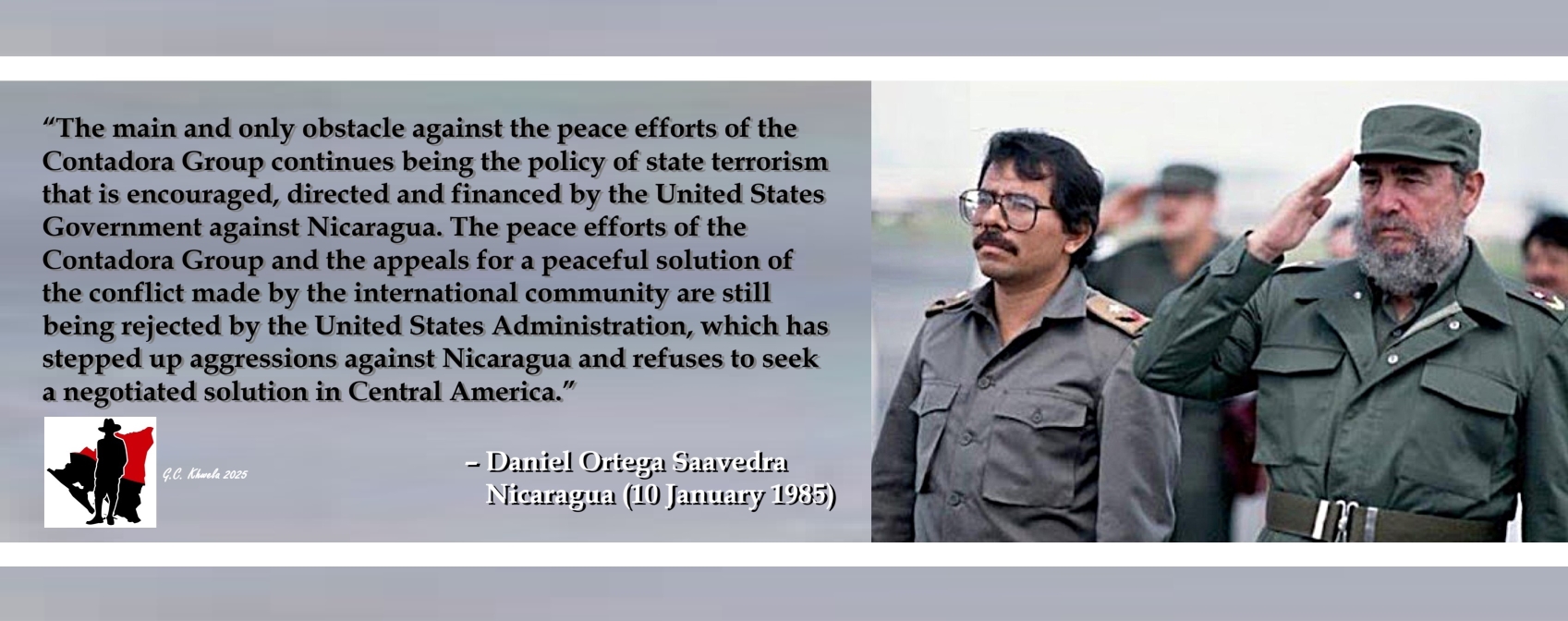
On 10 January 1985, Daniel Ortega took office as the President of Nicaragua after the Sandinista National Liberation Front (FSLN) won with 67 percent of the vote at the November 1984 general elections. In the early phases of the campaign, Ortega enjoyed many institutional advantages, and used the full power of the press, police, and the Supreme Electoral Council against the fractured opposition.
In the weeks before the November election, Ortega gave a United Nations speech denouncing talks held in Rio de Janeiro on electoral reform, but by 22 October, the Sandinistas signed an accord with opposition parties to reform electoral and campaign laws, making the process fairer and more transparent.
During the campaign, Ortega promoted the Sandinistas’ achievements, and at a rally said that “Democracy is literacy, democracy is land reform, democracy is education and public health”.
International observers judged the election to be the first free election held in the country in more than half a century and a report by an Irish government delegation stated that “The electoral process was carried out with total integrity. The seven parties participating in the elections represented a broad spectrum of political ideologies.” Moreover, the general counsel of New York’s Human Rights Commission also described the election as “free, fair and hotly contested”.
A study by the United States’ Latin American Studies Association (LASA) concluded that the FSLN (Sandinista Front) “did little more to take advantage of its incumbency than incumbent parties everywhere (including the U.S.) routinely do”.
Nevertheless, notwithstanding all these overwhelming approvals for the election process, the United States’ Ronald Reagan administration described the elections as “a Soviet-style sham”, and contemporary North-American media coverage tended to cast doubt on the election’s legitimacy.
Five years before the elections, on 19 July 1979, Daniel Ortega became a member of a five-person Junta of National Reconstruction when Anastasio “Tachito” Somoza Debayle was overthrown in a revolution led by the Sandinista Front (FSLN). After attaining power, the FSLN embarked upon an ambitious programme of social reform.
They arranged to redistribute 20 000 square kilometres (5 million acres) of land to about 100 000 families; launched a literacy drive, and made health care improvements that ended polio through mass vaccinations, and reduced the frequency of other treatable diseases. The Sandinista nationalisation efforts affected mostly banks and industries owned by the extended Somoza family.
However, despite the nationalisation drive, more than half of all farms, businesses, and industries remained in private hands. The revolutionary Sandinista government wanted to preserve a mixed economy and support private sector investment.
In 1980 the Sandinista government launched the massive Nicaraguan Literacy Campaign and said the illiteracy rate fell from 50 to 13 percent in a period of five months, which resulted in UNESCO (United Nations Educational, Scientific and Cultural Organisation) awarding Nicaragua the Nadezhda K. Krupskaya prize in recognition of its efforts.
The Sandinista government also focused on improving the Nicaraguan health system, particularly through vaccination campaigns and the construction of public hospitals. These actions reduced child mortality by half, to around 40 deaths per thousand. By 1982, the World Health Organisation deemed Nicaragua a model for primary health care. During this period, Nicaragua won the UNESCO prize for exceptional health progress.
Nevertheless, in 1981, United States President Ronald Reagan accused the FSLN-Sandinista government of joining Soviet-backed Cuba in supporting Marxist revolutionary movements in other Latin American countries, such as El Salvador.
Officials within the Reagan administration gave authorisation to the Central Intelligence Agency (CIA) to begin financing, arming and training rebels as anti-Sandinista guerrillas, collectively known as the Contras, some of whom were former officers from Somoza’s National Guard.
This resulted in one of the largest political scandals in United States history, which became known as the Iran-Contra affair. Several members of the Reagan administration, including Oliver North, a National Security Council staff member, defied the Boland Amendment, selling arms to Iran and using the proceeds in order to secretly fund the Contras. The Contra war claimed 30 000 lives in Nicaragua.
“Pueblo, Ejercito, Unidad… Garantia de Victoria!”
Castro Khwela
Good morning fellow Compatriots!🙏🏾✊🏾👊🏾
Discover more from CASTRO KHWELA
Subscribe to get the latest posts sent to your email.