Nkosazana Dlamini: The ANC is the Answer
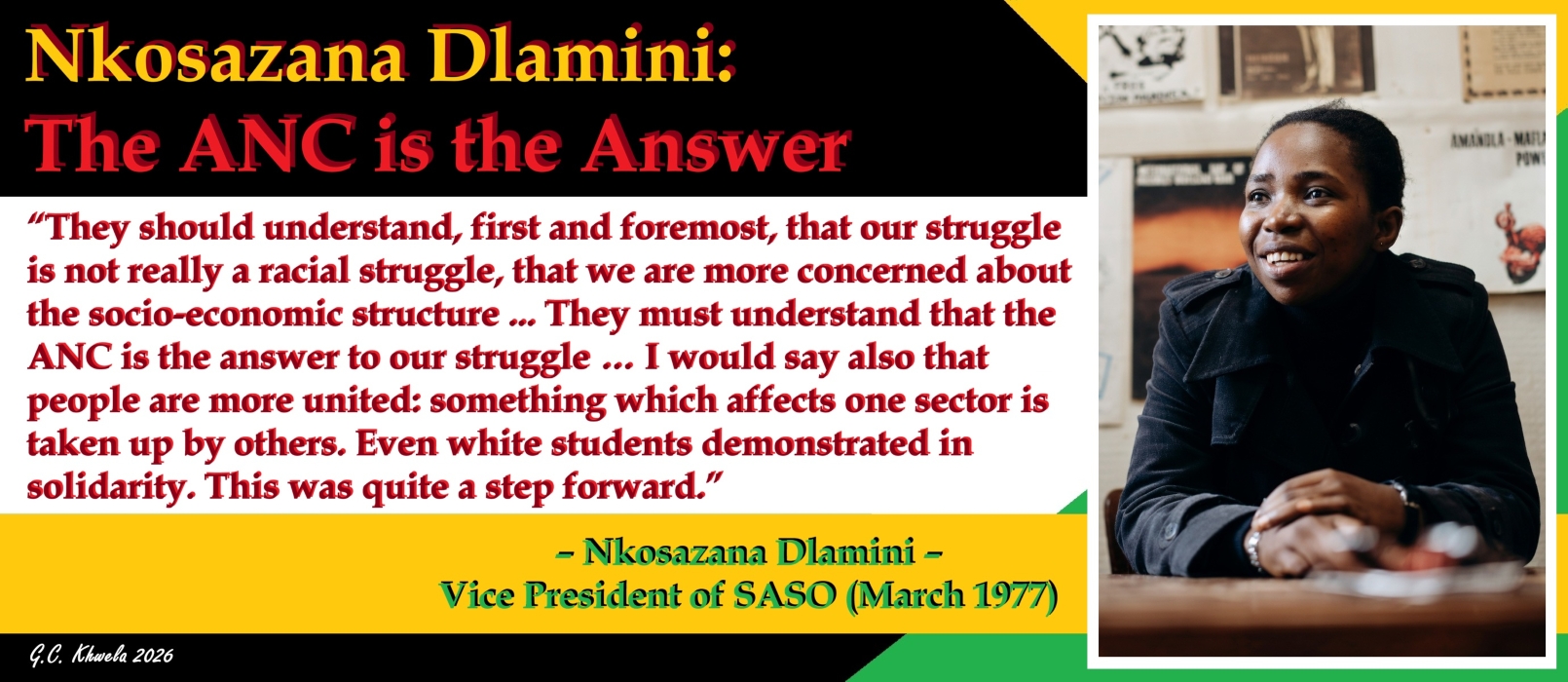
In March 1977, Nkosazana Dlamini, the Vice President of SASO (South African Students Organisation) and a member of the African National Congress (ANC) underground inside South Africa was interviewed by Sechaba, the official organ of the ANC of South Africa. When she escaped the country, Nkosazana was the only member of SASO’s executive not in detention. Dlamini was interviewed while she was representing the Movement in Amsterdam, in the Netherlands, where she was describing the development of political consciousness among the youth of South Africa and the common stand on a number of contemporary issues. The following are excerpts from her interview:
QUESTION: The ferment among young people reached a head just as exams were coming close. Did you not feel worried about getting politically active at this time, and upsetting your exams?
DLAMINI: Well, when the June incidents came, I was already involved. In fact, they broke in the middle of our half-yearly exams – but all the students decided they were not going to continue. I just found myself getting on with my political work. I knew that if it came to the crux, I would have to leave the country. But there was no point in leaving what I had started just for a degree. Even if I passed the degree, I would still suffer the same oppression. It was a feeling that to make something of education – or anything else – there must be a complete political change. We all felt that we should rather concentrate on getting the people mobilized and politicized to bring political change, before we can enjoy education.
The only thought I had was for my parents. You know how important it is for them, if they are putting you through medical school. But the police started harassing them, even before I left the country, so fortunately there were with me. Thousands of parents came to feel the same way, that the struggle was the only alternative.
QUESTION: There is an argument, as expressed by Gatsha Buthelezi [Chief Minister of the KwaZulu bantustan, Ed.], that it is against your own interests to be militant against these institutions because they are helping you. What do you feel about that?
DLAMINI: I think that’s totally wrong. The kind of education we get would not advance anybody. It is meant to create a reservoir of cheap labour, to exploit the people! The idea is to equip us to take instructions from our white rulers, and to cope with the economic demands of the country. It is not to advance us as a nation. The buildings burned were government buildings, symbols of oppression – and there were also bantustan buildings burned – which shows how the people really reject these “homelands”.
QUESTION: Is the feeling against Gatsha Buthelezi and his group very strong among the people of Zululand and Natal?
DLAMINI: Yes – very strong. When he first came up some people were not quite sure, because he had been known before as a militant politician. He himself said he was only taking up a position in the Bantustan framework to prove to the world that the Bantustans are a sham. So, some thought: we cannot dismiss him.
Recently people have seen him for what he is. He has gone out of the country and canvassed for foreign investments for KwaZulu. His party Inkatha met with very strong criticism when it was called Inkatha KaZulu. People felt it was very wrong to start a purely ethnic movement. They have come to realize that one of the main reasons for their defeat in the past was that they were fighting in small ethnic groups – Xhosa wars, Zulu wars and so on. So, they suspect anyone who tries to put one tribal group against another.
When the present uprising started, he said that the policy should deal with the students, and that he would organize vigilante groups to counteract the students. All this has lost him the little support he had. In May there was a big demonstration against him at the University of Zululand when he accepted an honorary degree. Once in Soweto he could draw quite a crowd. Last July (1976) he could not even hold a meeting-there was nobody.
QUESTION: Why in your view was there this sudden rallying over the education issue in June, and then this sustained heroic militant action by the people everywhere? How do they remain so resilient?
DLAMINI: One reason why it has been sustained is that there has, in fact, been a great deal of political work going on before, which brought out the pre-conditions before the outbreak. The June incidents sparked off something among the people who were really prepared and determined to carry on the struggle. Lots of people who left the country did not do so to apply for asylum as refugees. They left determined to acquire the necessary skills to fight, and to help the people in their struggle.
To show that much of the work which has been done has come from the ANC – almost everybody who leaves the country looks for the ANC. They know where to go, they know who is going to give them the necessary skills to overthrow the regime.
As for the older people, they are staying and getting some education in the role they can play as workers in the struggle. Especially in South Africa, we don’t need everybody to be a fighter with a gun. Even initially, during the peaceful demonstrations, parents supported the pupils. It was they who opposed the original introduction of Bantu Education, and the forced introduction of Afrikaans as a medium revived their original rejection of the system.
But what really thrust the parents into action was the brutal police killings. The police had always been ruthless with peaceful demonstrators, but nobody expected the cold-blooded murder of young children. So besides their solidarity with young people, they were angered – and their hatred and rejection of the whole system came to the surface. They were completely with the students in their militancy. Even the workers’ strikes were very successful.
QUESTION: At one point the government tried to use Zulu migrant workers against the demonstrators. What was your view of what happened?
DLAMINI: The government and police were taking advantage for instance of Gatsha Buthelezi’s statement that he was going to organize vigilante groups against the demonstrators. There is evidence that the police went to the township hostels and agitated the inmates. There is also evidence that most people who took part in the “anti -riots” were not really hostel dwellers, but disguised policemen, transported to the scene in police cars. White policemen were heard giving instructions like “don’t destroy the buildings, kill the people only”. Obviously, they were trying to reduce the whole thing to look like a tribal faction fight.
QUESTION: Do organizations like SASO and PBC (Black People’s Convention) still have a role to play? What should that role be? How should they work?
DLAMINI: I think they still have a role. They should concentrate on trying to break the racial and tribal barriers between different oppressed groups.
QUESTION: How do they go about doing this?
DLAMINI: We have lots of community projects ranging from literacy training to home industries, legal aid and medical aid. When we carry out these programs, we also explain to the people why it is they have to be taught basic reading at their age, why they always fall on the wrong side of the law, why their medical services are so poor in other words, how they are affected by the system.
We explain to Africans that Indians and Coloureds are paid more so that the oppressor will be able to divide different sectors of the oppressed people, so they will see their interests as different, and not fight against the oppressor in a group. At our work camps we give talks too. We explain when we are with Coloured people why the whites seem to be favouring them – it is not that the whites see them as better, but just part of the whole process of divide and rule; in fact, they are just as affected as the Africans.
As medical students we ran clinics among all three black groups. Indian, African and Coloured students would go as a team into African, Coloured and Indian ghettoes to demonstrate that we can all work together to help each other, and we can fight the enemy together. So, people begin to see each other as part of an exploited, oppressed group.
QUESTION: In the future, do you think the struggle will take a direction which shows that the people are understanding who the real enemy is?
DLAMINI: Yes – the whole theme of the last SASO conference was the socio-economic structure of the country. There were many commissions to discuss how to explain to the people that the problem lies in the socio-economic structure rather than in racial differences. We felt we could do this, because we now have solidarity. We have consciousness. If we had tried to explain to an apathetic man: the white man is not your problem as such, your problem is capitalism and imperialism – he wouldn’t have known what we were talking about. Now that they are with us – the student body and the mass of people – it is easier to explain the fundamental problems of our struggle in South Africa.
There is lots of literature, some of which is being simplified to reach the ordinary person, with the facts. Some of it is coming from SASO, some through ANC underground.
QUESTION: In recent weeks you have been around Britain and in Europe. You have seen and addressed a number of support movements. If you had just five minutes to sum up the most important things for our Western supporters to realize, and to do, what would you say?
DLAMINI: They should understand, first and foremost, that our struggle is not really a racial struggle, that we are more concerned about the socio-economic structure. They have to stop their governments and others from any form of contact or collaboration with South Africa. They must understand that the ANC is the answer to our struggle. The people inside cannot alone bring about effective change. They need the leadership of the ANC for an armed struggle – which is the only answer.
QUESTION: How do you see the present uprising in the context of the struggle that has been going on over the last few generations?
DLAMINI: I think what is happening now is at quite an advanced stage. The people are fighting at a national level, responding nationally to something which originally affected a smaller group, in one place. Now, if you take the Bambatha rebellion – those people were revolting against the poll tax, but the revolt never spread around the nation. I would say also that people are more united: something which affects one sector is taken up by others. Even white students demonstrated in solidarity. This was quite a step forward.
The way the resistance has been sustained shows that our people are more determined. Also, in the past, students have demonstrated alone and workers never joined them, while workers have struck and students never realized that the strike was part of the national struggle. Now, people have got together. Also, many people have realized they have got to go out of the country to join the ANC so that they can train and return to fight.
QUESTION: Do you think the regime will buy over a small group who will seize the chance to make money out of the situation, and form the core of a bourgeoisie in the Bantustans?
DLAMINI: Well, it might happen, but the only people who would benefit are a few cabinet ministers and a few businessmen. They look towards the “homelands” because that is where they can develop their interests and make money. They are the only ones supporting the Bantustan policy. The rest of the people are not. Maponya, Soweto’s only millionaire, went to stay in an international hotel in Johannesburg during the Soweto uprisings because he was afraid the people might harm him. He was quite aware that the people no longer identify their enemies by their skin. I don’t think the regime has time to build up a middle class or bourgeoisie, because the people are already determined to fight. Maybe if they had started much earlier…
QUESTION: Would you say that in South Africa in general, the people’s strengthening resistance is really the white government’s own fault – because through Bantu Education, they have tried to force an obviously inferior and oppressive form of education on the people, and it is bouncing back on them?
DLAMINI: If you look at the earlier generations – those who were educated under the more British type of system, you will see that they tended to be more on the passive side. They seemed to feel they could be assimilated into the British way of life. But Bantu Education spells everything out – and now it’s coming back to hit the people who introduced it! I think if we had been left with the British type of education, a middle class might have been created by now. But Bantu Education has made the lines of confrontation sharper.
QUESTION: You were a speaker at the Emergency Solidarity conference in Addis Ababa. What is your impression of African continental support for ANC?
DLAMINI: I had the impression of very wide support for the ANC. It is really encouraging – if they can keep it up, and it does not end in the conference room.
Sources:
South African History Online (SAHO).
Southern Africa, “Soweto Student Speaks Out: Interview with Nkosazana Dlamini, Vice President of SASO”, Southern Africa, Vol. X, No. 2, March 1977.
Sechaba, “The ANC is the Answer: Interview with Nkosazana Dlamini”, Sechaba, Second Quarter 1977.
Castro Khwela
Good morning fellow Compatriots!🙏🏾✊🏾👊🏾
Discover more from CASTRO KHWELA
Subscribe to get the latest posts sent to your email.