Implementing the Kabwe Conference Resolutions: Operation Vula
On 10 May 1986, the National Executive Committee (NEC) of the African National Congress (ANC) convened to assess the implementation of the Kabwe Conference’s resolutions that senior members be sent into the country to provide leadership of the mass movement. Unfortunately, this was not the first follow-up since the conference, and again there was little progress to report on.
In June 1985, during the 2nd National Consultative Conference held in Kabwe, Zambia, from 16 to 25 June 1985, the Strategy and Tactics Commission began setting up a drafting committee consisting of Pallo Jordan, as Chair, Simon Makana, Mac Maharaj and Joe Slovo, among others, to draw up a formal Strategy and Tactics document on the commission’s behalf that could be circulated within the movement at a later date. Although they were unable to deliver a full Strategy and Tactics document at the time, the commission did manage to deliver a draft document for the conference’s consideration.
A number of recommendations were made, including some concerning the Bantustans and bringing the workers into the struggle in greater numbers. The final recommendation read: “We can no longer allow our armed activities to be determined by the risk of civilian casualties. The time has come when those who stand in solid support of the race tyranny and who are its direct or indirect instruments, must themselves begin to feel the agony of our counter-blows. It is becoming more necessary than ever for whites to make it clear on which side of the battle lines they stand.”
Meanwhile, the Commission on Internal Mass Mobilisation issued its completed report to the conference, recommending the establishment of Area Political Military Committees inside the country in order to ensure that presence of an all-round political and military leadership in all areas of the country. It further recommended that ‘The ANC should be present in all public organisations. Operatives manning the PMC’s should consistently go inside the country to get first-hand information on the situation’.
Mac Maharaj was concerned about the failure to implement conference resolutions and approached Joe Slovo, Chris Hani and Jacob Zuma to say the National Executive Committee consisted of 30-odd persons, and could not implement sensitive resolutions. Alternatively, what needed to be done was to move a resolution empowering the president to be in charge of that area of work and not to disclose the details before the entire NEC. The three then approached Oliver Tambo, who proposed the matter be raised in the meeting. The resolution was adopted leading to the establishment of a special committee comprising of Oliver Tambo and Joe Slovo, who were empowered to conduct the work without reporting to the NEC, unless they wished to do so.
Oliver Tambo indicated that he wanted the meeting to be clear, that the president was given powers which were not properly understood. Tambo then started jabbing his finger randomly at the people in the room: “You, it means I can send you and you have no reason to refuse my orders and I can put restrictions where you are not to tell a single other member what you are doing?” Because of the sensitivity of the task, Mac Maharaj suggested that the tasks should be left to volunteers, and Tambo objected, and said he would handle it in his own way.
Subsequently, Siphiwe Nyanda was called to Oliver Tambo’s office in Lusaka wherein he was told that he was going to be part of a very sensitive mission, known only to a few people. The mission was to establish an ANC leadership core within the country, codenamed “Operation Vula”, that was to include Joe Slovo and Mac Maharaj. After meeting with Oliver Tambo, Nyanda met Slovo and Maharaj, and was told that he should remain in Lusaka until he had to go to East Germany on intelligence course.
Operation Vula (meaning “open the way” in isiZulu, short for “Vulindlela”) was envisioned in 1986 as a top secret high-level strategic initiative to create an internal, secure underground leadership structure to lead a national insurrection against the apartheid regime. The operation was spearheaded by Mac Maharaj and Siphiwe Nyanda under the guidance of Oliver Tambo and was designed to turn the “unprecedented opportunities” of the 1980s uprising into a decisive battle for power.
It was Tambo who selected the operatives and sent them inside to work underground politically, among the various opposition organisations burgeoning at home. Joe Slovo was instrumental in reorienting the Politico-Military Council (PMC) for insurrection. The Operation was conceived as part of the “People’s War” strategy to bring senior leaders, who were previously based in exile, directly back into South Africa to oversee the final, most violent phase of the armed struggle.
Key aspects of how Vula was envisioned included the establishment of an internal underground leadership. The primary goal was to move key ANC and South African Communist Party (SACP) leaders back into South Africa to directly direct, command, and manage the armed struggle, overcoming the strategic limitations of operating from distant exile bases. Vula was designed to establish a secure communication infrastructure, which was a highly secure, technologically advanced, encrypted communication system (using computers, codewords, and secret codes) to allow communication between top leadership inside the country, in exile, and in prison.
Furthermore, Vula envisioned an armed insurrection and arming the masses, which was aimed to move beyond isolated acts of sabotage and towards a “People’s War” that would lead to an insurrectional assault against the apartheid state. Therefore, Vula was tasked with establishing secure methods for bringing in Umkhonto we Sizwe (MK) personnel and large stocks of weapons (like AK-47s, hand grenades) into the country, which had previously been a major logistical failure.
The strategy was intended to break down apartheid authority in townships, destroy administrative structures, and create “liberated zones” where the liberation movement would have control. The intention was that Vula was to act in concert with popular mass mobilisation, providing a specialized and professional military leadership to work with the political uprising, aimed at intensifying the struggle. In 1987, some restructuring of personnel took place: Steve Tshwete was moved from Military Headquarters to head the Internal PC of the PMC, responsible for mass organisations; Chris Hani resumed his post as Commissar; and Tim Ngwenya (aka “Bra ‘T’”) was pro-moted to Chief of Staff.
When envisioning Operation Vula, the leadership of the Movement identified several critical strategic and operational challenges that had historically hindered the liberation struggle. The primary challenges identified included the geographic isolation of leadership, which was viewed as a major weakness, particularly the physical distance between the top leadership in exile (Lusaka) and the masses driving the uprising inside South Africa. This made it difficult to provide real-time strategic direction.
Other challenges included insecure communication, since previous operations suffered from slow and insecure communication lines. Leadership recognised the urgent need for a sophisticated, encrypted system to link internal units with exile headquarters and leaders in prison. Moreover, the movement was plagued by apartheid security force spies. Vula was designed with extreme secrecy, even within the ANC itself, to mitigate the risk of betrayal. The other challenges included logistical failures in arming the struggle. Earlier attempts to smuggle weapons often resulted in material falling into the hands of the security forces. Leadership identified the need for more professional logistics to create potentially armed structures.
Politically and strategically, there was a lack of coordination between the various pillars of the struggle. This was a long-standing item in the history of the liberation effort, the unfortunate tension between political and military programmes, and a lack of coordination between armed actions and popular mass mobilisation. This was compounded by the factor of hostility from bordering states. By the late 1980s, Frontline States, such as Swaziland, Lesotho, Botswana and Mozambique, were under intense pressure from the apartheid regime to expel ANC operatives, making traditional infiltration routes extremely dangerous. Largely, there was a high risk of death for operatives, which was notably calculated to only a five percent chance of survival for those involved in internal operational missions.
In order to address the challenges relating to Operation Vula, the leadership identified several critical success factors necessary to transform the struggle into a decisive insurrection, which primarily included the establishment of an internal command structure. This became a non-negotiable factor, the physical presence of senior leadership within South Africa to provide “on-the-spot” strategic direction, closing the gap between the exiled leadership in Lusaka and the masses, as well as the coordination of armed actions and popular mass mobilisation.
Furthermore, the development of a purpose-built, encrypted communication system was seen as the number one requirement. Success depended on a single, reliable channel that could securely link internal activists, the leadership in exile, and those in prison. And to prevent the infiltration that had crippled previous efforts, Vula was envisioned as a President’s Project – under the direct leadership and command of Oliver Tambo. Knowledge of the Operation was restricted to a very small core of leaders, ensuring its survival even if other ANC structures were compromised.
Success was not going to be defined by immediate operations and conflict, but by the ability to smuggle and store large quantities of weaponry in secret safe houses. This created a military capacity that could be activated instantly if negotiations failed. Moreover, the integration of the pillars of the struggle, especially to finally unify the four pillars of the ANC’s strategy, the underground structures, mass mobilisation, armed actions, and international pressure, was made to be a major priority.
All these depended on the ability to successfully smuggle high-profile leaders like Mac Maharaj and Siphiwe Nyanda back into the country without detection, which became the initial benchmark for the operation’s viability. Leadership identified that revolutionary pressure must feed the prospects for negotiations. Success for Operational Vula was envisioned as providing the liberation movement with an insurance policy that improved their bargaining power during negotiations and the transition. To ensure the successful implementation of Operation Vula, Nyanda and Mac Maharaj underwent highly specialized training that focused on both conventional military leadership and unconventional underground tradecraft.
Their training was designed to allow them to operate as autonomous, high-level commanders within a hostile environment. Key areas included advanced military and combat work, and Nyanda, specifically, underwent an advanced officer-level commander’s course and an artillery course. This was supplemented by training in conventional drills and basic combat to ensure they could lead military structures if the struggle escalated into open insurrection. Moreover, they were trained in Military Combat Work (MCW), which included sophisticated skills for individual operations, such as photography and secret writing – for documentation and secure data transfer; hiding places and Dead Letter Boxes (DLBs), which were techniques for concealing themselves, weapons, and communications; as well as booby trapping and engineering (handling explosives).
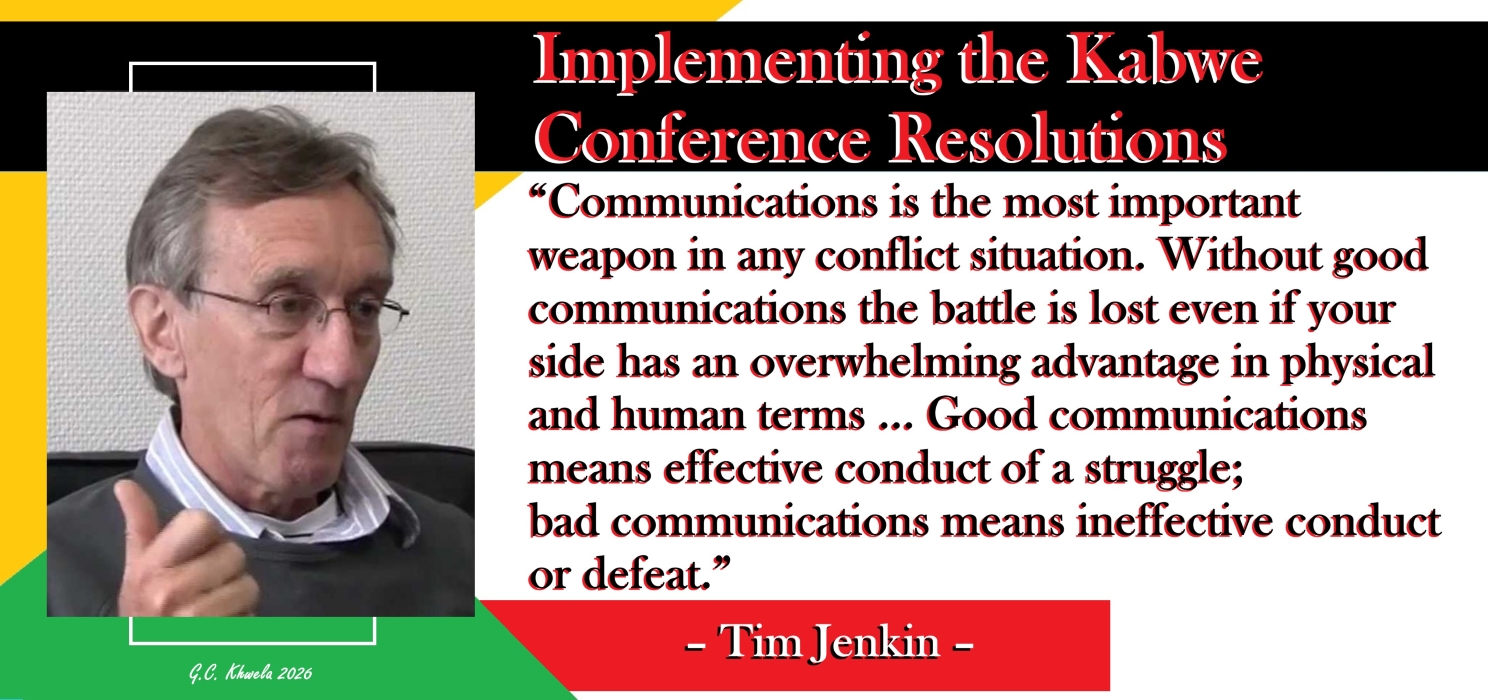
The course also included secure communications and cryptology, which was a cornerstone of their preparation to master the encrypted computer communication system developed by Tim Jenkin. They were trained to use personal computers and modems to transmit messages via international telephone lines, replacing slow and insecure manual book codes with advanced numerical ciphers. In order to enter South Africa undetected in 1988, they were trained in the use of sophisticated disguises – including high-quality wigs and facial alterations – and the maintenance of false identities to navigate security checkpoints.
Their training emphasised strict adherence to the “need to know” principle and extreme secrecy. Accordingly, they learned to operate in a way that kept their presence hidden even from other senior members of the ANC to prevent discovery by the apartheid security forces. This training combined the rigour of Eastern Bloc military instruction (Nyanda trained in the Soviet Union and East Germany) with innovative technological solutions tailored specifically for the South African context.
Operation Vula, which was code-named the President’s Project, was first mentioned at an NEC meeting in 1987, wherein no minutes were taken of Oliver Tambo’s remarks. He indicated to the leadership that he had set out to establish a beachhead inside the country. The subsequent report was tabled in 1988, wherein Tambo announced that he had drawn Joe Slovo into running the project – again, no minutes were taken. Tambo made it his solemn duty to protect the people under his care by ensuring that he prioritised security concerns and secrecy over open debate.
Sources:
Wikipedia.
South African History Online (SAHO).
ANC, “2nd National Consultative Conference: Report, Main Decisions and Recommendations”, African National Congress, 22 June 1985 (https://www.anc1912.org.za/national-consultative-conference-1985-report-main-decisions-and-recommendations/)
Mac Maharaj, “Chapter Nine: Tactics of Talks Tactics of Confrontation”, The Road to Vula, July 1985 – December 1986, Nelson Mandela Foundation.
Tim Jenkin, “Talking with Vula: The Story of the Secret Underground Communications Network of Operation Vula”, Mayibuye Archives: University of the Western Cape, 1995.
Rocky Williams, “The Other Armies: A Brief Historical Overview of Umkhonto We Sizwe (MK), 1961-1994”, Military History Journal, Vol 11, No 5 – June 2000.
Luli Callinicos, “Oliver Tambo: Beyond the Engeli Mountains”, David Philip, 2004.
Thula Simpson, “Umkhonto we Sizwe: The ANC’s Armed Struggle”, Penguin, 2016.
Henning van Aswegen, “Operation Vula – A Deadly Miscalculation”, Nongqai Books, 28 December 2025.
SAHA, “The Movement is Very Big Now”, South African History Archives (SAHA), (https://www.saha.org.za/nonracialism/the_movement_is_very_big_now.htm) Accessed 10 May 2026.
Castro Khwela
Good morning fellow Compatriots!🙏🏾✊🏾👊🏾
Discover more from CASTRO KHWELA
Subscribe to get the latest posts sent to your email.