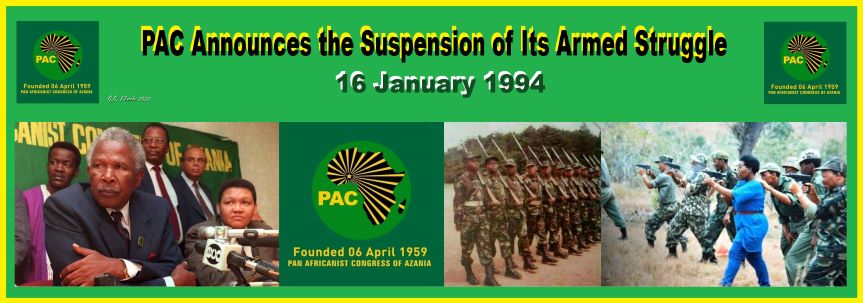
On 16 January 1994, the Pan-Africanist Congress (PAC) President, Clarence Mlami Makwetu, announced the PAC’s suspension of its armed struggle, thus opening the way for participation in elections by its members.
Making the announcement, Makwetu maintained that the PAC leadership took full responsibility for the decision by the Azanian People’s Liberation Army (APLA) guerillas to target white civilians in the early 1990s, since targets were chosen by local APLA commanders without consultation with the organisation’s leaders in Dar-es-Salaam. The announcement by Makwetu therefore marked the cessation of armed hostilities between the liberation movement and the apartheid government.
The PAC was formed on 5 and 6 April 1959 by a group of disgruntled African National Congress (ANC) members in Orlando, Soweto. The breakaway group was led by members of the so-called Africanist movement, as it objected to the ANC’s Freedom Charter assertion that “the land belongs to all who live in it both white and black” and also rejected a multi-racialist worldview, instead advocating a South Africa based on African nationalism. They insisted that the historic mission of the PAC of The People of Azania was the complete freedom, liberation and independence of Afrika, which entailed political, social, economic and military independence.
With the ANC and the PAC banned and African political activity officially limited to government-appointed bodies in the homelands, people sought alternative means to express their political aspirations. This led to a period of exile and the turn to armed struggle by the Azanian Peolple’s Liberation Army (APLA) and Umkhonto we Sizwe (MK), military wings of the PAC and ANC respectively. Along with the ANC, the PAC was the only “official” South African liberation movement recognised by the United Nations (UN) and by the Organisation of African Unity (OAU), which implied that the movement received support from countries internationally and from the African continent.
The armed struggle, which was begun early in the 1960s, was intensified in the second half of the 1970s through to the early 1990s. During the Frederik Willem de Klerk period, militant PAC leaders, especially leader Zephania Mothopeng, rejected appeals by Mandela and by Zimbabwe’s President Robert Mugabe for the PAC leader to join Mandela in pursuing negotiations in Pretoria.
However, in April 1992, PAC President Makwetu declared during the PAC’s Annual Congress that his party would not oppose participation in the multi-racial negotiations to end apartheid. In spite of the PAC’s failure to achieve its goals at the negotiations, which rejected outright Mandela’s proposals for a multiracial government and demanded black control over future decision-making institutions, the PAC eventually decided to participate in the 1994 elections, thus ordering APLA to end its armed struggle.
Rejection by the PAC to participate was largely due to the draft constitution published on 26 July 1993, which contained concessions to all sides in the political landscape – a federal system of regional legislatures, equal voting rights regardless of race, and a bicameral parliament. However, the negotiators were undeterred by the storm of protests that followed, and they went ahead to establish a Transitional Executive Council (TEC), a multiracial body that would share executive responsibilities with President de Klerk’s apartheid government during election preparations.
This led to the formation of the Concerned South Africans Group, or COSAG, which was a group established by Inkatha Freedom Party (IFP) leader, Chief Mangosuthu Gatsha Buthelezi, other Bantustan and Afrikaner Right-wing leaders whose power bases were eroding. COSAG was against the Record of Understanding within the Convention for a Democratic South Africa (CODESA), and it boycotted the TEC and formed the Freedom Alliance, which was supported by the PAC to demand equal status with the government and the ANC.
Still, the multiracial TEC was installed in December 1993, as part of the executive branch of the government – over objections of the Freedom Alliance and the PAC. The anti-election Freedom Alliance began to unravel in early 1994, when white conservatives stepped up their demand for a separate, whites-only homeland.
Sensing new momentum, however, the apartheid government cracked down on right-wing violence and tried to reason with white extremists, without slowing the pace of election preparations. Other Bantustan leaders broke away from the Alliance, as their unstable governments began to crumble.
With the Freedom Alliance severely weakened, PAC President Clarence Makwetu, who was also against the elections at the time, announced the organisation’s suspension of its armed struggle, thus opening the way for election participation by its members and for the inclusion of APLA members in a National Peacekeeping Force and ultimately the South African National Defence Force (SANDF).
Castro Khwela
Good day fellow Compatriots!
Discover more from CASTRO KHWELA
Subscribe to get the latest posts sent to your email.