“If it is true that a revolution can fail even though it is based on perfectly conceived theories – nobody has yet made a successful revolution without a revolutionary theory.” – Amilcar Cabral
At the very beginning of the 1960s when one African country after another acquired independence and many people began to think that prospects for consistent decolonisation were more favourable than ever before, Amilcar Cabral started to speak about a crisis that had gripped the African revolution.
At the Third Afro-Asian Peoples’ Solidarity Conference in Cairo in March 1961, he said, “It seems to us that this is not a crisis of growth, but chiefly, a crisis of consciousness. In many cases the practice of the liberation struggle and its future prospects have no theoretical basis and are also out of contact with reality to one degree or another. Local experience and the experience of other countries accumulated during the struggle for national independence, the consolidation of national unity and the building of foundations for progress have been or still are forgotten.”
According to Cabral, the successful development of the anti-imperialist struggle depended on a concrete knowledge of the actual state of affairs in every country and Africa as a whole, and also the experiences of other peoples and the formulation of science-based strategic principles.
In Amilcar Cabral’s opinion, the essence of the crisis of the African liberation movement was that in many countries it had not followed the revolutionary path and that the aspirations of the masses were thwarted by illusory independence which concealed new forms of neocolonialist exploitation. His ideal was the transformation of the national liberation movement into a revolution which would resolutely and fully liquidate all forms of imperialist oppression and also abolish inequality and exploitation sprouting on local soil.
Like many other fighters for true independence, Amilcar Cabral followed Lenin’s teaching that imperialism was the highest stage of capitalism. He looked upon colonialism as a natural product of the capitalist economy, a result of the policy of state-monopoly capitalism and the striving of the super-monopolies for regular and high profits. Hence the conclusion: so long as the capitalist system of economy exists, its expansion into the backward countries continues and only the forms of exploitation change. From classical colonialism the industrialised capitalist countries turn to neocolonialism.
Amilcar Cabral studied the forms of neocolonialist exploitation and emphasised that imperialism’s strategic objective in the new conditions was to use “assistance” to the former colonies as a means of creating a pseudo-bourgeoisie there and thus slow down the revolution and increase the potential of the bourgeoisie as a force that neutralises the revolution. In other words, in an era when direct political diktat becomes impossible, imperialism’s objective in the developing countries is to abet the local exploiting elements which, in contraposition to the revolutionary path, pursue a policy of national reformism and conciliation with international capital.
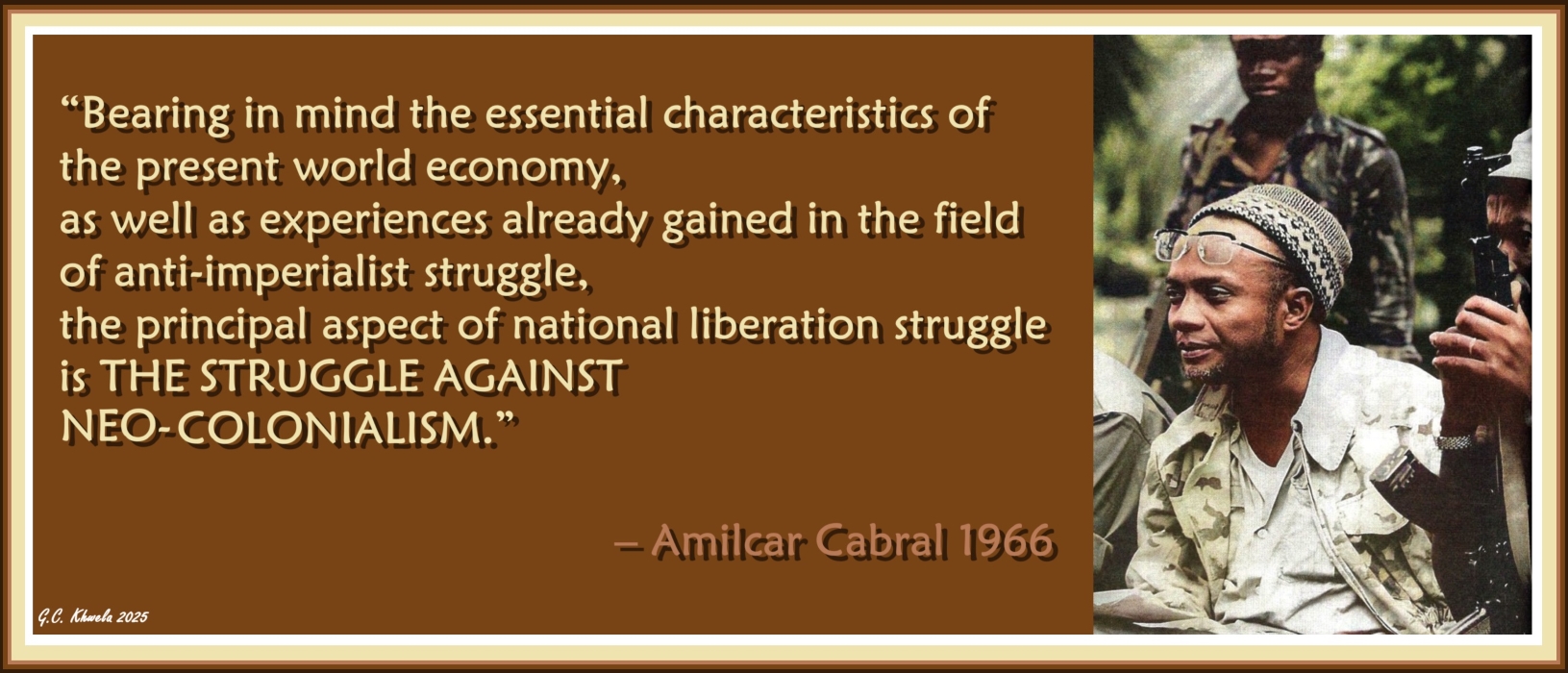
That is why Amilcar Cabral regarded the anti-colonial movement as a means of emancipating the national productive forces from every direct or indirect exploitation. Cabral stressed in particular that THE MAIN ASPECT OF THE NATIONAL LIBERATION STRUGGLE WAS THE STRUGGLE AGAINST NEOCOLONIALISM.
Extracted from Rostislav Ulyanovsky, “The African Communist”, No. 99, Fourth Quarter, 1984.
VIVA AMILCAR CABRAL! HERÓI DO POVO AFRICANO!
UM NOTÁVEL REVOLUCIONÁRIO E INTERNACIONALISTA AFRICANO DOS NOSSOS TEMPOS!
Castro Khwela
Good morning fellow Compatriots!🙏🏾✊🏾👊🏾
Discover more from CASTRO KHWELA
Subscribe to get the latest posts sent to your email.