On 27 January 1973, the Paris Peace Accords, officially termed as the “Agreement on Ending the War and Restoring Peace in Viet Nam” were signed. This was a peace agreement to establish peace in Vietnam and to end the Vietnam War, which was scheduled to take effect at 08:00 the following day. Signatories to the agreement included the governments of the Democratic of Vietnam (North Vietnam), the Republic of Vietnam (South Vietnam), the United States of America, and the Provisional Revolutionary Government of the Republic of South Vietnam (PRG), which represented the South Vietnamese revolutionary liberation movement.
Already in 1969, United States ground forces had begun to withdraw from Vietnam after suffering from deteriorating morale during the withdrawal. Those that remained behind during the beginning of 1972 had very little involvement with the various combat operations. Actually, the last American infantry battalions had been withdrawn in August 1972, while most air and naval forces, as well as advisers, were gone from South Vietnam by the time the Paris Peace Accords were signed. However, some of the air and naval forces not based in South Vietnam were still playing a large role in the war which continued just before the signing of the Accords. Therefore, the Paris Peace Accords removed the remaining US forces from Mainland Southeast Asia. This implied that direct United States military intervention came to an end, and fighting between the three remaining powers temporarily stopped for less than a day.
As United States forces’ casualties had mounted throughout the conflict since 1965, American domestic support for the war had deteriorated, and by late 1972 there was major pressure on the Nixon administration to withdraw from the war. Consequently, the United States brought great diplomatic pressure upon their ally in South Vietnamese to sign the agreement while Nixon pledged to provide continued substantial aid to South Vietnam. The negotiations that led to the Accord began in 1968, after various lengthy delays. The main negotiators of the agreement were US National Security Advisor, Henry Kissinger, and the and the North Vietnamese Politburo member Lê Đức Thọ. Both men were awarded the 1973 Nobel Peace Prize for their efforts, but Lê Đức Thọ refused to accept it.
Although, the signing of the Paris Accords did not bring an end to the fighting in Vietnam, they were a final phase towards the victory of the people of Vietnam. The reactionary regime in south Vietnam made a determined effort to eliminate the national revolutionary forces remaining in the south, while in the north leaders continued to strengthen their military forces in preparation for a possible future confrontation.
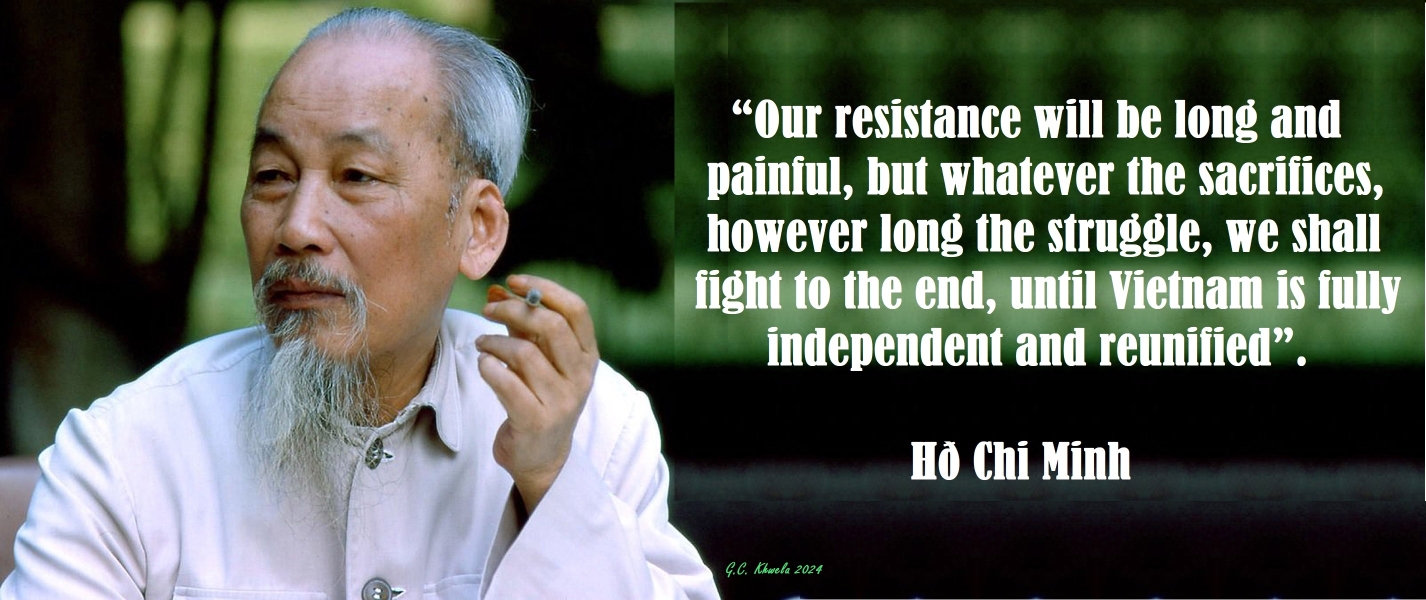
By late 1974, the revolutionary people’s government in the north had decided that victory could be achieved only through armed struggle. Accordingly, during the early part of the following year, 1975, North Vietnamese troops launched a major offensive against the south. The reactionary forces in the south retreated in panic and disorder, and their leaders ordered the abandonment of several northern provinces. However, their efforts to stabilise the situation were too late, and on April 30, 1975, the revolutionary forces, under the leadership of General Võ Nguyên Giáp, entered Saigon in triumph. The Second Indochina War was finally at an end.
What are the lessons can we learn from the Vietnam national liberation struggle?
According to a report published in Sechaba (May 1973) of the African delegation of the World Peace Council that visited Vietnam after the signing of the Paris Peace Accords, which Alex La Guma of the African National Congress’ (ANC’s) External Mission was part of, “For those engaged in the national liberation struggle in their own countries, Vietnam had many lessons to offer:
“That in order to win, the whole people must be drawn into the struggle; that in spite of difficulties and hardship, the people’s organisation survived; people were organised from street to street, from district to district up to the city level; that here was complete co-operation between the people and their elected leaders and the army; that there was co-operation between the urban population and the people of the countryside.”
“… But the struggle could never have become so all-embracing and never have been brought to a successful conclusion without the spirit of patriotism and a programme capable of giving the masses a clear understanding of what they were fighting for. In the South, the National Liberation Front welded the people together in the struggle against imperialist aggression, for a peaceful, independent and democratic South Vietnam.”
“’Imperialism cannot afford a direct confrontation with the Socialist powers, therefore they chose the front of national liberation’, said a representative of the Vietnamese people. ‘I it had been able to push back the forces of liberation in Vietnam, it would be able to destroy the liberation movements in other parts of the world. It is necessary for world imperialism to ponder over the advancement the people have made at this stage of world history.’”
“Vietnam has proved that a people fighting for freedom and independence, relying on the support of the revolutionary and progressive forces all over the world, cannot be overwhelmed. Such a people is invincible.”
“Lessons of Vietnam”, Sechaba, Vol. 7 No. 5, Special Issue (May 1973).
Castro Khwela
Good morning fellow Compatriots!
Discover more from CASTRO KHWELA
Subscribe to get the latest posts sent to your email.