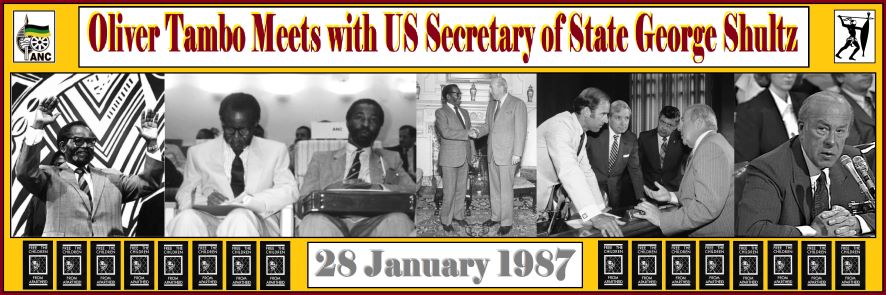
On 28 January 1987, Oliver Tambo, President of the African National Congress (ANC), met with the United States Secretary of State George P. Shultz in Washington D.C. to use American influence to press other Western countries to impose economic sanctions on South Africa, at least as strong as those enacted by Congress over President Reagan’s veto. Emerging from a 50-minute meeting with Shultz, Tambo said he had also urged a broadening of the American sanctions.
The meeting marked the first time any Secretary of State had met with the ANC leader Tambo, whose organisation advocated for an end to apartheid in South Africa, was banned by the racist Pretoria authorities. It also was an indication that the United States recognised the ANC as a central factor in the South African struggle and was willing to engage in discussions with the organisation.
George Shultz held the meeting amid criticism from conservatives, who condemned the ANC as a “pro-Soviet terrorist” organisation. The Secretary addressed these two issues at the outset of the discussions, according to the State Department spokesman, Charles E. Redman. He said that Shultz had “laid out our concerns about the degree of Soviet influence in the ANC” and the group’s use of violence.
Oliver Tambo, on the other hand, called it “a very serious and substantive meeting”, and Redman used the same characterisation. “We found there was a large area of agreement on the nature of the apartheid system, on the need to abolish it, and we are considering together the ways of achieving this”, Tambo said. He criticised the US Administration’s “constructive engagement” policy, under which Washington had sought to exert quiet pressure on South Africa, as “unhelpful” in combating apartheid.
Although George Shultz’s stated purpose was to explore the possibility of an American role as a broker in the South African conflict, State Department officials acknowledged that the meeting was largely symbolic and, in part, an effort to defuse criticism of American policy by black African leaders.
In an unusual show of force, dozens of uniformed policemen were stationed in and around the diplomatic entrance to the State Department, and the adjoining street was closed to traffic along the full length of the building. Secretary Shultz’s decision to meet with Oliver Tambo drew strong criticism from the Conservative Caucus, which condemned the ANC for both its use of violence and its ties to the Soviet Union. Senator Bob Dole, Republican of Kansas, said that he feared that the session would be seen as “showing approval for terrorism”.
Charles Redman emphasised the Secretary of State’s desire “to work with all of the parties, to bring them together so they can start talking”. The South African authorities had refused to negotiate with the ANC. The session with Secretary Shultz came at a time when relations between Washington and Pretoria were at a low point and American influence with the apartheid South African government appeared to be practically non-existent. Michael Armacost, U.S. Undersecretary of State for Political Affairs, met with top leaders of the ANC on 21 December 1986, which the United States regarded as “the main guerrilla force seeking to overthrow the white-minority government in Pretoria”.
During his visit to Washington, Oliver Tambo had endorsed the use of violence in the struggle against apartheid. “Apartheid is inherently a practice of violence”, he said in a speech at Georgetown University on the same day of the meeting with the Secretary of State. “We choose not to submit but to fight back, arms in hand. We have no alternative but to intensify our armed resistance because, as your Declaration of Independence says, in the face of systematic tyranny, it becomes a duty and a right to take up arms.”
He told reporters that the ANC was indebted to the Soviet Union for providing arms, but he stressed that non-military assistance had also come from Norway, Sweden, Italy, the Netherlands and other Western countries.
For Oliver Tambo, the time had come for the United States to review its policy towards southern Africa, as it had the potential to make an important contribution towards resolving some of the challenges affecting the region. In essence, Tambo correctly believed that “these problems should not be viewed through the distorting prism of the East-West conflict”.
As a suggestion, Tambo asked “why does not the United States meet the Soviet Union and discuss together how they could cooperate to help bring about a new system?” Secretary of State Schultz shockingly accepted the proposition and told Tambo that at the next United States meeting with the Soviet Union, which was forthcoming, he would raise the issue there.
In his speech at Georgetown University, Tambo extended gratitude to “the American people as a whole for moving Congress not only to pass sanctions against apartheid South Africa but also to override President Reagan’s veto”. He emphasised the possibility for United States to move “to save hundreds of thousands more lives by acting to help bring about the dismantling of apartheid and the establishment of a non-racial and democratic society in South Africa”, just as it did when it provided aid that helped to save millions of lives during the great drought in Africa.
At the conclusion of his engagements, Tambo declared that “We, for our part, are ready to deal with the United States government honestly and openly for the sake of the cause of justice in our country and peace in southern Africa… We shall live up to that responsibility and expand the frontiers of democracy to our country as well. To carry out this task, which faces all humankind, we count on your support. We’re certain you’ll not fail us!”
Castro Khwela
Good morning fellow Compatriots!
Discover more from CASTRO KHWELA
Subscribe to get the latest posts sent to your email.