
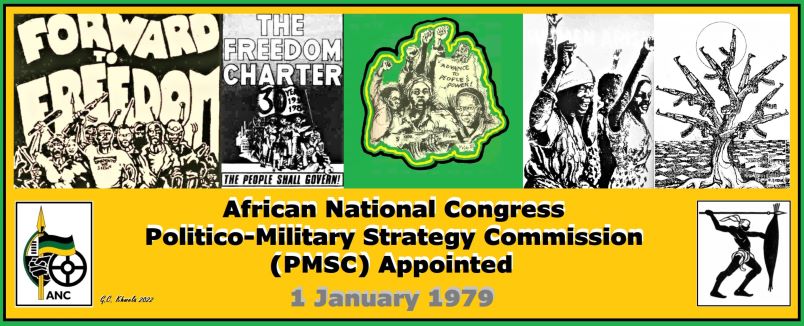
On 1 January 1979, a Politico-Military Strategy Commission (PMSC) was appointed at a Special African National Congress (ANC) National Executive Committee (NEC) Meeting in Luanda, Angola, following the visit to Vietnam by a small delegation, led by ANC President Oliver Tambo, in October 1978.
A copy of the report on the Vietnam visit was presented to that NEC meeting in Luanda, from 27 December 1978 to 1 January 1979, to consider the ANC’s strategic impasse. The context of the meeting was to consider the report on the Vietnam visit and to appoint a PMSC to review the ANC strategy, tactics and operational structures.
The composition of the PMSC combined both political and military leadership, which consisted of Joe Slovo, Thabo Mbeki, Joe Modise, Moses Mabhida, and Joe Gqabi, who had just been released from Robben Island.
Furthermore, the PMSC also had to reflect on the Communist Party’s (SACP’s) crucial role within the ANC-led national liberation struggle, notably in its operational structures. What the NEC expected of the PMSC was that it should develop a report to be presented in March of that year in which it was to address the strategic trajectory of the liberation struggle and particularly the role of the armed component within that struggle.
As expected, the PMSC did present a report in March and most, but not all, of its central recommendations were formally adopted as the “Green Book” by the ANC five months later in August 1979. This heralded the second stage of the strategic review after the Morogoro Conference.
The NEC endorsed the four strategic lines recommended by the PMSC. They were that the ANC should: elaborate an over-all strategy based on the mobilisation of ‘the masses’ inside South Africa; create the broadest possible national front of organisations and people inside the country for national liberation and win this front into alignment with the ANC’s objectives; draw into ANC underground structures those promising activists thrown up in popular organisations and anti-apartheid struggles; and accept that military operations evolved out of political activity and should be guided by the needs and level of political mobilisation and organisation.
Of these, the PMSC identified political mobilisation and the creation of a broad front of organisations, as requiring most urgent attention. It reasoned that the ANC had to relate politically to the majority of its potential constituency. This meant becoming deeply involved in popular organisations operating in the legal and semi-legal spheres.
The major theme of the PMSC report was that the ANC had to make a deliberate turn to the masses for the purpose of teaching them and learning from them. The ANC had for too long acted as if the repressive conditions made mass legal and semi-legal work impossible. The militaristic vanguardism of the past had manifestly failed.
To realise this breadth, the PMSC said that ANC activists would have to be present wherever and whenever people took action against apartheid repression in order to steer popular organisation in a revolutionary direction. Building the front was to be the primary task of the ANC underground for the foreseeable future.
Clandestine forms of political work would remain a necessity because of the ANC’s illegality. But the popular movement would provide the basis for the growth of the underground. The underground would then be able to identify within the ranks of the popular movement a number of recruits to its ranks.
The ANC and its allies, the SACP and the South African Congress of Trade Unions (SACTU), had to stand at ‘the core of the revolutionary struggle’ that had to maintain ‘its independence’ in relation to the envisaged broad front.
The PMSC suggested that a campaign should be launched to re-popularise the ANC’s vision contained in the Freedom Charter. For its part, Umkhonto we Sizwe (MK) should choose targets highlighting demands made in the ‘Freedom Charter’.
The ANC highlighted in its strategic review that its emphasis on armed activity had failed to foster an organised domestic political base. Yet it needed such a base in order to wage a sustained armed struggle. The ANC concluded, therefore, that its stress on armed activity had, paradoxically, undermined its ability to mount a sustained revolutionary armed struggle.
The intention was to harness the various efforts into a single struggle which would be represented by a front led from the underground by the ANC, a struggle which would progressively transform itself into a popular armed challenge for state power.
What struck the ANC delegation during their visit to Vietnam, which also had a huge impact on the PMSC’s report, and ultimately the Green Book, was the manner in which the Vietnamese had embraced the notion that a revolution should “walk on both feet”, the one political and the other military. This contrasted strongly with the strategic presumptions that were persued prior to the visit, which made the armed struggle the basis of the political struggle.
Castro Khwela
Good day fellow Compatriots!
Discover more from CASTRO KHWELA
Subscribe to get the latest posts sent to your email.


It is of the utmost importance that we keep on getting these revolutionary historical material of our liberation struggle Lest we forget our glorious history. Amandla