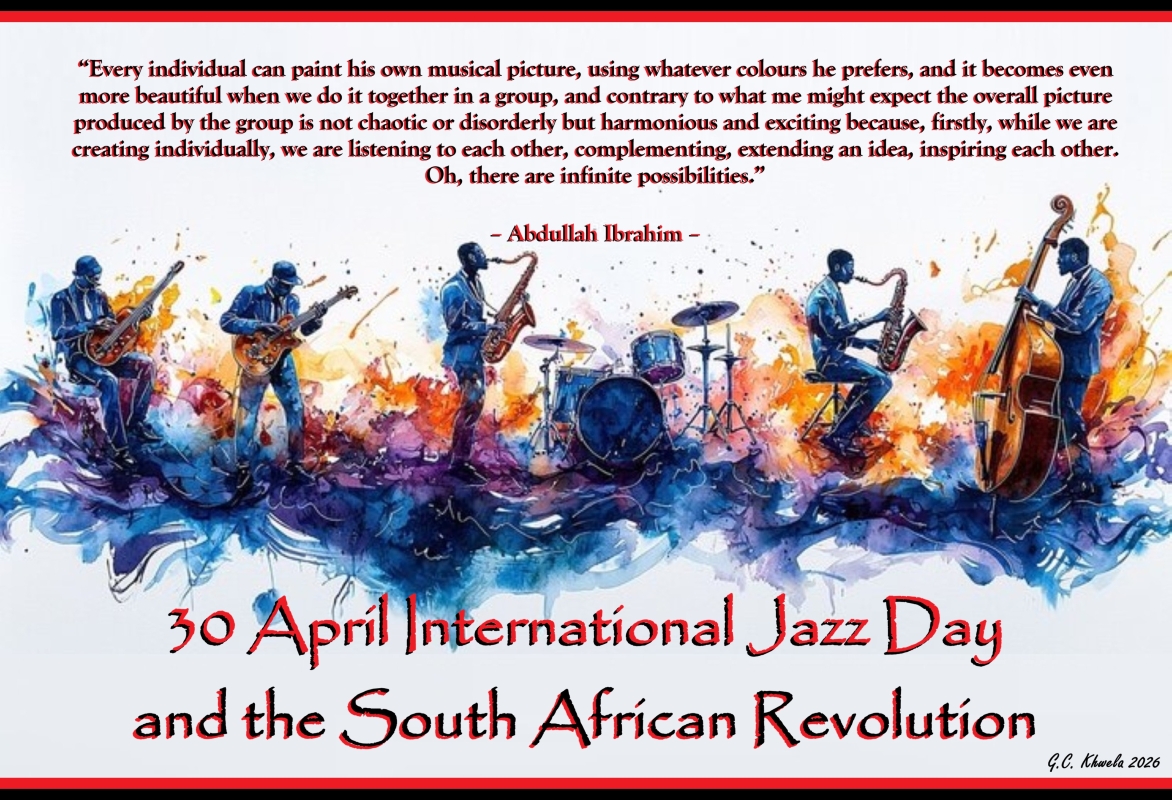
30 April International Jazz Day and the South African Revolution
International Jazz Day is an International Day, which is celebrated annually on April 30, was declared by the United Nations Educational, Scientific and Cultural Organisation (UNESCO) in 2011. The declaration was “to highlight jazz and its diplomatic role of uniting people in all corners of the globe”. The idea came from jazz pianist and UNESCO Goodwill Ambassador Herbie Hancock, who currently chairs the Jazz Day together with the UNESCO Director-General. The celebration is recognised on the calendars of both UNESCO and the United Nations.
Currently, the Herbie Hancock Institute of Jazz, which was formerly known as the Thelonious Monk Institute of Jazz, chaired by Hancock, is the lead organisational partner for Jazz Day. The Institute coordinates activities in the UNESCO member states as well as the Global Host Celebration. Events in the Host City culminate in an All-Star Global Concert, which involves numerous jazz musicians from around the world performing in or around an historical landmark.
Nearly 200 countries participate in International Jazz Day every year. In addition to concerts and jam sessions, events include workshops, conferences, and community outreach. The official registry of worldwide events is hosted on jazzday.com where they are displayed and indexed alphabetically by country.
International Jazz Day is officially described by UNESCO as an annual celebration in the context of the 2005 Convention on the Protection and Promotion of the Diversity of Cultural Expressions, maintaining that Jazz Day “integrates culture in sustainable development frameworks”, “promotes human rights and fundamental freedoms”, and “protects and promotes the diversity of cultural expressions”.
Following his designation as a UNESCO Goodwill Ambassador for Intercultural Dialogue on 22 July 2011, Herbie Hancock announced his intention to create an International Day celebrating the diplomatic role of jazz. After a favorable recommendation by the 187th Executive Board, in November 2011, UNESCO’s General Conference proclaimed 30 April as International Jazz Day, thus recognising jazz as “a means to develop and increase intercultural exchanges and understanding between cultures for the purpose of mutual comprehension and tolerance”.
The date of 30 April was proposed to position International Jazz Day as the culmination of the Smithsonian Institution’s April Jazz Appreciation Month (JAM), although there was no formal connection that existed between the Jazz Appreciation Month and International Jazz Day. The United Nations General Assembly formally recognized International Jazz Day on its official calendar in December 2012.
The jazz scene in South Africa grew much as it did in the United States. Through performances in nightclubs, dances, and other venues, musicians had the opportunity to play music often. Musicians learned by going to nightclubs and jam sessions and waiting for opportunities to offer their talents.
One unique aspect of the South African jazz scene was the appearance of individuals imitating popular artists as closely as possible because the real musician wasn’t there to perform in the area. For instance, one could find a “Cape Town Dizzy Gillespie” who would imitate not only the music, but the look and style of Dizzy. This practice created a strong environment to nurture some artists who would eventually leave South Africa and become legitimate contributors to the international jazz scene.
Among the first major bebop groups in South Africa in the 1950s was the Jazz Epistles, which consisted of trombonist Jonas Gwangwa, trumpeter Hugh Masekela, saxophonist Kippie Moeketsi, and pianist Abdullah Ibrahim, who was then known as Dollar Brand. The Epistles brought the sounds of United States bebop, created by artists such as Dizzy Gillespie, Charlie Parker and Thelonious Monk to Cape Town, with Moeketsi modelling his sound and style on that of Charlie Parker. This group was the first in South Africa to cut a record in the bebop style, but their contemporaries, The Blue Notes, led by pianist Chris McGregor, were no less involved in the local jazz scene. Together, these two groups formed the backbone of South African bebop.
South African jazz served as a powerful cultural weapon against apartheid, blending indigenous folk harmonies with American jazz to create a sophisticated, defiant soundscape. It facilitated community mobilisation, provided clandestine spaces for multiracial gathering, and amplified the liberation struggle through both local performance and global protest by exiled musicians. An early use of jazz as an anti-apartheid tool was the production of a musical entitled King Kong. The musical was written as a social commentary on young black South Africans, much of the music was arranged and performed by famous South African jazz musicians, including all the members of the Jazz Epistles, minus bandleader Abdullah Ibrahim.
The musical was premiered to an integrated audience at the University of Witwatersrand despite efforts by the apartheid government to prevent its opening. The university had legal jurisdiction over its property and was able to allow the gathering of an integrated audience. From this point on, as the play toured South Africa, it carried this undertone of defiance with it. The success of the play eventually took it to premiere in London, and while failing financially outside of South Africa, allowed many local jazz musicians an opportunity to obtain passports and leave the country.
Following the Sharpeville Massacre in March 1960, which was the first in a series of small uprisings occurred, censorship was dramatically increased by the apartheid regime. This led to the shutting down of all venues and events that catered to or employed both black and white individuals. Gatherings of more than ten people were also declared illegal. As a result, a mass exodus was created of jazz musicians leaving South Africa seeking work. Among these were pianist Abdullah Ibrahim, his wife and jazz vocalist Sathima Bea Benjamin, trumpeter Hugh Masekela, and vocalist Miriam Makeba.
These musicians who went into exile, used their international fame to protest against the apartheid regime, wherein jazz became a “music of struggle” that challenged the racial segregation and dehumanisation of apartheid. It was a sophisticated urban sound that countered the narrative that black South Africans were rural and simple. Township shebeens served as essential gathering spots where music and politics intertwined. Among others, The Blue Notes, for example, were “double coding”, using American jazz while subtly opposing the racial “colour” restrictions of the state.
Jazz became a crucial weapon in the South African anti-apartheid movement, serving as both a platform for community mobilisation and a sophisticated medium for political defiance. The music affirmed the humanity and dignity of oppressed people, facilitating self-knowledge and confidence. Musicians, particularly via the underground scene and later international campaigns, helped keep the anti-apartheid movement in the public consciousness. Moreover, the international fame of South African musicians helped mobilise global pressure against the apartheid government.
Jazz challenged the apartheid narrative of black South Africans as unsophisticated or rural. By playing experimental and complex genres like hard bop and free jazz, musicians asserted a non-tribal, modern urban identity that the regime denied existed. This type of jazz thrived in shebeens and unconventional venues like movie theatres and funerals. Such venues became vital gathering spots for political discourse and community solidarity when formal gatherings were banned.
During bleak periods in the 1960s when formal political structures were dismantled, freedom songs and jazz helped keep the idea of the struggle alive in the minds of the people. Jazz became an integral, often subversive, force in the South African revolution against apartheid, acting as a “sonic weapon” that defied the regime’s attempts to impose racial segregation, destroy black identity, and stifle a “non-tribal, urban Black identity”. The music served as a crucial tool of mobilisation and resistance, thriving in spaces of collective joy and political defiance.
Jazz, as a cosmopolitan, urban, and modern genre, was never a strictly segregated music; it mixed people and cultures, challenging the racist state’s enforced separations. It was used to energise crowds and unify people, particularly at funerals of activists, which were often the only allowed gatherings. Due to strict censorship, musicians used double meanings and oblique references to discuss the struggle, for instance, the song “Yakhal’ inkomo” by Winston Mankunku Ngozi became a powerful, emotional symbol of the era’s pain and resistance.
Those prominent musicians who were forced into exile, used their fame to mobilise global moral outrage against apartheid. Hugh Masekela’s 1987 song, “Bring Him Back Home (Nelson Mandela)”, became a global anthem for the anti-apartheid movement and Miriam Makeba, who came to be known as “Mama Africa”, used her platform at the United Nations in 1963 to denounce the apartheid regime. Exiled musicians performed at major international benefit concerts, such as the “Festival for Freedom” and Nelson Mandela’s 70th birthday tribute, to raise funds and sustain pressure on the South African government.
For some of the exiled artists, the move proved to be fortuitous. Ibrahim and Benjamin found themselves in the company of US jazz great Duke Ellington in a night club in Paris in early 1963. That engagement resulted in a recording of Ibrahim’s trio, “Duke Ellington presents the Dollar Brand Trio”, and a recording of Benjamin, “A Morning in Paris”, accompanied by Ellington, Billy Strayhorn, Abdullah Ibrahim, and Svend Asmussen. Artists such as Masekela, Todd Matshikiza, Jonas Gwangwa, Miriam Makeba, Caiphas Semenya and Letta Mbulu travelled to the United States and were exposed first hand to the American jazz scene.
Lastly, by merging with township urban dance music, like Cape jazz, marabi and kwela, and expressing a non-tribal identity, South African jazz helped turn a struggle for rights into a vibrant cultural movement. Cape jazz originated from Cape Town and surrounding towns and was inspired by the carnival music of the area, sometimes referred to as Goema. Marabi evolved from jazz influence in the 1920s, while immigrants from Malawi developed the Kwela sound by fusing Malawian music with Marabi.
Sources:
Wikipedia.
South African History Online.
Gwen Ansell, “Soweto Blues: Jazz, Popular Music and Politics in South Africa”, Continuum International, 2005.
Chatradari Devroop and Chris Walton (Eds.), “Unsung South African Jazz Musicians under Apartheid”, Sun Press, 2007.
George McKay, “Apartheid and South African Jazz in the 1960s”, George McKay, 6 December 2013.
Nusra Khan, “Abdullah Ibrahim and the Politics of Jazz in South Africa”, South African History Online (SAHO), 18 December 2014.
Salim Washington, “Silence, Music, Revolution: Jazz as Narrative Agent in Mongane Wally Serote’s To Every Birth Its Blood”, Journal of Literary Studies, Vol. 31, Issue 1, 2015.
Stephanie Vos, “South African Jazz and Exile in the 1960s: Theories, Discourses and Lived Experiences”, Doctor of Philosophy: Royal Holloway, University of London, September 2015.
Brett Pyper, “Public Culture, Sociality, and Listening to Jazz: Aural Memorialisation in the Time of COVID”, University of the Witwatersrand, 2023, https://orcid.org/0000-0002-5615-6392
Carol A. Muller, “Why Jazz? South Africa 2019”, Dædalus, the Journal of the American Academy of Arts and Sciences, Vol. 148 (2) Spring 2019.
Lindelwa Dalamba, “The Blue Notes: South African Jazz and the Limits of Avant-Garde Solidarities in Late 1960s London”, Safundi: The Journal of South African and American Studies, Vol. 20, Issue 2, 2019.
Castro Khwela
Good morning fellow Compatriots!🙏🏾✊🏾👊🏾
Discover more from CASTRO KHWELA
Subscribe to get the latest posts sent to your email.