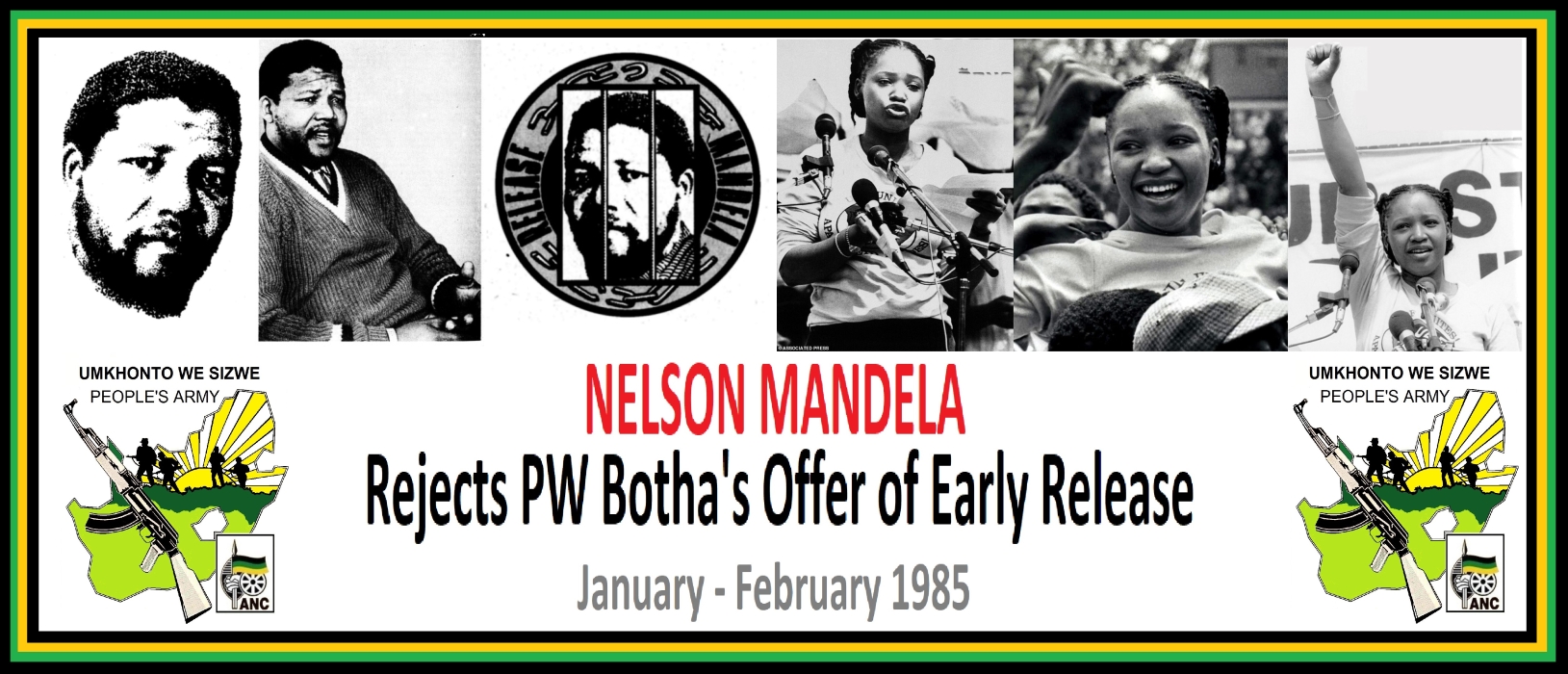
On 31 January 1985, faced with trouble at home and pressure from abroad, the apartheid State President PW Botha offered a tepid, halfway measure for Mandela’s freedom. In a debate in Parliament, PW Botha publicly offered Mandela his freedom if he “unconditionally rejected violence as a political instrument”.
This offer was also extended to all political prisoners. Then, as though he were staking Mandela to a public challenge, he added, “It is therefore not the South African government which stands in the way of Mr Mandela’s freedom. It is he himself”. So “the choice is his. All that is requested him now is that he should unconditionally reject violence as a political instrument, a norm which is respected in all civilised countries of the world”.
This offer followed an interview on Monday, 21 January 1985, of a 66-year old Nelson Mandela in Pollsmoor Prison by Lord Bethell, a Conservative Party member of the European Parliament. Bethell wanted to know about his views on the armed struggle. Mandela said to him: “The armed struggle was forced on us by the government, and if they want us to give it up, the ball is in their court. They must legalise us, treat us like a political party and negotiate with us. Until they do, we will have to live with the armed struggle” Extracts from the interview appeared in Britain’s “Mail on Sunday” on 27 January 1985.
According to Nelson Mandela, the government had sent “feelers” to him over the years, beginning with Minister Kruger’s efforts to persuade him to move to the Transkei. These were not efforts to negotiate, but attempts to isolate him from the African National Congress (ANC). On several other occasions, Kruger said to Mandela: “Mandela we can work with you, but not your colleagues. Be reasonable”. Although Mandela did not respond to these overtures, it was obvious that the government was testing the waters.
In late 1984, Mandela had a visit from Professor Samuel Dash, a professor of law at Georgetown University, in the United States, and a former counsel to the United Stats Senate Watergate Committee. Both visits were authorised by the new Minister of Justice, Kobie Coetsee, who appeared to be a new sort of Afrikaner leader. During the visit by Professor Dash, Mandela laid out what he saw as the minimum for a future non-racial South Africa: a unitary state without homelands, non-racial elections for the central Parliament and one-person-one-vote.
Mandela had been warned by the apartheid authorities that the racist government was going to make a proposal involving his freedom, but he had not been prepared for the fact that it would be made in Parliament by the State President. Mandela was keen to do a number of things in the response, because Botha’s offer was an attempt to drive a wedge between himself and his Comrades by tempting him to accept a policy the ANC rejected.
The ANC also responded to the offer made to Mandela, by emphasising that “The target is the ANC. We say: Nelson Mandela is the leader of the ANC, which adopted the policy of armed struggle. If Botha talks of release of Nelson Mandela, he must release Nelson Mandela and all political prisoners unconditionally.” (response republished in Sechaba, March 1985).
Mandela met his wife Winnie and his lawyer, Ismail Mahomed Ayob, on a Friday, 8 February 1985, since it had already been arranged that on the following Sunday, 10 February 1985, a United Democratic Front (UDF) rally was to be held in Soweto’s Jabulani Amphitheatre, where his response was to be made public.
Indeed, on 10 February 1985, at the Soweto Jabulani Amphitheatre before an estimated crowd of 8,000 people, Nelson Mandela’s 22-year-old daughter, Zindzi, was hoisted for ten minutes on the shoulders of the dancing, singing crowd. She was there to convey her father’s response to Botha’s release offer and mainly to share his words to people who have never heard his words legally for more than twenty years.
She read the following: “I am a member of the African National Congress. I have always been a member of the African National Congress and I will remain a member of the African National Congress until the day I die. Oliver Tambo is more than a brother to me. He is my greatest friend and comrade for nearly fifty years…I cannot sell my birthright, nor am I prepared to sell the birthright of the people to be free”.
Then, referring to President Both directly, she read: “Let him guarantee free political activity so that the people may decide who will govern them…Let him renounce violence. Let him say that he will dismantle apartheid…What freedom am I being offered when my very South African citizenship is not respected? Only free men can negotiate. Prisoners cannot enter into contracts…I cannot and will not give any undertaking at a time when I and you, the people, are not free. YOUR FREEDOM AND MINE CANNOT BE SEPARATED. I WILL RETURN!”
Castro Khwela
Good morning fellow Compatriots!
Discover more from CASTRO KHWELA
Subscribe to get the latest posts sent to your email.