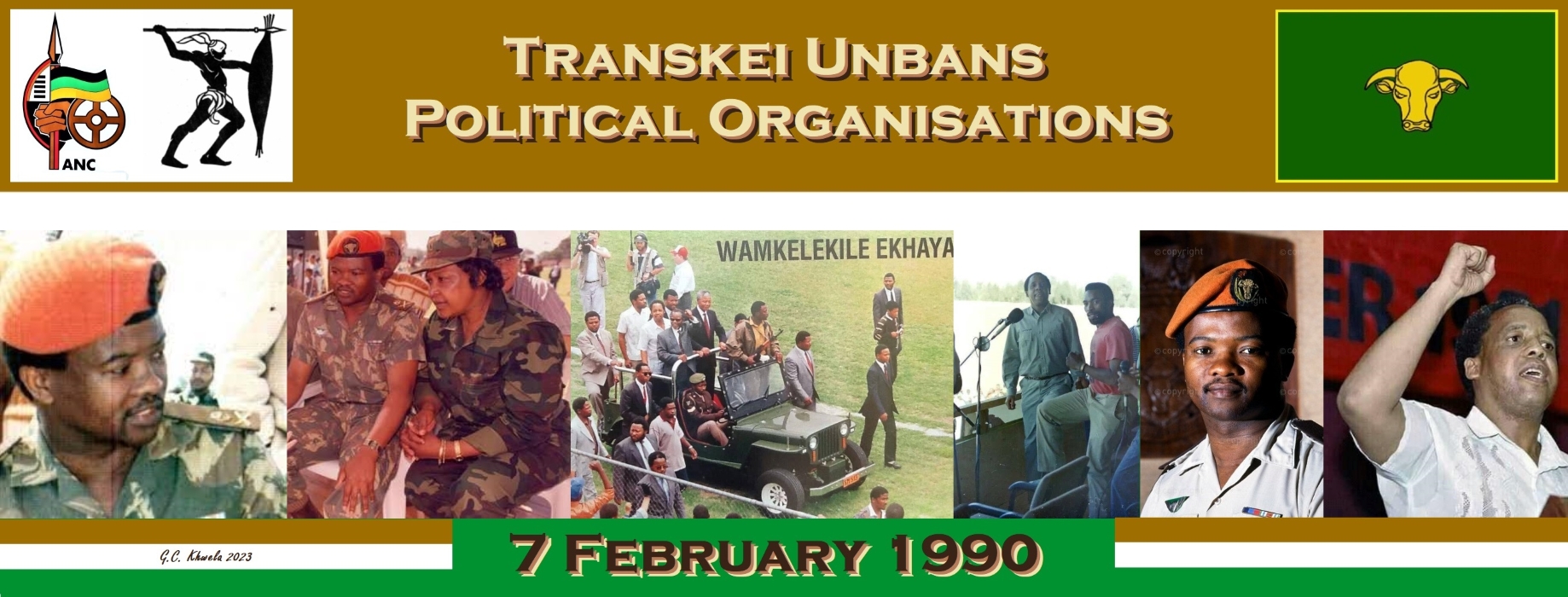
On 7 February 1990, the Transkei leader, Major General Bantu Holomisa, announced the unbanning of the African National Congress (ANC), the Pan Africanist Congress (PAC), the South African Communist Party (SACP) and the Azanian Liberation Movement (ALM) among others. The unbanning allowed all political organisations to resume their political activities by lifting banning restrictions and amending the Public Safety Act to allow free political expression in the Transkei Bantustan.
In the same speech Holomisa announced the release of all political prisoners, including Umkhonto we Sizwe (MK) cadres Ndibulele Ndzamela, Phumzile Mayaphi, Teko Mokhou, Tandisile Jada, Mcebisi Waqu and Sindiso Sigcu.
As head of the Transkei Defence Force (TDF), Holomisa led successive coups against the Transkei Bantustan regimes and then became the head of its military government. He turned the Transkei into a “liberated zone” even before the political movements were officially unbanned, giving shelter to ANC and PAC activists around 1988 and 1989, and declared his intention of holding a referendum on the reincorporation of the Transkei into South Africa.
On 30 December 1987, he ousted the then ruler of the Transkei, Stella Sigcau, and became Chairman of the Military Council of Transkei. Between 1988 and 1989, his government unbanned approximately 33 organisations which had been banned by his predecessors, paving the way for the ANC and PAC to set up camps in Transkei. His government worked closely with the liberation movements. Then 32 years old, Holomisa’s no-nonsense, principled approach to leadership helped pave the way for the ANC to hide some of its leaders, who were wanted by the apartheid security police, in the Transkei. These actions brought him immense popularity and the military dictator became a liberation hero for many South Africans.
The increasingly overt sympathies of the Transkei Bantustan military ruler, Bantu Holomisa, towards the ANC during the late 1980s created a regional stronghold for the ANC and for its armed wing, Umkhonto we Sizwe (MK). MK thrived in the Transkei as its guerrillas were afforded a secure operating base in socially and geographically hospitable terrain bordering South African territory. With Holomisa offering its cadres a safe haven, MK was able to operate with far greater freedom than it had enjoyed elsewhere in South Africa, organising, training and deploying openly even before the February 1990 onset of negotiations between the apartheid regime and the ANC.
Whereas MK’s inability to sustain a military presence in the rest of South Africa, MK’s guerrilla operations became a key component of the ANC’s pursuit of a revolutionary democratic transition being based in the Transkei. Actually, under the leadership of MK Chief of Staff, Chris Hani, the Transkei became MK’s centre of gravity, considering the fact that it had no immediate military bases in the neighbouring states, as most of its fighters were largely based in Uganda, Tanzania and Zambia. The Transkei thus became a “liberated guerrilla zone” in the classical sense of guerrilla warfare, wherein the revolutionary forces had assumed complete (day and night) control of the area.
During that period, the South African Defence Forces’ Military Intelligence (MI) waged an extensive counterinsurgency campaign to weaken MK, which included an attempt to topple Holomisa by a November 1990 coup attempt, which was thwarted by the Transkei Dence Force. The intention of the coup plotters was to install a stooge sympathetic to the apartheid regime in Holomisa’s place. MK forces based in the Transkei continued to undertake armed operations within South Africa, which placed them in direct confrontation with the apartheid military until the ANC came to power in 1994.
On the allegations that MK cadres were responsible for suppressing the coup, Holomisa insisted that the story was a mischievous statement carried by the South African Press Association (SAPA), since those who were behind the coup attempt were embarrassed that he could stay up on his feet without asking the apartheid regime for help. According to Holomisa, “That must have belittled them” (Interview by the Centre for Social and Development Studies at the University of Natal, published in the INDICATOR SA Vol. 8 No 1 Summer 1990).
MK fighters in Holomisa’s Transkei could instead operate in a “liberated zone”, rather than being forced to live and operate undercover, representing one of unusual circumstances in which the ANC’s armed wing achieved its goal of “the setting up of autonomous administration in areas which are under our control or where the enemy, for one reason or another, had forfeited control” (South African History Archives – SAHA – Section 5.17, Umkhonto we Sizwe, ‘MK and the Future’, docUniverument dated November 1990, author unknown).
During this period, from 1988 to 1990, certain MK fighters in Transkei could on Holomisa’s orders even walk freely in uniform carrying their symbolic Soviet-made AK-47 rifles without being interfered with by the law enforcement agencies. Locals in the Transkei were delighted at the sight of MK cadres openly brandishing their trademark weapons, according to guerrillas that operated in the Bantustan at the time.
Largely trained in the USSR and other Warsaw Pact countries and having gained combat experience in the eastern and northern parts of Angola against UNITA (National Union for the Total Independence of Angola), which was supported by the United States and apartheid South Africa, MK veterans became a formidable force alongside the TDF, due to their training, experience and ideological commitment to the anti-apartheid revolutionary struggle.
Sources:
South African History Online (SAHO).
South African History Archives (SAHA).
Daniel Douek (2013): “‘They Became Afraid When They Saw Us’: MK Insurgency and Counterinsurgency in the Bantustan of Transkei, 1988 – 1994”, Journal of Southern African Studies, Vol. 39, No. 1, 207 – 225.
Graham, Paul 2014. Committed to Unity: South Africa’s Adherence to Its 1994 Political Settlement. Inclusive Political Settlements Paper 6. Berlin: Berghof Foundation.
“The Day of the Generals”, Bantu Holomisa Interview by the Centre for Social and Development Studies at the University of Natal, published in the INDICATOR SA Vol. 8 No 1 Summer 1990.
Castro Khwela
Good day fellow Compatriots!
Discover more from CASTRO KHWELA
Subscribe to get the latest posts sent to your email.