Rhodesmustfall Movement
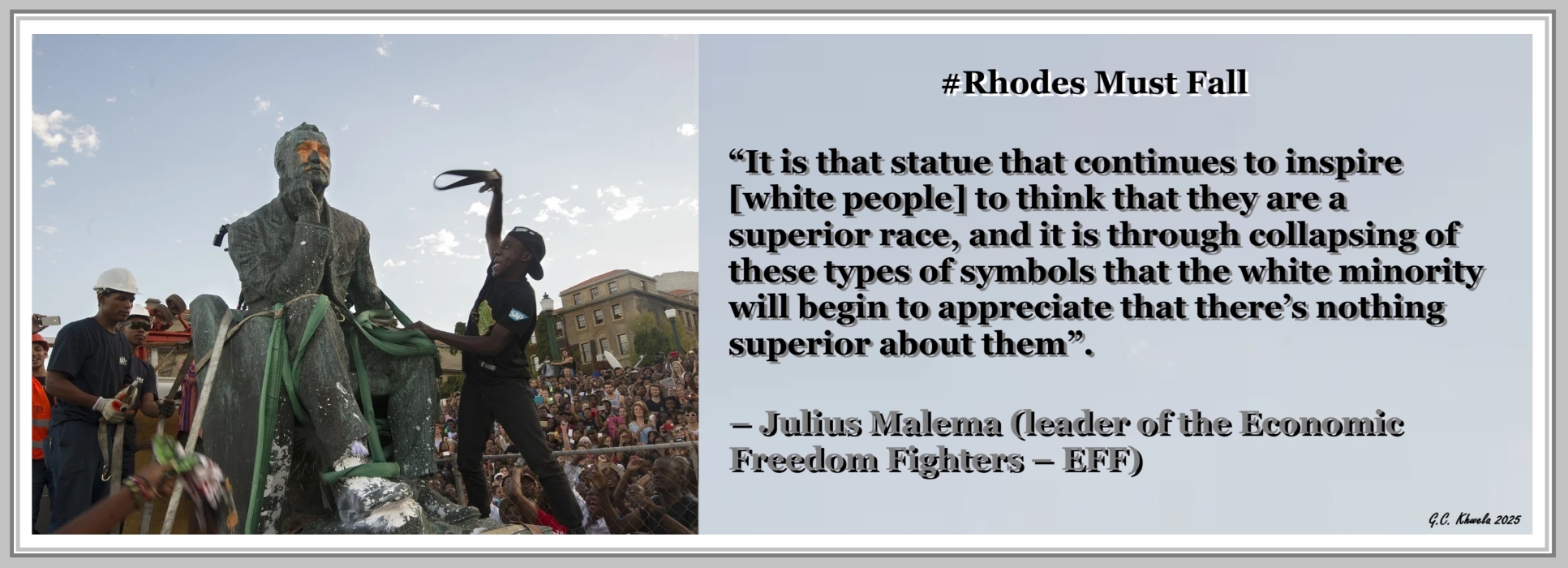
On 9 March 2015, Chumani Maxwele threw human excrements at a statue of Cecil John Rhodes that was situated on the campus of the University of Cape Town, on Rugby Road. This action became a catalyst for heightening student activism and movements throughout universities in the country, stimulating political discourse within South Africa as well as around the world.
Maxwele’s protest, staged as a political performance, was in response to the lack of attention given to the symbols on campus that are physical reminders of White supremacy and Black subjugation and oppression that is rooted in South Africa. By taking human excrement from Khayelitsha, his action sought to make a connection with the lack of human dignity given to Black people living in townships. The subsequent question therefore will be: Who was Cecil Rhodes?
Cecil John Rhodes, born on 5 July 1853, was a British mining magnate and politician in southern Africa who served as Prime Minister of the Cape Colony from 1890 to 1896. An ardent believer in British imperialism, Rhodes and his British South Africa Company colonised the southern African territory of Rhodesia (now Zimbabwe and Zambia), which the company named after him in 1895. South Africa’s Rhodes University is also named after him. Rhodes set up the provisions of the Rhodes Scholarship (funded by his estate), which until 1976, candidates had to be unmarried white males between the ages of 19 and 25.
Rhodes entered the Cape Parliament at the age of 27 in 1881, and in 1890, he became Prime Minister. After overseeing the formation of Rhodesia during the early 1890s, he was forced to resign in 1896 following the disastrous Jameson Raid, an unauthorised attack on Paul Kruger’s Transvaal Republic. Thereafter, Rhodes’s career never recovered; his heart was weak and after years of poor health he died on 26 March 1902.
Significantly, Rhodes believed that the Anglo-Saxon race was, to quote a letter of 1877, “the first race in the world”. Under the reasoning that “the more of the world we inhabit the better it is for the human race”, he advocated vigorous settler colonialism and ultimately a reformation of the British Empire so that each component would be self-governing and represented in a single parliament in London.
When he arrived in Africa, Rhodes lived on money lent by his aunt Sophia. After a brief stay with the Surveyor-General of Natal, Dr. P.C. Sutherland, in Pietermaritzburg, Rhodes took an interest in agriculture. He joined his brother Herbert on his cotton farm in the Umkhomazi valley in Natal. The land was unsuitable for cotton, and the venture failed.
In October 1871, 18-year-old Rhodes and his 26-year-old brother Herbert left the colony for the diamond fields of Kimberley in the Northern Cape Province. Financed by N M Rothschild & Sons, Rhodes succeeded over the next 17 years in buying up all the smaller diamond mining operations in the Kimberley area.
His monopoly of the world’s diamond supply was sealed in 1890 through a strategic partnership with the London-based Diamond Syndicate. They agreed to control world supply to maintain high prices. Rhodes supervised the working of his brother’s claim and speculated on his behalf. Among his associates in the early days were John X. Merriman and Charles Rudd, who later became his partner in the De Beers Mining Company and the Niger Oil Company.
In 1896, after consulting with Molteno, Rhodes began to pay more attention to export fruit farming and bought farms in Groot Drakenstein, Wellington and Stellenbosch. The successful operation soon expanded into Rhodes Fruit Farms, and formed a cornerstone of the modern-day Cape fruit industry.
Rhodes was the target of much criticism, with historians labelling him as a ruthless imperialist and white supremacist, and some activists demanding that his memorials be removed. Rhodes once stated that “if the whites maintain their position as the supreme race, the day may come when we shall all be thankful that we have the natives in their proper place.” Need we say more?
Sources:
Wikipedia
Amit Chaudhuri, “The Real Meaning of Rhodes Must Fall”, The Guardian, 16 March 2016.
Castro Khwela
Good morning fellow Compatriots!🙏🏾✊🏾👊🏾
Discover more from CASTRO KHWELA
Subscribe to get the latest posts sent to your email.