State of Emergency Declared in the Natal Province
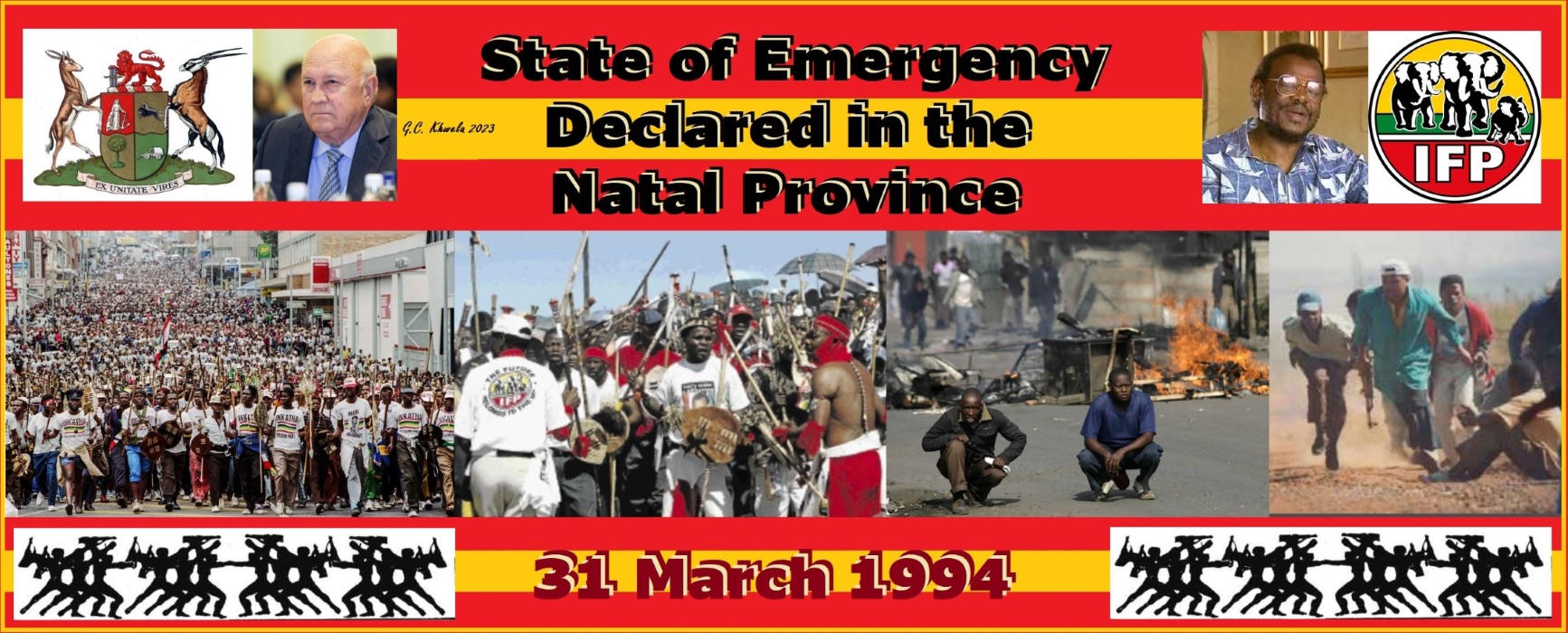
On 31 March 1994, apartheid President F.W. de Klerk imposed a state of emergency in the Natal Province, coinciding with a report by the South African Human Rights Commission (SAHRC) that it had recorded 266 political killings in Natal since the beginning of March, the highest death toll in three years.
Meanwhile, Inkatha Freedom Party (IFP) leader Mangosuthu Gatsha Buthelezi vowed to fight the African National Congress (ANC) “to the finish” unless the elections scheduled for 27 April 1994 were postponed – as the Transitional Executive Council (TEC) recommended emergency measures to be proclaimed by the President within the following few days encompassing the whole of Natal and the KwaZulu Bantustan. The declaration was intended to halt the escalation of violence in the region as well as ensure free and fair elections in the following month of April.
According to De Klerk, the decision was taken to ensure that there was free political activity and that elections would take place in Natal. He disputed the rumour circulating that the decision was taken following the Transitional Executive Committee’s insistence that such action was necessary. In a move that was long overdue, security forces were given powers to detain people for thirty days without charge, to use the necessary force to maintain order and to search people and premises without a warrant. The measures also prohibited unauthorised military training and the display of weapons, including traditional weapons, and set strict conditions for marches.
ANC President Nelson Mandela, on the one hand, gave his organisation’s support to the clampdown and called ANC members to co-operate with the security forces. While, on the other hand, IFP President Mangosuthu Gatsha Buthelezi described the state of emergency as humiliating and an invasion in Natal, which was likely to make elections impossible. “I think that my people will get even more angry and they’ll see this as an invasion”, Buthelezi told reporters in Durban (Los Angeles Times). He referred to the failure of constitutional procedures as the main reason for the declaration of the emergency.
Sources within the transitional government claimed that chilling intelligence reports predicted a sharp increase in the Natal violence fatalities as the election approached, which finally persuaded President de Klerk to declare a state of emergency in the region. Buthelezi reacted indignantly, denouncing the clampdown as another “chapter of oppression” and also rejected the elections scheduled in four weeks as an assault on the Zulu King and on their ethno-national pride. Buthelezi argued that “What is being done is really comparable to someone holding a woman for someone to rape that woman. It amounts to that for us” (The New York Times).
Since mid-March, when the Zulu King and Chief Buthelezi issued their most unequivocal appeal for an election boycott, black townships and villages in Natal and in the Pretoria-Witwatersrand-Vaal (PWV) Area had erupted in audacious killings and house-burnings by Inkatha vigilantes, followed by reprisals from ANC self-defence units (SDUs). As the transition to multi-party democracy was looming in the horizon, Buthelezi feared the erosion of his power. He demanded a more federal system of government, with guarantees that the status of traditional Zulu leaders would be respected.
According to several analysts, under the interim constitution adopted in December 1993, KwaZulu and the other Bantustans created under apartheid were to officially cease to exist after the elections. The first black-led government was predicted to stop paying for Buthelezi’s perks, patronage and power base. In a speech in January 1994, Buthelezi had warned that if the ANC came to power, “we will end up with a government that has the avowed intention to finally dismantle KwaZulu and destroy my leadership roles” (Hilary Lynd).
De Klerk insisted that the state of emergency was not an attempt to take over the homeland. On the contrary, he said, the troops would also be there to protect Buthelezi against any attempts to destabilise the Bantustan. “This is not aimed at the KwaZulu government”, De Klerk said. “It is not aimed at the position of the chief minister. It is not aimed to have any effect on the position of the King.” According to De Klerk, Buthelezi would remain in office as the chief minister of KwaZulu, but that troops were there to protect political campaigning and voting in the homeland and the Natal Province (The New York Times).
Although De Klerk did not spell out the scale of the operation, Nelson Mandela, who was briefed on the plan and endorsed it, said soldiers and members of the national police force were to be deployed throughout the region and the army would also take command of KwaZulu’s police force, which had 3,500 members and had been accused of collaborating in the murder of political rivals. “Effectively what this means is that the KwaZulu police are going to be confined to barracks, and they will perform such duties as they are permitted by the defence force”, Mandela said (The New York Times).
Mandela maintained that “Today’s action has one purpose – to stem the tide of violence which threatens to engulf us all. … The declaration of a state of emergency now is intended to save innocent lives. It is intended to counter the activities of those elements who want to prevent the masses of the people from choosing their own government on April 27. We cannot and shall not allow the spoilers and the wreckers to succeed” (Los Angeles Times).
Sources:
Wikipedia.
South African History Online (SAHO).
South African History Archives (SAHA).
Business Day, “Buthelezi threatens to fight as TEC agrees on a state of emergency”, Business Day, 30 March 1994.
BBC, “Chief Mangosuthu Buthelezi: The man who divided South Africa”, British Broadcasting Corporation, 9 September 2023.
Bill Keller, “De Klerk Orders Army to Protect Vote in Zulu Area”, The New York Times, 1 April 1994.
Bob Drogin, “S Africa Declares State of Emergency in Natal Province: Violence: De Klerk sends troops into Zulu-dominated region”, Los Angeles Times, 1 April 1994.
Hilary Lynd, “The Peace Deal: The Formation of the Ingonyama Trust and the IFP Decision to Join South Africa’s 1994 Elections”, South African Historical Journal, Vol. 73, No. 2, 2021.
Castro Khwela
Good evening fellow Compatriots!
Discover more from CASTRO KHWELA
Subscribe to get the latest posts sent to your email.