Gang of Eight Expelled from the African National Congress (ANC)
Exactly 50 years ago, on 11 December 1975, the African National Congress of South Africa (ANC) issued a Statement on “the expulsion of a conspiratorial clique”, which was presented by the Secretary-General, Alfred Nzo, following a meeting of the National Executive Committee (NEC) in Morogoro, Tanzania. The ANC Statement referred to the expulsion of eight members due to what the Movement described as “disruptive factionalist activities based on reactionary racial grounds”.
The statement maintained that “A small discredited conspiratorial group of dissidents, some of them formerly active in the African National Congress, and other splinter movements, have recently intensified their campaign of lies, slander and malicious distortions intended to cause disruption within the ranks of the African National Congress and create confusion and demoralisation among the oppressed people of South Africa and world public.” Amongst those expelled were Alfred Kgokong Mqota, Tennyson Makiwane, Ambrose Mzimkulu Makiwane, Jonas Matlou, George Mbele, Thami Bonga (real name Thami Mhlambiso), Pascal Ngakane and O. K. (Milton) Setlhapelo.
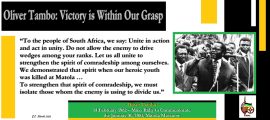
This was because the eight members were pushing an Africanist position within the ANC which rejected the inclusion of non-Africans in the Revolutionary Council (RC). At the memorial of Robert Resha, Ambrose Makiwane criticised what he felt was a small group of communists who had taken over the ANC and Oliver Tambo’s leadership. Makiwane and the other seven maintained that Oliver Tambo had betrayed the sacred trust and mandate given to him the ANC to head the external mission and was accordingly unfit to lead the revolutionary struggle.
They argued that “Tambo, his hand always clutching to a passport, always on the point of flying off somewhere, make a remarkable contrast to a leader like Samora Machel, who during the struggle was seen always having a gun slung over his shoulder, leading his men into the fight. Tambo stands in contrast to leaders like (Eduardo) Mondlane, (Amilcar) Cabral and (Herbert) Chitepo, who lived with their families at the headquarters of their organizations in Africa. Tambo chose to buy a stately home in the posh Muswell Hill suburb of London.”
In response the ANC Statement said, “Determined at all costs to attract public attention to themselves, they deliberately conspired to use the name of the late Robert Resha and the solemn ceremonies connected with his death and the unveiling of his tombstone for an outright and unprecedented attack on the African National Congress of South Africa. The attack was carried under cover of a booklet ostensibly published in the memory of the late Robert Resha. This action was the culmination of a persistent and prolonged treacherous and subversive campaign by some of the ringleaders of this faction.”
“… In fact from their clandestine meetings,” the Statement averred, “mainly confined in the U.K., they proceeded to create an organised clique with a constitution contrary to the principles and policies of the ANC of South Africa. It was clear that what the faction tried to exploit as a London or U.K. problem arising from the decisions of the 1969 Morogoro Conference was a mere subterfuge for their activities against the ANC as a whole, its policies and its leadership of the revolution in South Africa against the fascist and their allies. Whilst proclaiming loyalty to the principles of the ANC they were in fact propagating by example, deeds, and words reckless defiance of the decisions and instructions of the organisation.”
In a direct reference to what these expelled members were accused of, was that “… they were basically anti-African National Congress of South Africa and its allies and anti-the South African Communist Party’s members participating in the ANC. These questions are not new to the ANC of South Africa and in due course we shall answer the questions as to who benefits by the emergence of a clique based on the slogans of racialism, anti-ANC and anti-Communism. Let it be made abundantly clear that the policies of racialism and anti-communism have been and still are diametrically opposed to the policies, traditions and practices of the African National Congress of South Africa.”
Following the ANC Statement, around 15 December 1975, the South African Communist Party (SACP) also released a Statement titled, “The Enemy Hidden Under the Same Colour”, which was later published in “The African Communist”, Second Quarter, 1976. The SACP Statement also emphasised this point, that “The issues on which they have chosen to attack the liberation movement are as old as the struggle itself. The slander that the ANC is run by the Communist Party is not something new; it has always been spread by the racists and those who act as their agents.
“And”, according to the SACP Statement, “it has always been designed to weaken the people’s struggle. As early as the 1920s, liberals like Ballinger helped destroy the ICU (Industrial and Commercial Workers Union) by raising the banner of anti-Communism, and spreading scare stories about ‘Communist take-overs’. In the late 50s, the break-away PAC group also used the white liberal parrot-cry that ‘the Communists were running the ANC’ in an attempt to destroy it.”
The SACP Statement further maintained that “The principled stand of the ANC against the so-called ‘homelands’ policy has been attacked by the Bantustan collaborators as ‘Marxist-inspired’ and the creation of Communists who ‘dominate the ANC’.” This was also covered in the ANC Statement, which argued that “In all revolutions, defeated and counter-revolutionary elements resort to the Mqota-Makiwane method, and ultimately club together with the enemy. For example, it has already leaked out that this ‘ultra black’ faction has made contacts with the Bantustan leaders with the aim of going back and working under the Bantustan leaders. They are already attacking what they call ‘non-Africans’, and are indirectly portraying themselves as the Bantus – a concept that is in full accord with enemy’s policies.”
“South Africa’s press has given a great deal of space to anti-Communist, anti-ANC and racist propaganda with which,” the SACP Statement asserted, “it has been fed by the group of eight who were recently expelled from the ANC for persistently betraying its political and organisational principles. For the enemy, this group’s campaign against the people’s struggle could not have come at a better moment. It fits in very well with the Vorster government’s desperate attempts to find black collaborators both inside and outside the country, in order to break up the unity of the liberation forces and to cover its criminal aggression against our brothers in Angola.”
As a means to resolve this matter within the auspices of the ANC’s disciplinary processes, the ANC Statement maintained that “the ringleaders of the faction were each called upon to denounce the treacherous activities in which they participated or to face expulsion from the organisation”. However, they had “categorically and arrogantly refused to denounce their counter-revolutionary activities and are now busy intensifying their anti-ANC activities. The National Executive Committee of the ANC hereby declares that these traitors stand expelled from the African National Congress of South Africa.”
The SACP Statement concluded that, “And now the wedge-drivers who had been working behind closed doors against the whole liberation movement and its policies have come out into the open. They are part of the impure load which every revolution carries and when that load is thrown aside the journey to victory is always a swifter one.”
Sources:
South African History Online (SAHO).
T. Bonga, et. al., “Statement on Expulsion from the ANC of South Africa by the Eight Expelled Members” African National Congress (African Nationalists), December 1975.
Alfred Nzo, “Conspirators Expelled: Official Statement by the African National Congress on the Expulsion of Certain Members of the ANC”, Sechaba, Vol. 10, No. 2, Second Quarter, 1976.
SACP Central Committee, “The Enemy Hidden Under the Same Colour: Statement by the Central Committee of the SACP on the Racist and Anti-Communist Activities of the Group of Eight Recently Expelled from the African National Congress”, The African Communist, No. 65, Second Quarter, 1976.
Paul Trewhela, “The murder of Tennyson Makiwane”, Politicsweb, 29 September 2008.
Alexandre Moumbaris, “Alexandre Moumbaris Papers, 1970s-2000s”, Historical Papers Research Archive, University of the Witwatersrand, Johannesburg, South Africa, 2020.
Castro Khwela
Good evening fellow Compatriots!
Discover more from CASTRO KHWELA
Subscribe to get the latest posts sent to your email.