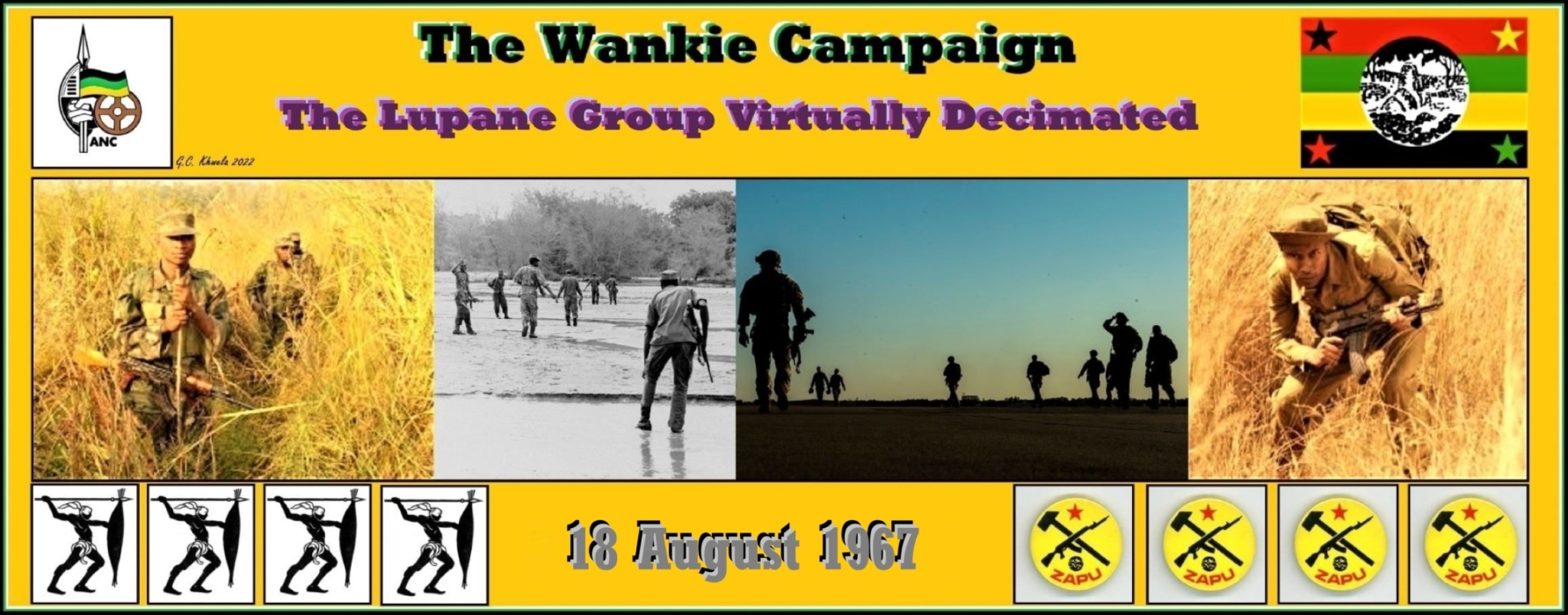
Wankie Campaign – The Lupane Group Virtually Decimated
On 18 August 1967, the Lupane Group, under the command of Jonathan Moyo (aka “David Madziwa”) of the Zimbabwe People’s Revolutionary Army (ZIPRA), with Andries Motsepe of Umkhonto we Sizwe (MK) as his deputy, was engaged in another confrontation with the Rhodesian security forces.
The entire episode began on 17 August 1967, just after sunset, when the Lupane Group began marching again, and at that time they were retreating west towards Botswana, as they were being hunted by tracker teams. When they reached an open area where there were two dead trees, Moyo instructed a portion of the group to sleep by one tree, and the other portion at the second. The group remained in these positions until around 15:00, on 18 August 1967, when the Rhodesian African Rifles (RAR) Tracker Unit under the command of Lieutenant Wardle arrived.
When one of the guerrillas crawled out of one of the trees, he was challenged by a member of the RAR forces to surrender. When the call was made several times in IsiNdebele and was not heeded, the patrol began opening fire. Three men then emerged with their hands up, surfacing from the thick bush surrounding the tree. The RAR forces then extended the challenge to the second group of guerrillas to surrender, which was not answered, and so they began opening fire. These shots caused a grenade to explode in the guerrilla positions, sparking a fire that detonated the guerrillas’ other grenades, thus creating an inferno.
Five men were found burnt to death at the scene of the blaze by the Rhodesian security forces, and at the same time they killed two and captured six others. The commander of the Group, Jonathan Moyo (aka “David Madziwa”), managed to crawl away successfully from the battlefield to safety. However, he was on his own, as the Lupane Group had effectively been destroyed as a fighting Unit. Comrade Rodgers was among the remaining members of the unit to be captured. Both Comrade Rodgers and Bothwell were subsequently sentenced to death by the Rhodesians.
South African newspapers reported that during a battle on 18 August 1967, eight guerrillas, believed to be from a group of 30 members of the banned African National Congress (ANC) trying to make their way to South Africa, were killed in Wankie Game Reserve. Another six guerrillas had been captured. According to the reports, the Rhodesian security forces had suffered no casualties.
After having been on his own since splitting from the Lupane Group on 18 August 1967, Jonathan Moyo was arrested in a kraal on 19 August 1967, in which he went to ask for food, and suffering from severe stomach pains. A Russian PPSH submachine gun and its magazines, as well as a Russian pistol and a Russian hand grenade were found in his possession.
However, the Joint Planning Staff of the Rhodesian Army only covered his arrest in a situation report (SITREP) that was dispatched to the headquarters of the South African Air Force on 3 September 1967. According to the SITREP, Moyo was arrested at an unspecified place and had been positively identified as a ZAPU (Zimbabwe African People’s Union) leader. Moreover, the report added that he was the sole survivor of the “24 men” that were involved in the first action against the security forces on 13 August 1967.
The unit that was moving south heard about the battle on a portable radio they carried with them. As a tactic to demoralise other units and bring about their surrender, the Rhodesian government announced that a large number of fighters had been captured and several killed. A day after the first clash, the Rhodesian security forces dropped thousands of leaflets printed in English and Shona over a small area of the Zambezi Valley, calling on the “terrorists” to surrender.
The leaflets contained photographs of two guerrillas who allegedly “recently gave themselves up to security forces” and sent the following message to the guerrillas: “You are far from your home. Do you want to die? You have been sent by your leaders in Lusaka to fight against us in Rhodesia. These men refuse to come themselves because they know our strength and do not want to die. They have sent you to die for them.”
The propaganda, however, had no effect on the second unit, which proceeded as planned. Nevertheless, Lennox Tshali, the Commander of the Luthuli Detachment, speculated that members of the smaller unit who were taken prisoner might have revealed the existence of the other unit to the Rhodesians.
When news of the military encounters between Umkhonto we Sizwe (MK)/Zimbabwe People’s Revolutionary Army (ZIPRA) forces and the Rhodesians reached Lusaka, ANC Deputy President, Oliver Tambo, summoned Eric Mtshali, and informed him that the Rhodesians had encircled a section of the Luthuli Detachment near the Zambezi River. He then instructed Mtshali to organise and lead a rescue team into Rhodesia.
Subsequently, Mtshali and Akim Ndhlovu, a ZIPRA Commander, assembled a group of 12, including Eric Manzi from Port Elizabeth, who was Mtshali’s Regional Head of Intelligence. They immediately began preparing to cross the Zambezi, where they reached the river in the morning and camped for a day, intending to observe enemy movement on the opposite bank.
On the same day, 19 August 1967, African National Congress (ANC) Deputy President Oliver Tambo and the Vice-President of the Zimbabwe African People’s Union (ZAPU), James Chikerema, held a press conference at the ANC Headquarters in Lusaka, Zambia. They then issued a joint ANC-ZAPU press release which read, “From the thirteenth of this month, the area of Wankie has been the scene of the most daring battles ever fought between Freedom Fighters and the white oppressors’ Army in Rhodesia. Only last night the Rhodesian Regime admitted having been engaged in a six-hour Battle yesterday”.
According to the statement, both the racist Rhodesian and apartheid South African regimes had claimed that ANC soldiers were involved in the battles. “We wish to declare here that the fighting that is presently going on in the Wankie area is indeed being carried out by a combined force of ZAPU and ANC that entered Rhodesia as Comrades-in-arms on a common route, each bound to its destination. It is the determination of these combined forces to fight the common settler enemy to the finish, at any point of encounter as they make their way to their respective fighting zones.” The declaration was signed by Tambo and Chikerema.
Following the Communiqué, the ANC issued a document, titled “THE BATTLE IS ON!” The document said, “It is now history that on August 13, armed members of Umkhonto we Sizwe, the military wing of the African National Congress together with their comrades-in-arms of the Zimbabwe African People’s Union (ZAPU) engaged the armed bandits of white supremacy in Rhodesia, on their march into the apartheid laager of Vorster. Furious battles are going on in many areas. Commenting immediately after receiving reports of the first battles, our “Flash” Newsletter stated:
“… The first volleys for freedom have been fired by the people’s guerrilla army, Umkhonto We Sizwe… The armed struggle has started. Already, they have inflicted a heavy death toll on the enemy. Already, blood has begun to flow from the ranks of the oppressor as it has always been flowing from the oppressed. Already, a number of our brave young men have died, but not before they had shaken Rhodesia and South Africa … Already, the history of Southern Africa has taken a new turn. But what we have heard are only the first shots in a struggle that will be long, fierce and costly in terms of human life. It will grow and spread in scope and intensity until it embraces, as one armed struggle under a unified command, the entire area of the racist and colonialist South… We shall have ‘Wankies’ everywhere; we shall repay Sharpevilles with Sharpevilles; we shall make peace when the majority rules!”
Finally, the document ended with a portion titled “News from THE BATTLE FRONT”. The portion mentioned that “Accounts of the fierce conflict that has erupted at Wankie on August 13 have been trickling out of Rhodesia despite the news black-out imposed by Smith and Vorster. Our Zambian Office Newsletter states: Informants tell of the near massacre of security forces in the first battles of the armed confrontation. It was a little Sharpeville in reverse.”
The document continued to say “… In a series of ambushes prepared with meticulous precision, security forces trailing the guerrillas frequently found themselves in the centre of a vicious hail of bullets from nowhere. Unable to explain their recurring misfortunes, in which they suffered heavy casualties, they found an explanation … word has been spreading among them that the guerrillas ‘are using drugs’…”
Subsequently, Retired Major General Chris Thirion, a former apartheid South African Defence Force’s Military Intelligence officer, confirmed the ongoing battles in the Wankie Game Reserve when he and others returned to Pretoria. This led to the deployment of a contingent of South African policemen to reinforce the Rhodesian armed forces.
In another statement issued by the Deputy President of the ANC, Oliver Tambo, to the press, he mentioned that the Luthuli Detachment indomitable fighters proved the lie of invincibility of the Rhodesian and South African racist and apartheid regimes. According to Tambo, “In battle after battle, the racist forces were overwhelmed by the courage and fire power of our gallant fighters instance after instance…”
Sources:
Dumiso Dabengwa, “The 1967 Wankie and 1968 Sipolilo Campaigns: The Impeccable ZAPU and ANC Alliance in Retrospect”, The Thinker, Vol. 80, 2019.
African National Congress, “Statement to the Truth and Reconciliation Commission”, August 1996.
Comrade Rodgers (Freddie Mninzi), “The Battle of Nyutuwe”, Dawn – Journal of Umkhonto we Sizwe, Souvenir Issue, December 1986.
Nicole (Nicky) Martina van Driel, “The ANC’s First Armed Military Operation: The Luthuli Detachment and the Wankie Campaign, July – September 1967”, MA Thesis, Univerrsity of the Western Cape, June 2003.
Joshua Chakawa and Vongai Z. Nyawo-Shava, “Guerrilla Warfare and the Environment in Southern Africa: Impediments Faced by ZIPRA and Umkhonto We Sizwe”, Oral History Journal of South Africa Vol. 2, No. 2, 2014.
Editorial, “ZAPU-ANC Fight On”, Supplement to Sechaba, Vol. 1, No. 10, October 1967.
Rendani Moses Ralinala, Jabulani Sithole, Gregory Houston and Bernard Magubane, “Chapter 12: The Wankie and Sipolilo Campaigns”, The Road to Democracy in South Africa, Vol. 1 (1960 – 1970), South African Democracy Education Trust (SADET), Zebra, 2004.
Thula Simpson, “Umkhonto we Sizwe: The ANC’s Armed Struggle”, Penguin, 2016.
Stephen R. Davis, “The ANC’s War against Apartheid: Umkhonto We Sizwe and the Liberation of South Africa”, Indiana University, 2018.
Castro Khwela
Good day fellow Compatriots!
Discover more from CASTRO KHWELA
Subscribe to get the latest posts sent to your email.