Beginning of the MK-Angolan Eastern Front
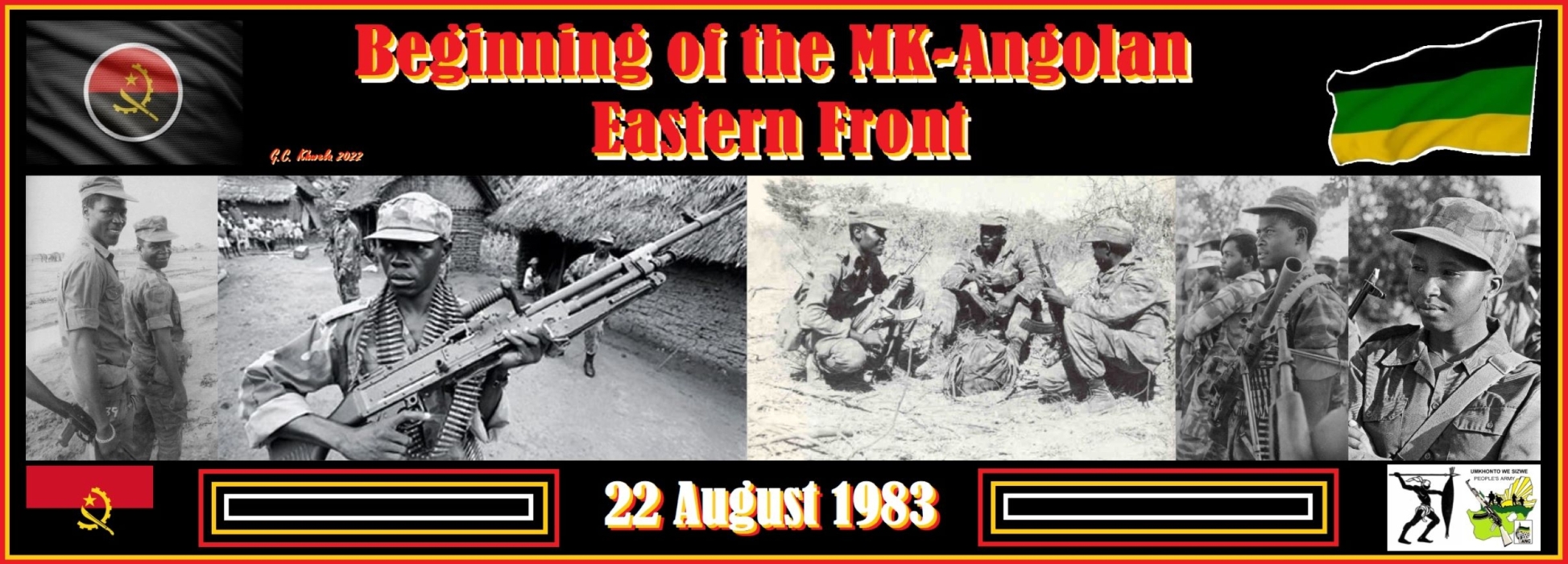
On 22 August 1983, the Chief Representative of the African National Congress (ANC) in Angola, Uriah Mokeba, wrote a second letter to the Head of the ANC’s International Affairs Department, wherein he warned that “the situation in the province of Malanje is really critical. Most of our people have been withdrawn from the North to assist in manning the security in the Province. Both comrades Joe Modise and Chris Hani are at the scene with units of MK (Umkhonto we Sizwe) assisting in combing the area which is to a very large extent infested with bandits”.
He then added, “We have been told, that our units, in the meantime, are in control of the situation. We shall keep in touch.” This letter followed a letter that Mokeba wrote on 18 July 1983 to the International Department in which he noted that the ANC’s training base in Malanje had become an enemy target, because the Union for Total Independence of Angola (UNITA) had sent groups of “bandits” to sabotage and destabilise the surrounding area. The bandits had at that time captured a village near the camp and had successfully tried to raid an MK logistics store.
In the first letter, Mokeba wrote, “we have come into agreement with the Angolan Defence Force – FAPLA – that we will patrol an area near our camp”. The letter was a consequence of a meeting between Julius Mokoena, the MK Chief of Staff in Angola with the Commander of the People’s Armed Forces for the Liberation of Angola (FAPLA) in the Malanje Province. The FAPLA Commander requested help from MK in fighting UNITA in the area, and the assistance was needed because most FAPLA combatants were engaged in fighting the apartheid South African Defence Force (SADF) in the south.
A joint FAPLA/MK Brigade was therefore established, to which the ANC contributed 450 cadres. The Unit’s overall commander was to be FAPLA’s Senior Lieutenant Colonel Sebastiao, while Julius Mokoena was to be Chief of Staff, and Chris Hani was to represent the ANC leadership and MK’s military headquarters on the command structure. MK cadres were then sent into battle against UNITA, the enemy of their Angolan hosts and an ally of both apartheid South Africa and the United States of America. In the following weeks, Umkhonto’s base camps emptied as troops were transported to Malanje province, which then became known as the “Eastern Front”.
In 1980, when the Zimbabweans achieved their independence, the Zimbabwe African People’s Union (ZAPU) moved out of Angola and gave their Zimbabwe People’s Revolutionary Army (ZIPRA) facilities to the ANC. These included two camps in the province of Malanje, Camalundi (also known as Hoji Ya Henda), which also doubled as a farm, and Caculama, which served as a major training camp. Camalundi was founded in 1980, and the camp was short-lived and was closed in January 1981, when it was shifted to Caculama and became known as part of Caculama Camp. Caculama camp, which was established in January 1981 in the Angolan town of Malanje, became the main training centre for MK cadres in the early 1980s.
During the early months of 1983, ANC President, Oliver Tambo, came to the camps to explain that MK was inextricably caught up in the net of the Cold War in Africa. A proxy civil war was raging in Angola. Angola was at that time in the grip of a devastating civil war with UNITA, whose bandits were receiving military and other logistical support from South Africa and certain Western countries. Their host, the Angolan defence force, FAPLA, together with Soviet Union technicians assisting in the area, had appealed for reinforcements against UNITA, backed financially by the USA’s Central Intelligence Agency (CIA) and militarily by South Africa.
In the late 1970’s, and early 1980’s, food supplies in all ANC centres in Angola were at times inadequate, as the ANC relied heavily on donations from sympathetic countries. These supplies, which were shared equally amongst those in the camps, arrived by ship irregularly and had to be transported by trucks to the various camps in the north and the east of Luanda. As UNITA were only 40 to 60 kilometres away from the MK camp in Malanje, the camp’s security was threatened, with UNITA bandits specifically targeting these supply lines. Even the apartheid Defence Minister, General Magnus Malan, expressed satisfaction that the destabilisation programme was working, estimating that within five years, the ANC would have been expelled by the Frontline states.
In November 1983, reports came of heightened UNITA military activity in and around the villages close to Cacuso (this is where the headquarters of the ANC for the Eastern Front campaign was situated) and surrounding areas. MK forces were deployed around the town of Cacuso to guard the railway line and secure the safety of the road from Luanda to Malanje. It was decided that the best form of defence was to attack UNITA and flush it out from its bases across the River Cuanza. In order to achieve that, firstly UNITA had to be driven back across Cuanza whilst at the same time its bases across the Cuanza were to be destroyed.
Following the arrival of a large number of MK combatants from Quibaxe, Pango and Luanda, the authorities announced a new military structure that was geared towards fulfilling its mandate of taking the war to UNITA. Vusi Mndebele (aka “Sipho Mathebula”) was appointed the Battalion Commander, and Dan Pietersen, the former camp commissar of Pango, his Commissar. Chris Hani and Lennox Lagu were also based in Cacuso and were responsible in directing the military operations against UNITA.
One day, two MK companies consisting of just less than two hundred comrades were instructed to proceed to a village called Camatete, which was situated about fifty kilometres south-east of Cacuso. Reports were received that UNITA was very active in the area, and the operation was to try and destroy the bases of UNITA in the area. Both Chris Hani and Lennox Lagu also accompanied the group as head of the MK contingent as FAPLA had also sent Colonel Sabastiao, who was the Brigade Commander and the most senior military official stationed at Cacuso at the time. After a week of patrolling the surrounding villages without success, the Commanding Officers decided to return to Cacuso.
On the day that the unit returned, it was led by one of the villagers into a large UNITA base, near Cacuso, which fortunately was not populated. Whilst the MK combatants were still shell-shocked, the villager, who had suddenly turned into a tracker, motioned that they should pursue UNITA and led them towards the direction in which he thought the UNITA bandits had gone to. As they were marching, without any forewarning, they got into an ambush, wherein a barrage of machine gunfire come towards the unit. Whilst they were engaging the bandits in gunfire, they then heard loud sounds followed by huge explosions of rockets.
The firing of rockets was coming from the direction of Camatete, at the exact positions where they were based for the week. These were the sounds of mortar bombs and cannon shells that were exploding. All of a sudden, the bandits, which was a platoon of more than thirty, began to flee as they were fired upon, as they vanished from the battle scene. After that short skirmish, a dead body of one of the bandits was discovered with an AK-47 lying next to him. The machine gunfire cut his body to pieces. Luckily no one amongst the MK reconnaissance unit was injured. When they arrived back at Camatete, they found the battalion waiting anxiously for them.
Actually, what happened was that when the reconnaissance unit went astray from the main convoy, the convoy could not proceed as they did not know what happened to the unit. They then decided to return to Camatete where they waited anxiously for the news of their whereabouts. Just as Chris Hani was instructing the battalion to go and search for the unit, they heard a burst of gunfire coming from the bush in the direction where they had disappeared.
They knew it was the reconnaissance unit that was engaged in the skirmish. Failing to locate their exact whereabouts, the fired artillery rockets randomly in the direction where the gunfire was coming from. Hearing the sounds of mortar and cannon projectiles exploding, the bandits were convinced that they were literally surrounded and that was why they decided to flee.
Back at Camatete, the reconnaissance unit began briefing Chris Hani that they were suspected of foul play since it was clear that the villager had knowingly led them into an ambush after speaking to Colonel Sabastiao. Obviously, Colonel Sabastiao and the villager knew all along where the UNITA bandits were hiding but did not divulge that information until the day when they were about to leave. Fortunately, Chris Hani also came to the same conclusion and decided to be careful in future dealings with the Angolan soldiers and villagers.
Involving Umkhonto cadres in what came to be known as “Luta Contra Bandidos” (the “Struggle against bandits”), ANC President Tambo wanted to diffuse the growing restlessness of the cadres impatient to join the struggle at home by providing a rehearsal for the action that might well be required in South Africa in the future. Tambo explained that the combat experience would be valuable and deployment would by no means detract from the MK’s main theatre of operations inside the country. He reassured the cadres that anyone participating in the “Luta Contra Bandidos” would immediately be recalled, if the “Forward Machineries” required him or her to be deployed inside South Africa.
The general response to President Tambo’s initiative was enthusiastic and genuine, since there seemed to be a general political understanding of the need to participate in the wider struggle against imperialism. Effectively, all MK combatants understood that after all, UNITA was virtually an extension of the apartheid South African Defence Force (SADF). And the cadres did indeed gain experience.
Accompanied by Chris Hani, they participated in mine-defusing operations, laying ambushes and patrolling duties, and forced the UNITA troops back for many kilometres. During that period, Umkhonto combatants engaged the adversary in many parts of Angola, cooperated with FAPLA and South West Africa People’s Organisation (SWAPO) units, under its revolutionary army, the People’s Liberation Army of Namibia (PLAN), as well as with Cuban and Soviet advisers. Umkhonto cadres also aided in the interception and translation of Afrikaans radio traffic and provided invaluable intelligence on the SADF.
Sources:
African National Congress, “Further Submissions and Responses by the African National Congress to Questions Raised by the Commission for Truth and Reconciliation”, 12 May 1997.
Maren Saeboe, “A State of Exile: The ANC and Umkhonto we Sizwe in Angola, 1976-1989”, Master of Arts: University of Natal, December 2002.
GC Castro Khwela, “Umkhonto we Sizwe’s Contribution to the Defence of the African Revolution in Angola”, Scientia Militaria – South African Journal of Military Studies, Vol. 30, No. 2, 2000.
Chris Saunders, “Angola: From War to Peace”, Transformation Critical Perspectives on Southern Africa, January 2009.
Luli Callinicos, “Oliver Tambo and the Dilemma of the Camp Mutinies in Angola in the Eighties”, South African Historical Journal, Vol. 64, No. 3, 2012.
Stuart Sterzel, “South Africa and the Angolan War: Report Issued to South African and Russian Military Veterans Organisations by Stuart Sterzel in August 2013”, February 2014.
Gregory Houston, “Military Bases and Camps of the Liberation Movement, 1961-1990”, Democracy, Governance, and Service Delivery (DGSD), Human Sciences Research Council (HSRC), 1 August 2013.
Thula Simpson, “Umkhonto we Sizwe: The ANC’s Armed Struggle”, Penguin, 2016.
Stanley Manong, “If We Must Die: An Autobiography of a Former Commander of Umkhonto we Sizwe”, Nkululeko, 2015.
Stephen Davis, “The ANC’s War Against Apartheid: Umkhonto we Sizwe and the Liberation of South Africa”, Indiana University, 2018.
Castro Khwela
Good day fellow Compatriots!
Discover more from CASTRO KHWELA
Subscribe to get the latest posts sent to your email.