Chile’s Salvador Allende Leads the Popular Unity Coalition to Victory
On 4 September 1970, Salvador Allende was elected President of Chile, as the leader of the Popular Unity Coalition. He won a narrow plurality in the election, which required a subsequent contingent vote by Congress to confirm his victory after no candidate secured an outright majority in the popular vote. Ultimately, on 3 November 1970, Salvador Allende became president of Chile, despite attempts by the United States’ Nixon administration to prevent his election. In office, Allende pursued a policy he called “La vía chilena al socialismo!” (Spanish for “The Chilean Way to Socialism!”).
On 4 September 1970, after winning the Presidential elections the government comprising the Socialists, Communists, Social Democrats and left Christian Democrats pursued radical anti-oligarchic, anti-capitalist, anti-imperialist policies. For the major parties, the socialist and communist, it was the culmination of a long, hard parliamentary and extra-parliamentary struggle. The victory demonstrated the strength of an organised working class and peasantry led by political parties guided by the ideology of Marxism-Leninism. The government inherited a colossal economic problem – the national debt was more than $4 billion, agricultural production was low, 300,000 were unemployed and some half-million families were homeless.
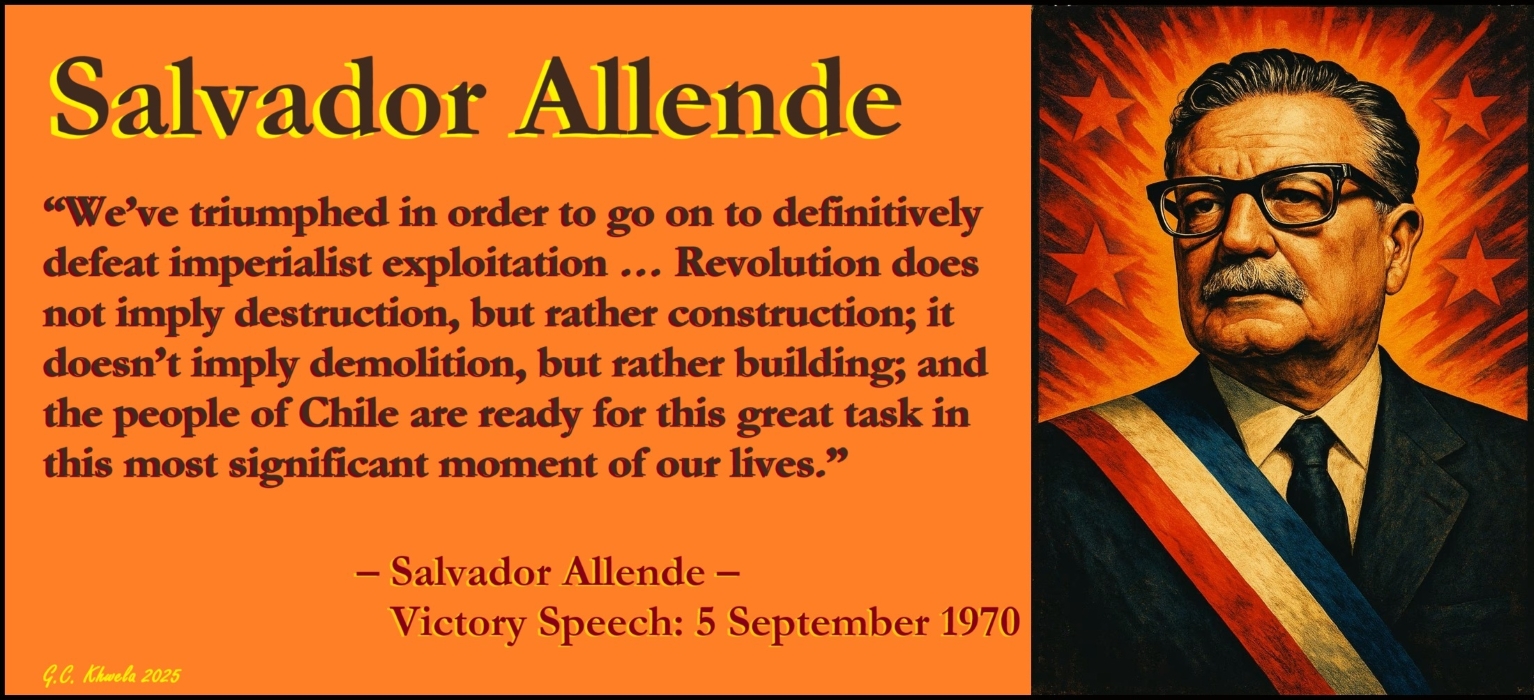
In his victory speech delivered on the morning of 5 September 1970, from the balcony of the building of the Federation of Chilean Students in Santiago, Salvador Allende said, “We’ve triumphed in order to go on to definitively defeat imperialist exploitation, to end with monopolies, to bring about a deep and serious agrarian reform, to control the commerce of imports and exports, to nationalize debt, all pillars that will make possible Chile’s progress, creating the social capital that will drive our development. … Revolution does not imply destruction, but rather construction; it doesn’t imply demolition, but rather building; and the people of Chile are ready for this great task in this most significant moment of our lives.”
Allende’s election was a historic milestone. For the first time ever, a socialist President came to power through the ballot box. Allende was elected at the head of a Popular Unity Coalition that included the Communist and the Socialist parties. Included in the Popular Unity government’s manifesto was a series of radical reforms in favour of the oppressed masses. The programme contained, among other measures: “the transformation of the state so workers could exercise power”; national planning at the centre of a mixed economic model; nationalisation of the copper mines and other important natural resources – which were in the hands of foreign capital and big monopolies; nationalisation of the financial system, monopolies, and strategic industries; and a monopoly on foreign trade.
Crucially, the manifesto planned to accelerate and deepen agrarian reform, with expropriated lands to be cooperatively organised. It also proposed wide-ranging reforms such as the extension of social security and medical care, and education reform. The three years were filled with intense class battles and innumerable problems had to be overcome. Inthe face of these difficulties, economic, political and social programmes were for the first time in the history of Chile carried out in the interests of the toiling masses. Wages were increased, living standards improved, land redistributed to the poor peasants, progress was achieved in the fields of education and public health, infant mortality was sharply reduced, and the problem of unemployment was dealt with.
Banks were nationalised and the state sector became the most significant part of the economy. The big copper mines were nationalised as a first step to restoring to the people of Chile their natural wealth. Some of these reforms were conquered in the first three years of government. In particular, the mines were nationalised; state control of foreign trade was implemented; agrarian reform was intensified; and there were material improvements in the living conditions of working people. Above all, the working masses were raised to their feet.
Subsequently, Chile made significant deductions in computing the amount of compensation due to the North American industries. Such deductions included charges for “loans invested poorly” and “excessive profits” among other reasoning. “Excessive profits” were assessed dating back to the 1950s. Ultimately, deductions for “social and financial malfeasance” when combined with other deductions resulted in the total deductions greatly exceeding the base book values of the mining enterprises. In effect, compensation to three of the five nationalised mines was wholly eliminated by subjective deductions determined by Allende’s government.
This programme, although reformist, was too far-reaching to be compatible with the interests of United States imperialism and the local capitalists. As Lenin had explained, the old ruling class never relinquishes power without a struggle (The State and Revolution). With the Vietnam War raging and an anti-war mood in the United States, however, there were limited possibilities for direct US military intervention. As such, the Nixon administration, in alliance with the national oligarchs, did everything in their power to internally destabilise the country in preparation for a coup.
Taking advantage of a relative parliamentary majority, the right-wing parties imposed a legislative blockade. The Popular Unity government mistakenly attempted to compromise with the Christian Democrats, tying their hands when it came to taking measures to give power to the workers and undermine the capitalist state apparatus. Meanwhile, the Central Intelligence Agency (CIA) funded a campaign of shameless, reactionary propaganda. In the economic field, while US mining companies imposed embargoes on Chilean assets abroad, national monopolies carried out sabotage through a boycott on production, capital flight, and withdrawal of consumer goods. This resulted in severe shortages.
All these despicable plots were systematically defeated by the masses. In some areas, elements of dual power appeared, mostly on the initiative of workers. Supply and price control councils were established, alongside housewives’ committees, peasants’ committees, and committees in defence of industrial production. These coalesced into “Regional Industrial Belts”, which were popular organisations that desperately appealed for state support: for legal recognition; for arms to defend the revolution; for a referendum to dissolve parliament; and for the expropriation of the saboteurs. Tragically, they only received kind words from the government.
Despite all the attempts to turn the population against the government, the parliamentary elections in March 1973 saw an increase in the Popular Unity vote. If the government had rested on the tremendous strength of the working masses, they could have crushed Chilean capitalism and smashed the old state. In its place, they could have formed a new workers’ state, based on arming the workers and generalising the elements of workers’ power that had emerged.
Fatally Allende tried right up until the end to negotiate with the parliamentary representatives of the Chilean ruling class, the Christian Democrats. But whilst negotiations with the representatives of capital went on inside parliament, the capitalists themselves were preparing a coup. Having failed to frustrate the revolution through parliamentary means, or exhaust it by economic strangulation, the imperialists and the bourgeoisie turned to the reactionary generals.
On the morning of 11 September 1973, the coup was launched. British-manufactured jets bombed the presidential palace to ashes, taking Allende’s life, and inaugurating one of the darkest periods in Latin American history. The revolutionary workers – unarmed – were unable to put up resistance. For the next 17 years, the military junta headed by Pinochet unleashed savage terror against its opponents and implemented the most extreme neoliberal counter-reforms. The lives of thousands of workers and young activists were the price of the failure of the Popular Unity to smash the capitalist state and to carry through the socialist revolution. As the workers of Chile and the world faced a new epoch of revolution, it is important we learn from the dearly bought lessons of the earlier Chilean Revolution of 1970–73.
The events in Chile are a further reminder of the importance of maintaining revolutionary gains, of the tremendous importance of being prepared promptly to change forms of struggle, peaceful and non-peaceful, of the ability to repel counter-revolutionary violence. The peaceful development of the revolution is guaranteed, not only by an alignment of social forces under which the bourgeoisie would not venture to start a civil war, but by the constant preparedness of the revolutionary vanguard and masses – in deed and not in words – to use the boldest means of struggle should the situation require it. Experience shows that the revolution can make good progress if its social base is consolidated and reinforced. After decisive political successes it is the economy that becomes the main field for victory of the revolution.
Three years of Popular Unity government gave not only the people of Chile, but all revolutionary forces, a wealth of experience. Its successes and gains should not be underestimated and likewise its mistakes should not be overestimated. In three years, the revolutionary movements guided by the science of Marxism-Leninism, brought about great changes in the lives of the toiling masses and this could never be totally destroyed. It was a tragic but temporary defeat suffered by the brave and heroic people of Chile and their revolutionary organisations.
“Only an organized and conscious people can bring about a different kind of society.” – Salvador Allende
Sources:
Wikipedia.
Diego Catalan, “50 Years Since Allende’s Election in Chile: Lessons for the Future”, The Communist, 4 September 2020.
Richard Pithouse, “Blood in the Streets of Santiago: Forty Years Since the Coup in Chile”, The South African Civil Society Information Service, 09 September 2024.
Salvador Allende, “Chile: The First Battle”, Tricontinental, No. 21-22, February 1971.
James N. Wallace, “Nov. 3, 1970: Salvador Allende Became President of Chile”, US Foreign Policy, World History/Global Studies, 3 November 1970.
Salvador Allende, “Speech to the United Nations (Excerpts)”, 4 December 1972.
Milestones, “The Allende Years and the Pinochet Coup, 1969–1973”, Milestones in the History of U.S. Foreign Relations, 1969–1976.
Salvador Allende, “Victory Speech 1970”, 5 September 1970.
Ahmed Azad, “Lessons of the Chilean Revolution”, The African Communist, No. 60, First Quarter 1975.
Castro Khwela
Good evening fellow Compatriots!
Discover more from CASTRO KHWELA
Subscribe to get the latest posts sent to your email.