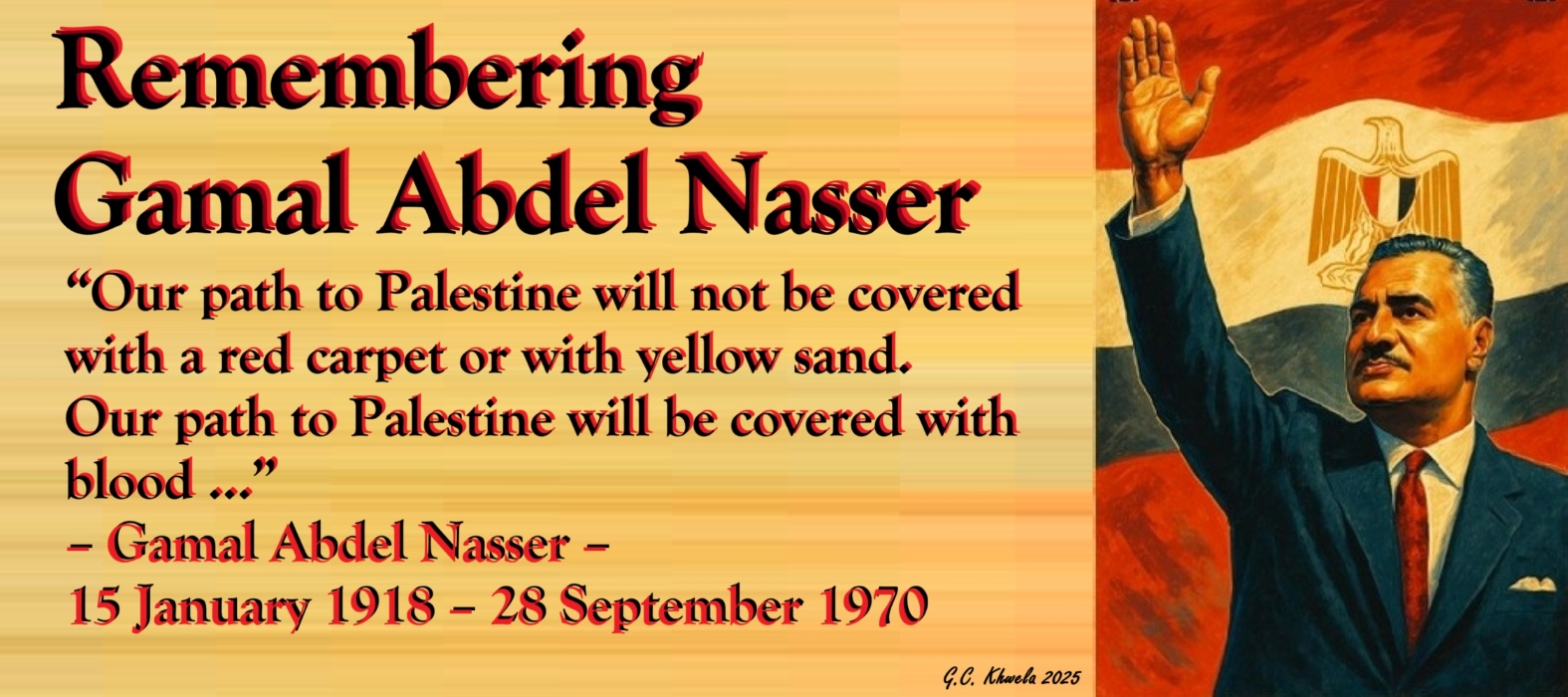
Remembering Gamal Abdel Nasser 55 Years On
On this day, 28 September 1970, Gamal Abdel Nasser Hussein, an Egyptian military officer and revolutionary who served as the second President of Egypt from 1954 until his death in 1970, suffered a heart attack and died several hours later. In the late 1950s and early 1960s, Nasser played a significant part in the strengthening of African solidarity and during this period, Nasser made Egypt a refuge for anti-colonial leaders from several African countries and ensured the provision of education and military training for liberation movements in the continent, including the African National Congress (ANC) and our Revolutionary People’s Army, Umkhonto we Sizwe (MK).
Nasser made Egypt fully independent of British influence and the country became a major power in the developing world under his leadership, as well as a key architect of Arab nationalism in the late 1950s and early 1960s. In 1961, Egypt broke its relationship with the apartheid South African government, and, for the first time in 1962, participated with a further 28 States to present the Apartheid issue in the United Nations (UN) Security Council in order for the policy of Apartheid to be considered as a threat to international peace and security.
Furthermore, Egypt rejected the Bantustan system, which was a tribal-racist border set by the white people through imposing the confinement of the African populations, who were then called as Bantu, and were prevented to enter places that were considered to belong to the white people. Moreover, Egypt remained in contact with the liberation movements in South Africa through its cadres in Cairo through radio programmes that were broadcasted in both English and Zulu via Radio Freedom. It is to be noted here that the ANC strongly supported Egypt at the time of the tripartite aggression, which was a British–French–Israeli invasion of Egypt, during the so-called Suez Crisis in 1956. This was followed by Nasser’s support for the national liberation movements, including the ANC and the Organisation of African Unity (OAU), against Apartheid.
Gamal Abdel Nasser was born in Alexandria, Egypt, on 15 January 1918. Inspired by a nascent sense of nationalism then sweeping Egypt, the young Nasser joined the army of the 11-year old independent country at the tender age of fifteen. Having graduated from the Royal Military Academy in 1938, Nasser rose rapidly through the ranks. Yet, Nasser considered the relationship between the house of the royal family of King Farouk and the former colonial government of Britain to be unnecessarily servile.
In the face of overwhelming poverty, socio-economic and political needs, the royal house began to be seen as self-serving, corrupt and venal, more concerned with its own importance and wealth than with the development needs of the nation. When in 1948 Egypt was defeated as part of the coalition of forces against the unilaterally declared independence of the State of Israel, it was the last straw. The military defeat was seen as a national dishonour and directly placed at the door of a monarchy that was seen as out of touch with the people of Egypt and responsible for failing to arm Egypt’s soldiers properly. These views were to shape Nasser’s perspective on the politics of his country and mould his vision for the future of Egypt.
On 22 July 1952, Nasser was part of a group of soldiers, the Free Officers Movement, at the head of a popular national uprising which overthrew the monarchy in a bloodless coup. When the leader of the revolution, General Mohamed Naguib, proved indecisive, the popular and charismatic 34-year-old military officer, who was a Lieutenant Colonel then, was called on to take over. He immediately proceeded with a revolutionary programme to overhaul his country. Nasser began to undertake fundamental social and political transformation, bringing about revolutionary reforms to the feudal agrarian system and implementing hugely popular socialist policies.
Nasser’s astute leadership through two decades of post-colonial, post-monarchical rule restored his nation’s sense of self-confidence and honour and laid the foundation of the modern Egypt. Freed from the limitations of a feudal society, Egypt underwent a period of rapid growth and development from which millions of Egyptian peasants benefited. His far-sighted policies and revolutionary practices raised the poorest of the poor out of the mire of poverty.
A true champion of anti-imperialism, Nasser rejected neo-colonialism. He set about to assert Egypt’s independence when he nationalised the Suez Canal on 26 July 1956, a stand for which he received much support throughout the Middle East. France and the United Kingdom, the largest shareholders in the Suez Canal Company, saw its nationalisation as yet another hostile measure aimed at them by the Egyptian government. Israel invaded on 29 October, having done so with the primary objective of re-opening the Straits of Tiran and the Gulf of Aqaba as the tightening of the eight-year-long Egyptian blockade further prevented Israeli passage. After issuing a joint ultimatum for a ceasefire, the UK and France joined the Israelis on 5 November, seeking to depose Nasser and regain control of the Suez Canal.
Shortly after the invasion began, the three countries came under heavy political pressure from both the United States and the Soviet Union, as well as from the United Nations, eventually prompting their withdrawal from Egypt. The Crisis demonstrated that the United Kingdom and France could no longer pursue their independent foreign policy without consent from the United States. US president Dwight Eisenhower had issued a strong warning to the British if they were to invade Egypt; he threatened serious damage to the British financial system by selling the American government’s bonds of pound sterling. Before their defeat, Egyptian troops blocked all ship traffic by sinking 40 ships in the canal. It later became clear that Israel, the UK, and France had conspired to invade Egypt.
This first clash with imperialism and its local agent, Israel, created two basic consequences for Nasser: it steeled his determination to end Egypt’s dependence on the capitalist West; and it fired the national spirit of the Egyptian people, making them feel for the first time that they could be masters of their own destiny. As a result of the Suez Crisis, Nasser brought in a set of regulations imposing rigorous requirements for residency and citizenship as well as forced expulsions, mostly affecting British and French nationals and Jews with foreign nationality. Nasser’s political position was enormously enhanced by the widely perceived failure of the invasion and attempt to topple him. British diplomat Anthony Nutting claimed the crisis “established Nasser finally and completely as the Rayyes (President) of Egypt”.
After years of foreign policy coordination and developing ties, Nasser, President Sukarno of Indonesia, President Josip Broz Tito of Yugoslavia, and Prime Minister Jawaharlal Nehru of India founded the Non-Aligned Movement (NAM) in 1961. Its declared purpose was to solidify international non-alignment and promote world peace amid the Cold War, end colonisation, and increase economic cooperation among developing countries. In 1964, Nasser was made president of the NAM and held the second conference of the organisation in Cairo. At the same time Nasser actively propagated the right of all people to freedom and supported liberation movements in the colonies.
Nasser’s life was a demonstration that the dictum “all power corrupts” is not invariable. Power gave Nasser the opportunity to learn and develop, the flexibility to change and adapt, while at the same time remaining a man of the people. He always lived simply; he could not be bought. When he first came to power, Nasser did not clearly map out the course he was going to follow. He had no ideology, no party, no programme for bringing about social change. He probably took capitalism for granted and thought only in terms of a few modest reforms – some redistribution of the land, some Egyptianisation of the administration and the economy. On all these points there was certainly no consensus among the Free Officers as a whole.
Nasser falls into that category of rare breed of principled internationalist revolutionaries. His steely resolve to carve out an independent foreign policy and his far-sighted international initiatives were way ahead of their time and ultimately paved the way for the current movement to redefine the relationship of nations of the South with each other and with the North. For Nasser lived and died for his people, for his country, for the cause of the oppressed people fighting imperialism in all corners of the world. It can truly be said of him that he sacrificed his life for the common weal. He elevated the poor yet proud nation of Egypt, into a major international power-broker.
He remains a highly revered figure in Egypt, the Arab world and among the people of the South. His legacy is forever etched into the popular consciousness of humankind. “Nasser did not choose the socialist road out of theoretical conviction. It was forced upon him by the logic of history. The American refusal to finance the Aswan Dam brought in its train: (a) the nationalisation of the Suez Canal; and (b) the acceptance of Soviet aid as the only alternative. The war which followed only served to make the issue crystal clear to everybody. The 1967 war, far from proving the disaster it seemed, became another turning point in Egypt’s history. The spontaneous mass rejection of Nasser’s resignation not only consolidated his position but also flushed out the rightists who had been plotting against him.”
“Once again pressures generated by the brutality and cupidity of the enemy both inside and outside the country had strengthened his determination to maintain independence, resist imperialism and continue the drive for socialism. Land distribution, nationalisation of key industries, regulation of wages and working conditions, housing, education, social services – in all these spheres enough had been done to earn Nasser the support and love of the masses which was demonstrated so abundantly and so movingly when he was struck down at the early age of 52. “But Nasser was not only a man for his own country, but also for the whole Arab people, and the whole of Africa. During the Nasser era, Egypt became one of the main bastions of support for the national liberation struggle against imperialism and White domination in other parts of the continent” (B.B., Sechaba).
Sources:
Wikipedia.
South African History Online (SAHO).
South African Presidency, “Gamal Abdel Nasser (1918 – 1970): The Order of the Companions of O.R. Tambo in Gold”, South African Presidency, 16 June 2004.
The Nasser Youth Movement, “Gamal Abdul Nasser and South Africa Revolution”, The Nasser Youth Movement Publication, 10 May 2022.
Robert St. John, “Gamal Abdel Nasser”, Encyclopaedia Britannica, 24 September 2025.
Joel Beinin, “Egypts Gamal Abdel Nasser Was a Towering Figure Who Left an Ambiguous Legacy”, Jacobin, 28 September 2020.
Stephen C. Feinstein, “Gamal Abdel Nasser”, EBSCO Knowledge Advantage, 2023.
Frederik Ohsten and Francesco Merli, “Nasser and the Arab Revolution”, In Defence of Marxism, 12 May 2011.
George Roberts, “Politics, Decolonisation, and the Cold War in Dar es Salaam, c. 1965-72”, Doctor of Philosophy: University of Warwick, September 2016.
B.B. “Gamal Abdel Nasser”, Sechaba, Vol. 5, No. 2, February 1971.
Stephen Ellis, “The Genesis of the ANC’s Armed Struggle in South Africa, 1948-1961”, Journal of Southern African Studies, Vol. 37, No. 4, December 2011.
Ama Biney, “How African Countries Assisted the South African Liberation Struggle: 1963-1994”, Journal for Contemporary History, Vol. 43, No. 1, 2018.
Jocelyn Alexander and JoAnn McGregor, “The Travelling Toyi-Toyi: Soldiers and the Politics of Drill”, Journal of Southern African Studies, Vol. 46, No. 5, September 2020.
Eric Burton, “Decolonization, the Cold War, and Africans’ Routes to Higher Education Overseas, 1957–65”, Journal of Global History, Vol. 15, No. 1, 2020.
Elie Podeh and Onn Winckler, “Rethinking Nasserism: Revolution and Historical Memory in Modern Egypt”, University Press of Florida, 2004.
Jonathan Cook, “Israel and the Clash of Civilisations: Iraq, Iran and the Plan to Remake the Middle East”, Pluto Press, 2008.
Vladimir Shubin, “Comrade Mzwai”, in Arianna Lissoni, et. al., “One Hundred Years of the ANC: Debating Liberation Histories Today”, Wits University, 2012
Stephen Ellis, “External Mission: The ANC in Exile, 1960–1990”, Oxford University, 2013.
Gregory Houston, et. al., “Transcripts of Interviews with Unsung Heroes and Heroines of the South African Liberation Struggle, Vol. 1”, Democracy, Governance, and Service Delivery (DGSD), Human Sciences Research Council (HSRC), 23 March 2015.
Lena Dallywater, Chris Saunders and Helder Adegar Fonseca (Eds.), “Southern African Liberation Movements and the Global Cold War ‘East’”, Walter de Gruyter, 2019.
Castro Khwela
Good evening fellow Compatriots!
Discover more from CASTRO KHWELA
Subscribe to get the latest posts sent to your email.