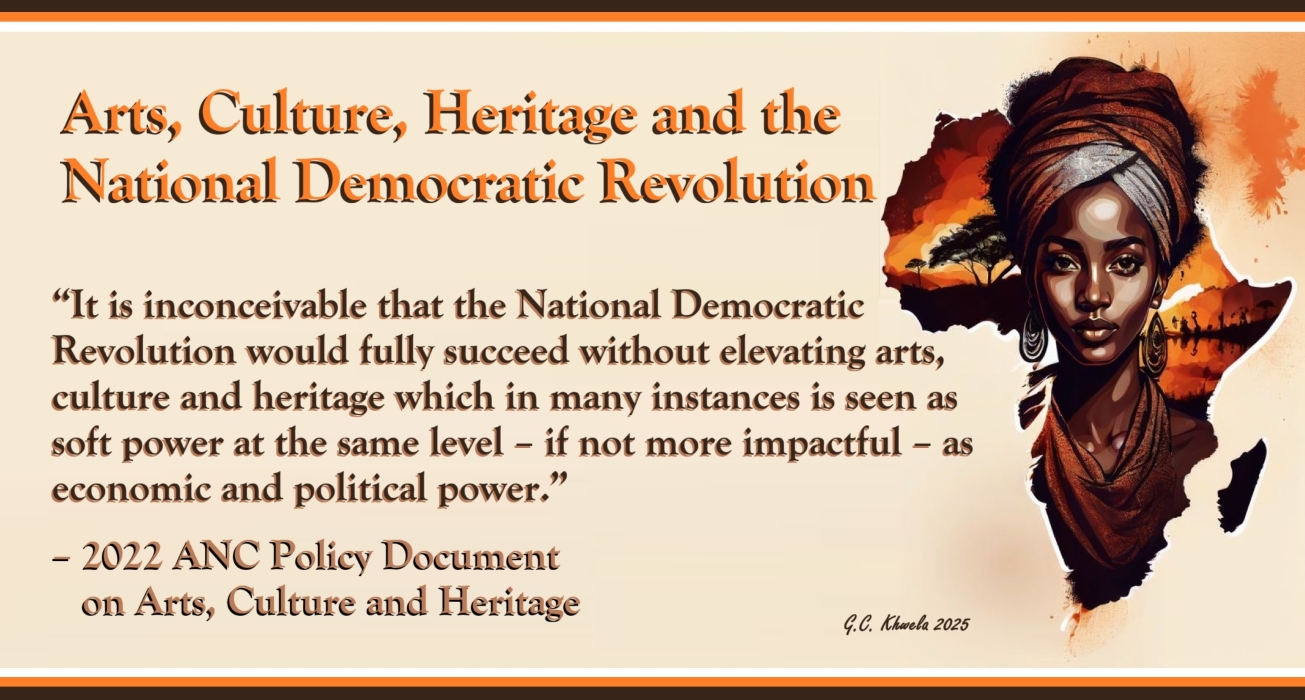
Arts, Culture, Heritage and the National Democratic Revolution
“It is inconceivable that the National Democratic Revolution would fully succeed without elevating arts, culture and heritage which in many instances is seen as soft power at the same level – if not more impactful – as economic and political power.”– 2022 ANC Policy Document on Arts, Culture and Heritage
(Revisiting the Proposed Interventions on the 2022 ANC Policy Document on Arts, Culture and Heritage)
WHAT IS TO BE DONE? PROPOSED INTERVENTIONS
Here we were acknowledging that the arts and culture played a pivotal role in the struggle for national liberation in South Africa and that it should continue to mobilise society around new objectives of building an inclusive non-racial, non-sexist and equal society for all.
These values “should be undertaken within the context of the ideological struggle to cultivate progressive values among all South Africans as part of building a national democratic society”. We are of the view that these could be achieved if we have a vibrant art, culture and heritage policy that is rooted in our communities and imbued by them.
(Urgently develop a legislated Funding Model, perhaps soliciting a substantial percentage from the lottery, to ensure sustainable resourcing of the arts, culture and heritage even during periods of economic challenges).
This is important in South Africa where the values and ethics of liberation struggle are under serious attack and the credibility of the ANC as leader of society is seriously challenged on all fronts by the forces that seek to control the narrative of liberation to suit them.
We are the oldest liberation movement in Africa and one of the oldest in the world. With this comes experience and responsibilities. We need to utilise this experience to rebuild our society through active citizenship. Knowledge of self and of society plays an important role in this regard. Archives are the source of this knowledge.
We have presided over the most internationalised anti-colonial and anti-apartheid liberation struggle in the world. We have also developed a home-grown experiment in resolving political conflict and a “world-acclaimed” model of peace and reconciliation. We however also acknowledge that this model has its own limitations that could be improved on.
After three decades of political power, the fissures caused by the continued economic disempowerment of the majority are showing. South Africa has a rich tangible and intangible culture and heritage which is globally recognised. All these are heritage treasures which could ignite and rejuvenate arts, culture and heritage emanating from a unique South African experience. It has the potential to capture national and global imagination.
More important, we must be deliberate to involve the youth as key agents who will also transmit this to future generations and also utilise it as part of the creative industry. Such mainstreaming of culture and heritage will also assist in decolonising the public social spaces and the education system.
GENERAL RECOMMENDATIONS
The following is a summary of recommendations of what could be done in the medium to long term:
Recognising the national and global unifying appeal of Arts, culture and heritage, the ANC should establish a dedicated Policy Commission at every conference that focuses on arts, culture and heritage as a focal point for policy development to guide government.
The ANC should:
a) Elevate and amplify the understanding of Ubuntu/Botho which is already widely embraced as a worldview and way of life for indigenous Africans and yet has a universal appeal.
b) Come up with New Funding Methods to ensure sustainable resourcing of the arts, culture and heritage even during periods of economic challenges. Lessons can be gleaned from other countries where this sector is regarded as a national treasure, and artists are on a continuous basis subsidised by the state.
c) Lead and champion the creation of a liberation memory bank , such as a Liberation Heritage Resources Centre, that transcends partisan lines, thus bringing on board different strands of liberation movements such as the Pan African Congress, Azanian Peoples Organisation, Unity Movement, Trade Union Movements and sister organisations.
d) Champion the promotion of digitization as part of the 4th Industrial Revolution. This should include archives of all liberation movements that participated in the liberation of South Africa. In this regard, the ANC needs to develop a clear position on the Department of Sports, Arts and Culture Policy on the Digitisation of Arts, Culture and Heritage and engage government on its position.
e) Develop a clearly articulated position paper on culture and heritage in a post-apartheid society.
f) Develop a clear policy and guidelines on repatriation and reburial of those who passed on in exile. On this, we note that Cabinet adopted in 2021 a National Policy on the Repatriation and Restitution of Human Remains and Heritage Objects.
g) The ANC, partly in line with the above, should develop a position on vandalism of heritage sites, especially graves and monuments associated with liberation movements.
h) Develop a clear policy and guidelines on how to pay respect and maintain the resting place (graves) of South Africans in general.
There is also a need for the ANC to pronounce on the concept of a place where struggle icons are buried or honoured in a form of a Heroes’ Acre.
Linked to the above, the ANC should also:
a) Develop a clear policy and guidelines on the repatriation of liberation material and cultural objects.
b) Aggressively drive and advocate for authentic prescribed history in schools, with culture and heritage emphasis in Life Orientation programmes.
c) Actively promote the development and adoption of the Southern African Liberation Heritage Route as an anchor flagship project of promoting and preserving liberation history – “Lest We Forget”.
d) The ANC should Champion the project of declaration of the Southern African Liberation Heritage Route as a World Heritage Site just like the Silk Road or other similar trails (e.g. “From Kongwa to Freedom Park”). The African Union has also expressed its support for this project. The embrace and adoption of this SADC-focused heritage project will go a long way to symbolically express gratitude to countries that hosted South African exiles and, in some form, address perceptions of South Africa as a xenophobic country that has no regard for the history of international and frontline state solidarity during the anti-apartheid struggle. It will be a significant manifestation of cultural diplomacy for the region and the rest of the continent. It is worth noting that some work towards realisation of the liberation heritage.
e) The ANC should develop a policy on the infusion of indigenous knowledge systems and craft including medicines into the mainstream life. Oriental alternative health and medicine is a prominent example of dual systems of health and wellness.
f) The ANC should promote intergovernmental corporation on departments that have a bearing on arts, culture and heritage. These include but are not limited to Arts, Culture, Science and Technology, Environmental Affairs, Basic and Higher Education and Training, Defence and Military Veterans, Cooperative Governance and Traditional Affairs and social development.
The ANC in collaboration with the Department of Sports, Arts and Culture and DIRCO should revive and send to its embassies, cultural attaches for pretty much the same kind of rooted solidarity that was established during the struggle years.
RECOMMENDATIONS ON PRIORITY POLICY INTERVENTIONS AND FLAGSHIP PROGRAMMES
All of the above-mentioned areas are important and worthy of intervention. But it is argued that at this historical moment it is important to single out and identify only a few flagship programmes and policies that have a catalytic impact on others as well as a huge symbolic importance for the liberation struggle. In terms of policy intervention, the following areas are in need of urgent attention:
a) Revival of cultural attaches established in critical embassies across the world.
b) Repatriation policy for mortal remains of South Africans abroad and those in the country away from their places of birth
c) Archives policy
d) Indigenous Knowledge Systems and language policy
e) Promotion and mainstreaming of Ubuntu.
d) (Come up with New Funding Model, solicited through the lottery, to ensure sustainable resourcing of the arts, culture and heritage even during periods of economic challenges).
There are specific flagship projects which are underway but can be formally adopted and endorsed because of their potentially profound impact on the liberation struggle in public memory and national consciousness. There projects are:
a) Southern African Liberation Heritage Route.
b) Liberation Memorial Multi-purpose Centre (and Liberation Heritage Educational Outreach Programme)
c) Establishment of a National, (Provincial and District/Local) Heroes Acres
Source: 2022 African National Congress (ANC) Policy Document on Arts, Culture and Heritage.
(Own additions in brackets)
Castro Khwela
Good morning fellow Compatriots!🙏🏾✊🏾👊🏾
Discover more from CASTRO KHWELA
Subscribe to get the latest posts sent to your email.