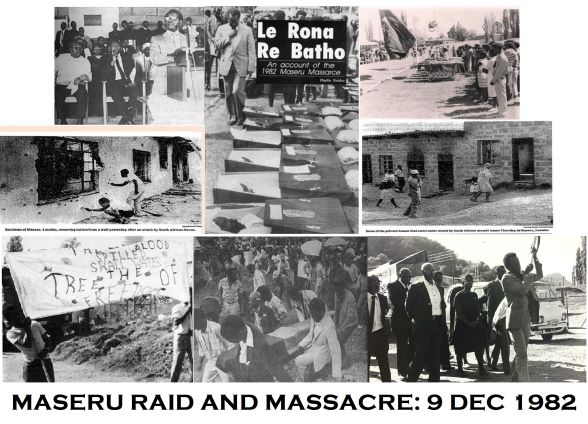
In the early hours of 9 December 1982, racist South African Defence Force (SADF) commandos crossed the border into Lesotho. Their target was a cluster of houses on the outskirts of Maseru where members of the African National Congress (ANC) were believed to be in hiding. Meeting no opposition from Lesotho’s tiny 2 000-man paramilitary force, they blasted their way through numerous homes.
By morning, 42 people were dead, 30 of them believed to be members of the ANC. The remaining victims were Lesotho residents, including five women and two children. Their mission accomplished, the members of SADF returned across the border to South Africa without incident.
“The target were ANC residences, including the Moscow house, which were apparently being used as a transit camp for ‘terrorists’ to and from South Africa”, according to the apartheid SADF communications. There were more than 11 500 South Africans staying in Lesotho at that time, most of whom were registered as refugees.
With the Maseru raid, the apartheid government wanted to shock other neighbouring states where the ANC had a presence especially in Mozambique, which was believed to be the main rear base for ANC insurgent operations.
Among the widely known ANC members based in Lesotho, was Chris Hani, labelled as the ‘most wanted’ ANC chief in Lesotho and a reputed member of the ANC’s armed wing, Umkhonto we Sizwe (MK), and his wife, Limpho Hani, who was the secretary of the ANC Women’s League in Lesotho. The aim of the raid was not only to get the ANC members out of Lesotho but also to kill them.
Following the massacre, the 1982 Christmas spirit quickly dissipated. Maseru residents were in a state of shock and disbelief. The city centre took on a new shape: bullet holes marked the walls of houses, homes were ransacked, windows broken, frames charred, and smoke emanated from debris comprised of a mixture of built fabric and human remains.
During the attack, some people were wrapped in blankets by racist SADF soldiers and officers, and were afterwards set on fire. Houses were devastated by incendiary devices. The SADF’s mission was to destroy strongholds of the ANC and kill as many rebels as possible. Scores of people were wounded.
In a dawn announcement in Pretoria, General Constand Viljoen, Chief of the SADF, explained that the raid, named “Operation Blanket,” had been a pre-emptive strike against ANC militants who had taken refuge in Lesotho over the past few months.
According to Viljoen, the ANC members were planning attacks in South Africa against political leaders in the black “homelands” (Bantustans) of Transkei and Ciskei. The apartheid SADF displayed a rocket launcher, rifles and some grenades of Communist-bloc origin that they said had been captured in the raid.
The ANC denied the South African charges and denounced the invasion as a “cold-blooded massacre.” Charging that the ANC members killed were political refugees, not terrorists. Lesotho’s Minister of Foreign Affairs, Charles D. Molapo, also labeled the attack as “murder”.
The raid met with a chorus of international outrage, even from Pretoria’s few remaining defenders. The raid was condemned by the Commonwealth as an infringement of territorial integrity of the sovereign states. From Washington DC, the Reagan administration deplored the attack and called for a settlement in Southern Africa “through peaceful negotiations”.
Religious organisations, such as the Evangelical Presbyterian Church in South Africa, damned the raid and the killings of people on the eve of Human Rights Day. The entire world condemned the act, including the UN, which even called on South Africa to compensate Lesotho for the raid that resulted in loss of life among nationals and damages to property.
The apartheid government, under PW Botha, however, was not yet ready for such an approach, and the “Maseru Massacre” as it came to be called, became one of many brazen cross-border raids conducted by the SADF during the 1980s.
According to the ANC, “This Israeli-type trans-border attack means only one thing: African government cannot choose their own systems of government and allies without the approval of Pretoria. The (apartheid) South African Defence Force infringed the territorial integrity of an independent African state and attacked refugees who had been given asylum in accordance with the Geneva agreement and other international codes.”
The following year, in the January 8 Statement, ANC President Oliver Tambo gallantly proclaimed:
“But we shall never be crushed. No people determined to free themselves have ever been crushed. And we are not about to become an exception. But we must organise ourselves for the capacity to attack effectively, as well as defend ourselves effectively. We must organise ourselves into a conquering force.”
Castro Khwela
Good day fellow Compatriots!
Discover more from CASTRO KHWELA
Subscribe to get the latest posts sent to your email.