National Insurrection Spreads to Cape Town
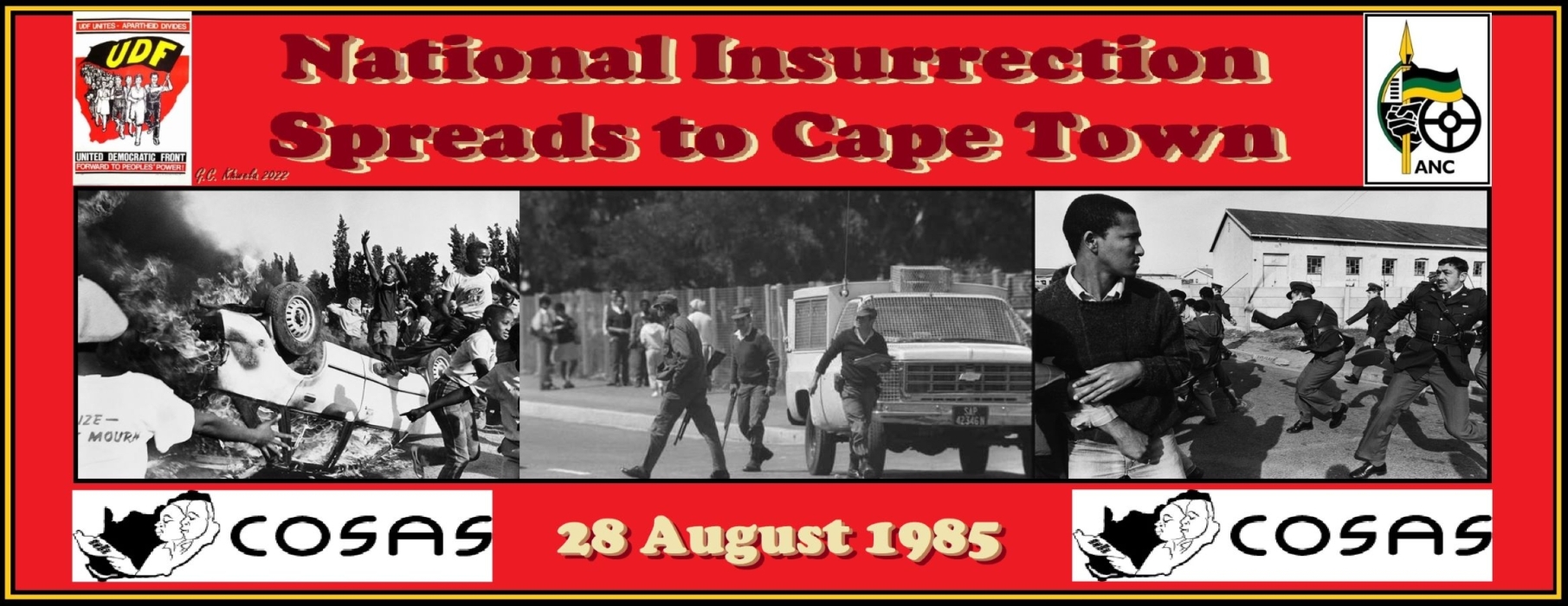
On 28 August 1985, at around 09:00 in the morning, close to 3 000 youthful protesters marched down Klipfontein Road in Gugulethu, in the Western Cape, towards a so-called Coloured township of Athlone. Along the way they set two cars alight and defied policemen who fired teargas to prevent them getting to their intended destination of Athlone Stadium.
The stadium had been earmarked as the marshalling point for a planned march to Pollsmoor Prison, where Nelson Mandela, Walter Sisulu, Raymond Mhlaba, Andrew Mlangeni and Ahmed Kathrada were incarcerated since 1982. On 23 August United Democratic Front (UDF) patron Dr Allan Boesak announced plans for a mass march to Pollsmoor prison, on 28 August, to demand the release of Nelson Mandela, but was detained under Section 29 of the Internal Security Act shortly before the march took place. Thousands of marchers set off from different points in Cape Town to Pollsmoor prison to demand the release of Nelson Mandela. The marches were violently disrupted by police.
In a separate development, the new violence erupted as officials in Pretoria, announced that they had decided to outlaw the country’s largest organisation of black high-school students. The group, the Congress of South African Students (COSAS), was an affiliate of the United Democratic Front (UDF), the country’s major opposition group. The apartheid government’s announcement, which called the congress an undesirable organisation, followed other indications that were seen as a major focus of resistance. Many of those detained since the emergency decree was issued were said to be political activists belonging to the group, and its banning was seen as a further effort to enforce calm on black high schools.
Nine people were killed that day, and by the end of the week the death toll had risen to 28, which ended in 31 deaths. The event helped spark the outbreak of street protests and severe unrest across Cape Town until the end of the year. When the marchers reached Gugulethu Police Station, three Casspir armoured vehicles were deployed in their path and the policemen on board used shotguns, whips, rubber bullets and sprayed tear gas at them. Subsequently, the policemen wielding sjamboks began to chase them back towards Gugulethu.
Meanwhile, South Africa’s most powerful black trade union, the National Union of Mineworkers (NUM), called a strike Sunday for 62,000 of its 150,000 members in gold and coal mines and threatened a country-wide stoppage. The clashes with policemen in Cape Town erupted in five separate places, including two university campuses, a teacher’s training college, Gugulethu township and outside a sports stadium.
Cape Town was not included in the 36 magisterial districts around Johannesburg and Port Elizabeth that were affected by the emergency decree. But since the state of emergency was declared, unrest spilled beyond those districts, as it did in Durban earlier in September 1985. The Western Cape had not been affected by the 1985 State of Emergency, and Operation Palmiet had the apartheid security forces concentrating their energies and strength in the Vaal Triangle, which included the Lekoa and Evaton Town Councils.
Apartheid security forces were bogged down by a fruitless “fire-fighting” approach, as they responded to the township rebellions, rioting emerged elsewhere, and when they withdrew, it returned where they had been. Their approach proved to be ineffective because it created an impossible situation for those puppet representatives of the councils who had to live permanently in such places. Rioting resulted in the collapse of most of the township puppet councils by early 1985 and the apartheid government responded by imposing a State of Emergency in the affected regions, which was an unprecedented concentration of martial and policing force.
Most protesters clashed with the police kilometres away from Pollsmoor Prison – on college campuses and in black townships. But seven white marchers made it to within 100 yards of the prison’s brown brick walls, they were immediately arrested. Some of the heaviest clashes were reported from the Hewitt Teacher Training College in Athlone, where the police charged the priests sitting in a road at the head of 1,500 would-be marchers. At one point, policemen charged with riot sticks and fired tear gas and rubber bullets at 1 500 protesters led by priests who sat in a road and sang a hymn near the Hewitt Teacher Training College. Nevertheless, the desired effect was never achieved, as it resulted in the established pattern of insurrection repeating itself on a grander scale.
Following the suppression of the march in Gugulethu, at around 09:50, at a spot further down Klipfontein Road, directly opposite the Athlone Stadium, a large cohort of local and foreign photographers were taking pictures as a group of around six hundred protesters who were told by a policeman on a loudhailer to disperse. When realising that the demonstrators were unshaken, as those in front held hands, determined and singing, the police officer in charge called on his section of policemen to form a line on the road. About five minutes afterwards he shouted “Maak skoon!” (Clean up!), and the section of police officers began to charge into the crowd with sjamboks.
The police reaction to the demonstration did not end the rioting, as all entrances to Gugulethu and Nyanga were blocked off by the police that evening. They consistently had to spray teargas to disperse groups of protesters and stone-throwers. This also affected Khayelitsha, which is a township a few kilometres from Gugulethu, where cases of arson were reported throughout the night. Nine journalists, including three Americans – a reporter from Time magazine and a reporter and a photographer from The Dallas Morning News – were arrested in Athlone, the scene of much of the day’s unrest. They were detained for three hours, fingerprinted and charged with interfering with the police. All nine journalists were ordered to reappear in court on Thursday, 29 August 1985.
Fires burnt out of control in most of Cape Town’s surrounding townships virtually ringing the city with flames, and heavily armed police and soldiers sealed off the areas to keep the riots from spreading to the few communities that were considered to be still peaceful. The focus of unrest remained the black township of Gugulethu, where police fought running battles with hundreds of black youths throughout the day, firing tear-gas grenades, rubber bullets and birdshot at them and being hit in return by firebombs and showers of rocks.
The man who was supposed to have led the march to the prison, the Reverend Allan Boesak, President of the World Alliance of Reformed Churches and Main Patron of the UDF, was detained on Tuesday, 27 August 1985, under a catchall security legislation, and his arrest seemed to had added to the passions of protest. Clerics who had gathered outside Athlone stadium, in a mixed-race suburb where the march was due to start, were detained and bundled into a yellow police van, singing “We Shall Overcome”, as they were driven away. Earlier on that day, the police used whips, known as sjamboks, to disperse other would-be marchers at the stadium.
At the predominantly white University of Cape Town (UCT), the police fired tear gas after a crowd demanding Nelson Mandela’s release bombarded an advancing line of policemen with stones. They had to intervene twice to disperse white students who held up portraits of Nelson Mandela on a grassy bank overlooking a main highway. The police were caught briefly in the middle of a main highway as traffic backed up behind them, and some officers took shelter behind a centre-road barrier under the barrage of stones.
At the University of the Western Cape, which under South African law is set aside for mixed-race students, policemen with riot sticks charged students who had gathered for the march. In “Coloured” schools and colleges, and the two local universities, these events gave the students of the region the opportunity to resume their display of dissatisfaction with an unequal and segregated educational dispensation, which was at the time in the hands of a “coloured” minister in the then House of Representatives. The 1984 poll for the House of Representatives had been staggeringly low in the Greater Cape Town area – the Tricameral Parliament had faced its first test and failed disastrously.
The apartheid Minister of Law and Order, Louis Le Grange, had outlawed all outdoor gatherings before the day’s protest erupted and had promised stern action. Nonetheless, despite those threats, more and more of the clashes turned into urban guerrilla warfare as youths set up barricades of burning tyres, wrecked autos, mattresses and old sofas, strung barbed wire across roads to decapitate police and soldiers riding in fast-moving armoured cars and lured security forces into ambushes, where they were showered with firebombs.
At least twenty-eight people, with an average age of seventeen, were killed in the ensuing uproar across the Peninsula. At least 150 were admitted to hospital with serious injuries, predominantly from Gugulethu, Nyanga, Athlone, Philippi and Manenberg. At the South African Council for Higher Education health project Clinic in Crossroads alone, at least eighty-nine people were treated for riot-related injuries. Lieutenant General Lothar Paul Neethling, who was chief deputy commissioner (second-in-command) of the apartheid South African Police, and Major General Wandrag, visited the area and Gugulethu, Manenberg, and Mitchells Plain, which were barred by security forces to all but residents. At least 172 people were arrested in the period of the march and thereafter. Fifteen policemen were also injured in the fray.
The Truth and Reconciliation Commission (TRC) found that “the goal of the ‘Pollsmoor March’ was symbolic in nature, namely to deliver a message to Mr Mandela and demand his release. Many of the groups of marchers were led by clerics, students and community leaders. The actions of the security forces on the day of the Pollsmoor March and the following few days were therefore unwarranted and used excessive force. The Commission finds that a minimum of twenty-eight deaths associated with the event were the responsibility of the security forces. The Commission finds that the harsh repression of this act of peaceful protest propelled the region into the most extensive period of public unrest in its history, lasting several months until the end of the year.”
In the September 1985 Editorial of Sechaba, the African National Congress, responded to all these developments by characterising “the apartheid system” as “cruel”. According to the ANC, “Apartheid is not just separation of people ‘according to races’. It is suspicion. It is ignorance of each other, and ignorance of the common interests. It is jealousy. It is hatred – of everything that is not ‘mine’. It is bigotry. It is everything that is inhuman and anti-human.”
Sources:
Wikipedia.
South African History Online (SAHO).
SAHO, “Re-Emergence of Congress Activity 1980s”, South African History Online, 20 October 2011.
Allan Cowell, “Cape Town Police Battle Thousands Trying to March”, The New York Times, 29 August 1985.
Michael Parks, “Riots, Fires Spread Near Cape Town: Police, Blacks in Running Battles; 2-Day Toll Is 21”, Los Angeles Times, 30 August 1985.
Allan Cowell, “Third Day of Unrest in Cape Increases Death Toll To 28”, The New York Times, 31 August 1985.
L.A. Times Archives, “S. Africa Police Break Up March with Whips, Guns: Thousands Defy Law in Protests”, Los Angeles Times, 28 August 1985.
Peter Williams and Premesh Lalu, “Honouring Belgravia High’s Political Legacy”, Cape Times, 28 September 2016.
Sapa, “Truth Commission to Hear Testimony on 1985 Pollsmoor March”, South African Press Association, 25 November 1996.
Truth and Reconciliation Commission, “Truth and Reconciliation Commission of South Africa Report, Vol. 3”, Truth and Reconciliation Commission, 29 October 1998.
Nelson Mandela Foundation, “Between States of Emergency: Photographers in Action, 1985 – 1990”, Nelson Mandela Foundation: Living the Legacy, 26 April 2021.
Lawrence Schlemmer, “Unrest: The Emerging Significance”, Indicator SA, Vol.3, No. 3, Summer, 1986.
Owen van den Berg and Brian O’Connell, “An Unfinished School Crisis in the Cape of Storms”, Indicator SA, Vol.3, No. 4, Autumn, 1986.
Thula Simpson, “Umkhonto we Sizwe: The ANC’s Armed Struggle”, Penguin, 2016.
Editorial, “State of Emergency”, Sechaba, September 1985.
Castro Khwela
Good evening fellow Compatriots!
Discover more from CASTRO KHWELA
Subscribe to get the latest posts sent to your email.