SADF ‘Third Force’-Related Officers Dismissed by De Klerk
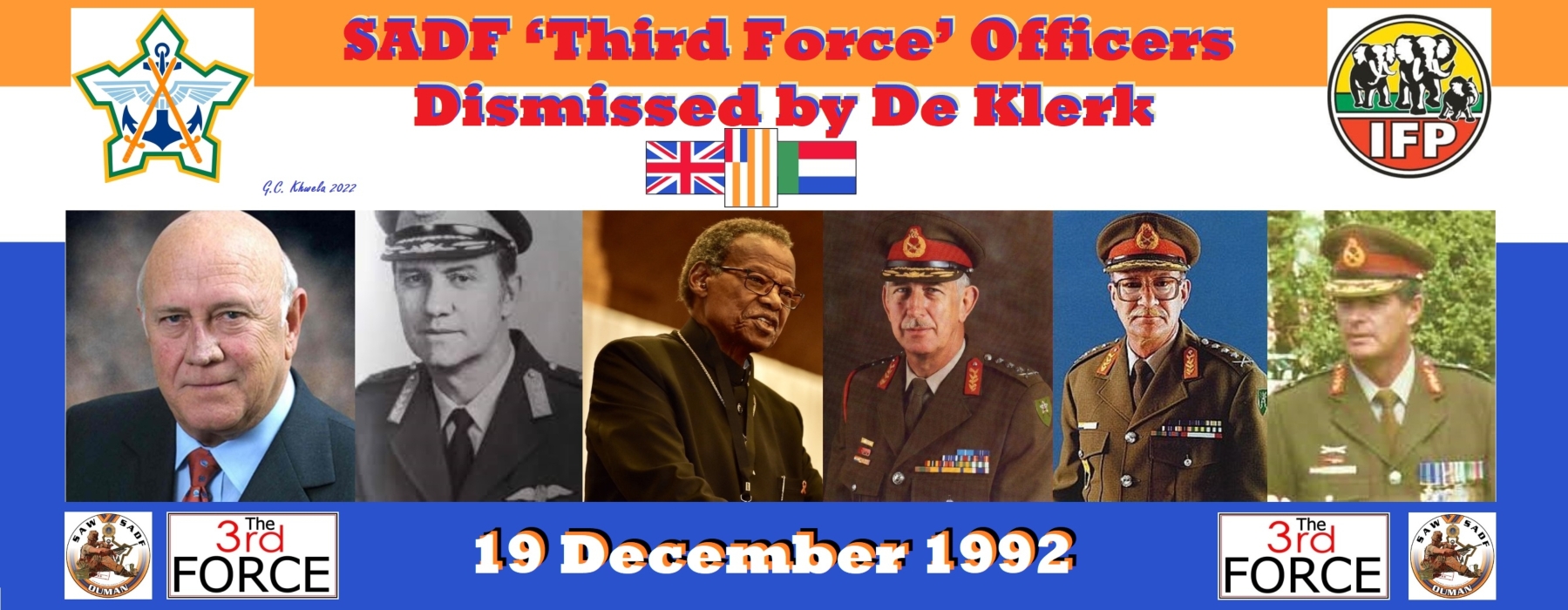
On 19 December 1992, apartheid State President F.W. de Klerk announced that 23 members of the South African Defence Force (SADF), including two generals and four brigadiers, were being forcibly retired or suspended. This followed the findings of a commission of inquiry into illegal or unauthorised activities by the SADF, set up under Lieutenant-General Pierre Steyn.
In 1991, de Klerk enacted legislation that provided for the creation of the Goldstone Commission, led by Judge Richard Goldstone. In November 1992, the Goldstone Commission’s investigators raided a Pretoria office building that Military Intelligence (MI) used as an operational headquarters. The Goldstone Commission investigators seized documents that contained information that MI was running a dirty tricks campaign against the ANC. The goal of the MI secret operation was to frame ANC members for criminal activities. De Klerk appointed General Pierre Steyn, who was assisted by Lieutenant-General Alwyn Conradie of the apartheid South African Police, to investigate the Goldstone Commission’s findings.
On 18 December General Steyn, presented his preliminary findings to President De Klerk and senior members of the government at Tuynhuys in Cape Town. He did not hand the President a report as such but gave a briefing based on contributions from a variety of intelligence sources. The account alleged that these SADF members were part of covert “Third Force” campaigns, intended to discredit the African National Congress (ANC).
The “third force” was simply that, a term, used by some to describe pro-apartheid organisations that engaged in violence during the “transitional period.” The “third force” was not a secretive government organisation, such as the United States’ Central Intelligence Agency (CIA), the Israeli Mossad, or even South Africa’s former C-10, which was a highly classified unit of the apartheid South African Police’s counter-insurgency unit, based at Vlakplaas, near Pretoria.
The activities included horrifying allegations of the involvement of SADF elements in fomenting and provoking violence between black factions in the townships, carrying out political assassinations, invoking a murderous reign of terror (specifically by the 5 Reconnaissance Regiment) on black commuter trains, stockpiling weapons and collaborating with the Inkatha Freedom Party (IFP) in what seemed as an effort to provoke a military crackdown against new freedoms for black South Africans.
The substance of the presentation by General Steyn was that components of the SADF – the Military Intelligence’s (MI) Directorate Covert Collection (DCC), Army Intelligence, Special Forces and the 7th Medical Battalion – were involved in a wide range of illegal and/or unauthorised activity. These included the establishment of arms caches and springboards for attacks; an attempt to overthrow General Bantu Holomisa’s government in the Transkei; the planting of weapons in Swaziland to discredit the ANC; corruption of DCC members in relation to arms deals; the selective leaking of information to right-wing groups; involvement in a chemical attack on FRELIMO; and corruption for personal gain.
While De Klerk refuted the notion that this was official policy of the SADF, he conceded that disciplinary action and possible criminal prosecution could follow, pending the completion of the probe. The offending units were immediately shut down and intelligence activities were restructured based on De Klerk’s instructions. ANC President, Nelson Mandela, publicly used the term “third force” for the first time in September of 1990, since the ANC believed there was a police or paramilitary force that was exacerbating already existing political violence between ANC-related organisations and Inkatha Freedom Party (IFP) supporters in the Natal Province and on the Rand. Moreover, Mandela and the ANC made direct accusations that the NP and de Klerk were aware of a “third force,” and provided funding to it.
Though some of the allegations were referred to the Attorney-General and the Goldstone Commission, most were never resolved, as the report was allegedly largely based on deliberately destroyed and thus unproven evidence. All the relevant documentation was ultimately given to the Truth and Reconciliation Commission (TRC), which also appeared to have had equally little success in establishing the truth of Steyn’s provisional findings. The TRC fingered De Klerk, accusing him of lying to Parliament and covering up the involvement of high-level army officers in murder and dirty tricks during the apartheid era.
The commission said that De Klerk had ignored the report’s recommendation that the charges be further investigated and instead asked three army generals, SADF Chief General ‘Kat’ Liebenberg, Army Chief General Georg Meiring and Chief of Staff Intelligence, General CP van der Westhuizen, who were themselves implicated as suspects in the report, were called to Tuynhuys to draw up a list of army and police personnel who should be punished. Twenty-three officers, including six generals, were dismissed or suspended. The top three generals kept their jobs, and General George Meiring as Chief of the Defence Force.
The TRC produced little evidence that the NP implemented official policy regarding “third force” activity. However, there is some evidence that high-ranking military and government officials unofficially supported “third force” activities. Specifically, Eugene de Kock and members of C-10 often received orders and support from political and military superiors. The TRC concluded, “Thus, while the involvement of security force individuals and structures in ‘third force’ violence was to some degree corroborated, lines of command and accountability, were not established. It is not clear whether senior security force personnel so involved represented their own, state or right-wing agenda. In a rapidly changing political situation with shifting alliances, is probable that there were several agendas involved.”
While many aspects of “third force” violence are not clear, the TRC report showed that Eugene de Kock and senior Security Branch personnel received orders to carry out violence. In addition, de Kock gave orders to members of C-10 to carry out violence. F.W. de Klerk immediately rejected the commission’s version of events, saying he was “astounded and disappointed” that the commission would attack him without giving him the opportunity in advance to discuss the allegations. It was the first time the TRC had suggested wrongdoing by De Klerk himself as it argued that he knew more than he admitted and was allowing top generals to escape unpunished, as ultimately, no prosecutions ever resulted from the report.
Allegations of “third force” activity peaked in the wake of the Boipatong massacre in June of 1992. Mandela blamed former President F.W. de Klerk for the massacre when he stated, “I am convinced we are not dealing with human beings but animals. We will not forget what Mr. de Klerk, the National Party and the Inkatha Freedom Party have done to our people. I have never seen such cruelty”. On 29 June 1992, at the funeral of the Boipatong Massacre, wherein 39 people were murdered, Mandela stated, “I can no longer explain to our people why we continue to talk to a regime that is murdering our people and conducting war against us.”
Sources:
Wikipedia.
South African History Online (SAHO).
Padraig O’Malley, “The Heart of Hope: From Buthelezi IFP to Third Force Theory”, https://omalley.nelsonmandela.org/index.php/site/q/03lv02424/04lv03275/05lv03294/06lv03299.htm
Jacques Pauw, “Into the Heart of Darkness: Confessions of Apartheid Assassins”, Jonathan Ball, 1997.
Botha W. Kruger, “Prenegotiation in South Africa (1985 – 1993): A Phaseological Analysis of the Transitional Negotiations”, Master of Arts: University of Stellenbosch, March 1998.
Stephen Ellis, “The Historical Significance of South Africa’s Third Force”, Journal of Southern African Studies, Vol. 24, No. 2, June 1998.
Truth and Reconciliation Commission, “Truth and Reconciliation Commission of South Africa Report, Vol. 2”, Truth and Reconciliation Commission, 29 October 1998.
Truth and Reconciliation Commission, “Truth and Reconciliation Commission of South Africa Report, Vol. 3”, Truth and Reconciliation Commission, 29 October 1998.
Truth and Reconciliation Commission, “Truth and Reconciliation Commission of South Africa Report, Vol. 5”, Truth and Reconciliation Commission, 29 October 1998.
Lesley J Fordred, “Narrative, Conflict & Change: Journalism in the New South Africa”, Doctor of Philosophy: University of Cape Town, January 1999.
Noel Stott, “From the SADF to the SANDF: Safeguarding South Africa for a Better Life for All?”, Centre for the Study of Violence and Reconciliation, Violence and Transition Series, Vol. 7, 2002.
Truth and Reconciliation Commission, “Truth and Reconciliation Commission of South Africa Report, Vol. 6”, Truth and Reconciliation Commission, 21 March 2003.
Anita Gossmann, “Eating Soup with a Knife: The South African Military & Counterinsurgency”, Master of Social Science in International Relations, University of Cape Town, 2006.
John Grimes, “Defining ‘Third Force’ Activity: The South African Truth and Reconciliation Commission and Eugene de Kock”, University of New Orleans Theses and Dissertations, Spring, 18 May 2012.
Rebecca S. Ward, “Daluxolo Luthuli”, Self-Published Online, 17 December 2013.
Christopher Merrett, “Born Out of Sorrow: Essays on Pietermaritzburg and the KwaZulu-Natal Midlands under Apartheid, 1948−1994, Vol. 1”, Natal Society Foundation, Pietermaritzburg, 2021.
Castro Khwela
Good evening fellow Compatriots!
Discover more from CASTRO KHWELA
Subscribe to get the latest posts sent to your email.