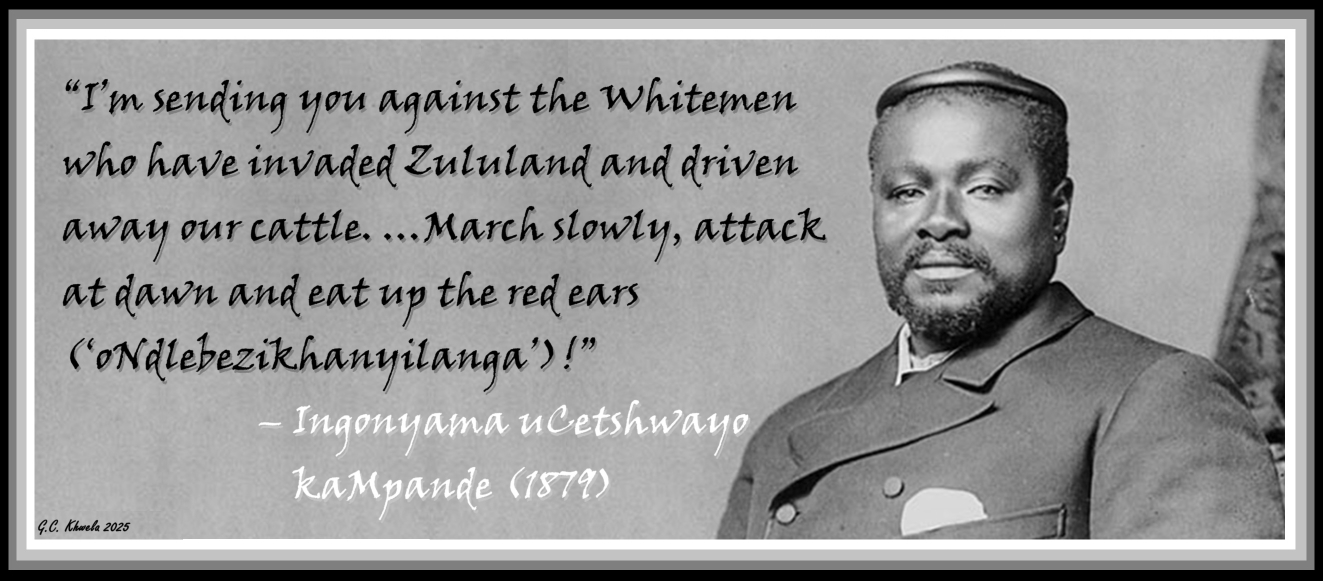
On 11 January 1879, when General Chelmsford’s ultimatum to the Zulu Ingonyama uCetshwayo kaMpande to disband the regiments and lay down arms had been ignored, a British Army of approximately 18 000 troops, cavalry and hundreds of wagon trains loaded with food, weapons and equipment, crossed the Tugela River and invaded Zululand.
As the Commander-in-Chief of British forces during the Anglo-Zulu War, General Chelmsford initially planned a five-pronged invasion of Zululand composed of over 16,500 troops in five columns and designed to encircle the Zulu army and force it to fight, as he was concerned that the Zulus would avoid battle. The centre of gravity was the Zulu capital, Ulundi, which was about 120 kilometres inside Zulu territory.
The invasion was part of the grand design of bringing the whole of Southern Africa under British imperialism’s political and economic control, which depended on smashing conclusively both the military power and the agrarian self-sufficiency of the Zulu people. This greedy plan was succinctly expressed by the master of treachery and deceit, Theophilus Shepstone, who, as Secretary for Native Affairs in Natal, reported regretfully after attending Ingonyama Cetshwayo’s coronation in 1872 that the Zulus “were so attached to their regimental system” that the “recruitment of labour from that people” was impossible.
For years Shepstone had sided with the Zulus in their bitter territorial dispute with the Transvaal Boers over the Buffalo and Pongola River arable lands. This time he treacherously switched sides when he became the administrator of the Transvaal, as Britain anticipated a pact with the Boers, and began to provoke the atmosphere for a so-called “civilising war” against Cetshwayo. In his report he depicted the Zulus as a barbaric and unruly race, unfit to govern their country and a constant menace to the ‘white civilisation’ of Natal.
Accordingly, the die was soon cast and the bloody process was launched which would in time transform Cetshwayo’s warriors into landless labourers working for wages. Henry Bartle Edward Frere, the British High Commissioner for Southern Africa, argued to the Colonial Office that if the British Confederation of Southern African states was to succeed, Cetshwayo’s forces had to be eliminated and Zululand annexed, which implied that the Zulu Kingdom under King Cetshwayo could not remain independent of British control.
After receiving support from the Colonial Office, Frere succeeded in provoking a conflict with the Zulus when Cetshwayo rejected the demands contained in an ultimatum of 11 December 1878. By not responding to the ultimatum as expected by the end of the year, Cetshwayo was granted a concession until 11 January 1879, after which Frere deemed a state of war to exist.
The British forces that were deployed for the defense of Natal had already been on the march with the intention to attack the Zulu kingdom. On 10 January they were poised on the border with Zululand, and on 11 January, they crossed the border and invaded Zululand.
To the Zulu people, the decision to make war came as a surprise, since disputes and conflicts had mainly been with the Boers, while relations with the British were often tactful and diplomatic. With the decision to launch a violent and sudden war on the Zulu kingdom, Shepstone, with the mandate of the British Colonial administration, had totally betrayed Cetshwayo’s trust.
Understandably, the British knew that Cetshwayo could not have complied with the order to disband his army and to abandon his military system within 30 days. Even if Cetshwayo wanted to bow down to the British ultimatum, he would have been deposed immediately by a more determined successor. Cetshwayo had no choice, but to fight.
“The time comes in the life of any nation when there remain only two choices: submit or fight.” Manifesto of Umkhonto we Sizwe (MK), the People’s Army.
Castro Khwela
Good morning fellow Compatriots!🙏🏾✊🏾👊🏾
Discover more from CASTRO KHWELA
Subscribe to get the latest posts sent to your email.