The Heartless and Vicious 1985 Lesotho Raid
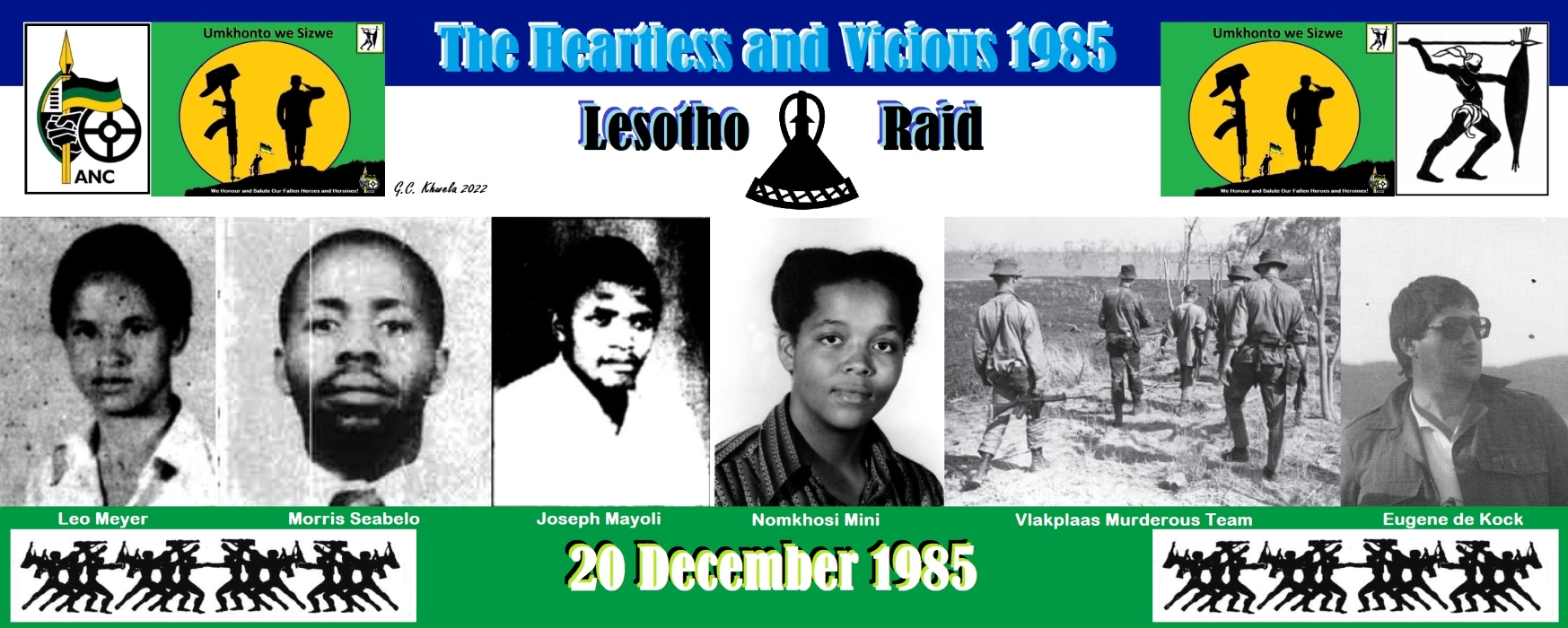
Exactly forty years ago, during the early hours of 20 December 1985, at around 01:00, Vlakplaas Commander Eugene de Kock was leading a unit of six men, as they were deployed at one of the houses in Hoohlo Township in Maseru. Amongst them was a young so-called Coloured man, Elvis Vincent Macaskill, who was a resident of the township, and was briefing them about the party that was taking place in the house. According to Macaskill, Joe and Jacqui Quin had left the party early and the other partygoers were still inside. De Kock then instructed Macaskill to lead Anton Adamson and another member of the group to Joe Quin’s house, which was approximately two kilometres away, while the other three, under De Kock’s leadership, preceded to the main target house.
When they approached the main house, they saw a man leaving the premises to look for something in his car and De Kock fired two shots at him. Afterwards, De Kock and Willie Nortjé stormed the house, while the other two members of the remained outside to keep watch. Inside the house, De Kock and Nortjé shot dead six people and after having made sure that those in the house were dead, they met the other two that went to the Quin’s residence in the getaway vehicle. Adamson reported that they struggled to capture Joe Quin alive, and they subsequently shot him. He then added that Jacqui Quin was also shot dead when she grabbed the silencer of one of the guns.
A few minutes later, according to a lady who was then in a women’s apartment, the glass panel of the front door was cracked open, as a man edged through, with two bullet holes in his side, bleeding profusely through his mouth and stomach, as he asked the lady for painkillers. Immediately the woman began to phone for an ambulance, but was struggling to get through. The man who came to the women’s apartment asking for painkillers, Joe Quin (real name Leon Meyer), who was an Umkhonto we Sizwe (MK) Commander in Lesotho, was already dead when she decided to head for the hospital to secure an ambulance.
When the police entered the Quin’s household, they found a one-year-old baby girl unharmed. Inside the main house, where the party took place, was a scene of carnage. Blood was smeared everywhere, trails of it showing where the dying had struggled vainly to reach help. Bullet marks scarred the walls, and flattened slugs and empty 9-mm cartridge cases littered the floors. The bathroom, where three bodies were found, looked like a slaughterhouse.
The party host, a South African Coloured man, later known to be Elvis Macaskill, invited a number of political refugees to the house, then excused himself just before midnight, offering the last round of drinks which he allegedly went to fetch from the Holiday Inn. Simultaneously, his wife, child and sister-in-law withdrew to an outside room, telling guests the sister-in-law had drunk too much and was feeling unwell. Approximately 30 minutes later, the allegation continues, he came back with the Pretoria regime’s murderers, who entered the house and opened fire on the partying guests. Elvis Macaskill had been infiltrated into that particular “MK Machinery”, known to the apartheid security forces as the “Meyer group”, by one of the Commander’s brother-in-law.
According to the Vlakplaas Unit’s Amnesty applications, “The plan was that Macaskill would arrange a party at his house and invite the group to join the party. He was also armed with some drug to dose the people at the party so as to facilitate the killing of these people. He would be paid R5 000 per person killed. It seems that he had difficulty in obtaining the amount he thought was due to him (Eugene de Kock paid him R18 000 after the killings – or R2 000 each for the people slaughtered). It is understandable that some other MK members may also have been at the party and not the primary targets but could have become casualties in the cross-fire. This was thought of and catered for. By the nature of the plan all of the people in the Macaskill home at the relevant time would be killed, in particular the Leon Meyer group, the specific targets.”
Ultimately, nine bodies were recovered from the early morning attacks, with seven people being killed at the main target house, which included Vivian Matthee, Joseph Monwabisi (aka “Mayoli”), Nomkhosi Mini (aka “Mary”), Mankahelang Mohatle, Lulamile Dantile (aka “Morris Seabelo”), Midian Zulu and one citizen of Lesotho. It later emerged that Lulamile Dantile, or “Morris Seabelo”, was an MK Commander in Angola, and Joseph Mayoli was his Chief of Staff, and the two had been sent to Lesotho only two months earlier to consolidate infiltrations into South Africa.
As part of his evidence with regard to this incident to the Truth and Reconciliation Commission (TRC), which was held in May 1997, the former apartheid Minister of Defence, General Magnus Malan, submitted minutes of an extraordinary meeting of the State Security Council (SSC) held on 21 October 1985. The meeting, which was chaired by apartheid State President PW Botha, recommended “offensive action against ANC bases inside Lesotho – even if it meant direct confrontation with government forces – because of the possibility that the ANC was stockpiling arms in the country”.
This raid apparently was planned in an extraordinary meeting of the SCC held in 1983, in Namibia. The SSC was a secretive cabinet committee that met at least once a week to co-ordinate the state’s security policy, which became Botha’s “inner cabinet” and the seat of real power during his period of office. Botha and his ministers were joined by the heads of the three arms of the security forces: the Commissioner of Police, General Johan Coetzee; the Chief of the Defence Force, General Constand Viljoen; and the Director General of the National Intelligence Service, Dr Niël Barnard.
On that day in Namibia, discussion focussed on the government’s security policy towards its neighbours. The SSC decided, “As far as the conventional build-up of arms in neighbouring states is concerned, it should be prevented, and in regard to the extent of danger it holds for the RSA, it should be destroyed/neutralised. This method is legally an act of war and should, therefore, be carried out in an indirect way. Actions against Lesotho should be intensified in regard to the extermination of terrorist bases and a change of government. The establishment of Marxist surrogate forces in Lesotho must be prevented.”
Based on the guidelines set out by the SSC, the raid had to be approved by the chairperson of the Council, the apartheid State President PW Botha. Subsequently, Eugene de Kock was tasked with this operation in December 1985, when a Vlakplaas death squad of six men raided two houses in the heart of the capital of Maseru. Former police commissioner, General Johan van der Merwe claimed personal responsibility for the December 1985 raid into Lesotho which resulted in the massacre of six underground ANC operatives and three Lesotho nationals.
General van der Merwe made this shocking admission in his application before the Truth and Reconciliation Commission’s Amnesty Committee, when he told the committee that he ordered the raid in the belief he had the tacit approval of the State Security Council, and by implication, the approval of then apartheid President PW Botha. Van der Merwe’s admission intensely contrasted the official South African Police and Defence Force statements at that time, which denied responsibility for or any involvement in the illegal cross-border attack. Unlike the 1982 Maseru raid in which South Africa claimed responsibility for the killing of 42 ANC operatives, the South African security establishment completely disowned the 1985 raid.
Rather, a man calling himself Mophete Mophete of the Lesotho Liberation Army (LLA), the military wing of the exiled Basotho Congress Party (BCP), claimed responsibility for the 1985 attack. At the time, the BCP and its armed wing were alleged based in South Africa, since the organisation had been expelled from the Frontline states for collaborating with apartheid South Africa in destabilising the government of former Lesotho prime minister Chief Leabua Jonathan. Mophete Mophete claimed responsibility on behalf of the exiled armed movement in a telephone call to the South African Broadcasting Corporation’s (SABC) Bloemfontein radio news division. Apparently, the claim also endorsed the rumours that the then BCP leader, Ntsu Mokhetle, had at one stage found sanctuary at Security Branch’s Vlakplaas farm.
On the night of 19 December, the men smuggled their silenced weapons across the Caledon River. According to De Kock, it was a suicide operation because Lesotho was politically very tense and everywhere in the streets were trucks full of soldiers. In the middle of the night, under cover of darkness, disguised and camouflaged, the men attacked two houses. De Kock said his men had instructions not to kill women and children, but a woman by the name of Jackie Quinn opened the door, saw the pistol and grabbed it. She was shot dead. Eight more people were assassinated. Jackie Quinn’s baby was also in the house, but she was left uninjured. The amnesty committee learned that the six Vlakplaas operatives, including De Kock, were awarded medals for bravery by the apartheid South African Police.
Subsequent to the raid, witnesses said that a raiding party of around ten white men in brown “overalls” who spoke Afrikaans, burst into a house where seven black refugees were holding a Christmas party and killed the four women and three men with 9-mm automatic pistols fitted with silencers. The raid followed the death on 15 December 1985 of six white civilians, including four children, in a land-mine explosion on South Africa’s northern border with Zimbabwe, which led to emotional calls by the white Afrikaner families for retaliation against the ANC, which admitted planting the mines.
According to the Lesotho police, after killing the seven people at the party, the raiding commandos moved to an apartment approximately two kilometres away where they shot and killed a mixed-race South African refugee, Joe Quinn (Leon Meyer), and his white wife, Jacquelina. Their one-year-old son was left unharmed in his crib. Afterwards, the raiders drove to the banks of the nearby Caledon River, at the border with South Africa, where they stripped the registration plates from their two getaway cars, set fire to the vehicles and crossed into South Africa. The two cars, only barely recognisable as Volkswagen Jettas, were parked side by side, soaked with gasoline and set ablaze with their hoods propped open, so that the intense heat engulfed the vehicles and obliterated all identification marks.
South Africa has carried out similar reprisal attacks on what it claimed were ANC “bases” in the Mozambique capital of Maputo, and in June 1985, the Botswana capital of Gaborone. The apartheid government had put particular pressure on Lesotho, accusing it of being a persistent supporter of the Umkhonto we Sizwe (MK) guerrillas, and for a time in 1983 South Africa choked the flow of traffic into the enclave country by tightening border controls. Faced with this pressure, Lesotho began evacuating South African refugees in 1984 to other African states willing to accept them.
On 3 December 1985, more than two weeks before the raid, apartheid South African Air Force (SAAF) military aircraft had intercepted a Zambian Airways plane with 150 refugees on board and forced it to return to Maseru. Most of those refugees had been flown out since then on three regular Lesotho Airways flights, but South African civil aviation authorities had refused clearance for a fourth group to overfly South African territory. An apartheid South African Defence Force spokesperson in Pretoria “categorically denied” that South African military aircraft had forced a plane carrying refugees from Lesotho to turn around.
Reacting to the various apartheid atrocities, the African National Congress (ANC) in its official journal, Sechaba, August 1986 Editorial, which said “The liberation struggle in South Africa is causing a crisis for racists and before things have come to the crunch the racists have run mad and those whom the Gods wish to destroy, they first make mad”. In the National Executive Committee’s January 8, 1986, Statement delivered by President Oliver Tambo, he paid “homage to the outstanding leaders and others of our people who were murdered this year by the death squads, the army, the police and the hangmen of the apartheid regime. … Their example of selfless service to the revolution will live on, inspiring us to intensify the struggle until victory.”
Sources:
South African History Online (SAHO).
Allister Sparks, “Lesotho Blames Raid On South Africa: Pretoria Denies It Attack Kills 9 in Capital of Black Enclave”, The Washington Post, 21 December 1985.
Oliver Tambo, “‘Attack, Advance, Give the Enemy No Quarter!’ Message of the National Executive Committee of the ANC by O. R. Tambo on the 74th Anniversary of the ANC, 8 January 1986”, Sechaba, March 1986.
Editorial, “Those Whom the Gods Wish to Destroy They First Make Mad”, Sechaba, August 1986.
Jacques Pauw, “Into the Heart of Darkness: Confessions of Apartheid’s Assassins”, Jonathan Ball, 1997.
Truth and Reconciliation Commission, “Truth and Reconciliation Commission of South Africa Report, Vol. 2”, Truth and Reconciliation Commission, 29 October 1998.
Staff Reporter, “I Ordered the Lesotho Raid”, Mail & Guardian, 10 March 2000.
Mbulelo Sompetha, “Hearings in Pretoria Including Lesotho Raid Hearings”, Department of Justice, South Africa, 26 May 2000.
Amnesty Committee, “Amnesty Application in Respect of Various Offences Flowing from an Incursion into Lesotho on or About the 19th December 1985”, Truth and Reconciliation Commission, 1 June 2000.
Erika de Beer, “De Kock Links PW to Maseru Massacre”, Independent Online – IOL, 20 December 2000.
Thembisile Makgalemele, “Informer Describes Pain of Betrayal”, Independent Online – IOL, 20 December 2000.
Thula Simpson, “Umkhonto we Sizwe: The ANC’s Armed Struggle”, Penguin, 2016.
Personal Testimony, “Testimony by Mthobeli Mthunzi Zokwe (aka “Trinity”), 20 December 2024.
Castro Khwela
Good evening fellow Compatriots!
Discover more from CASTRO KHWELA
Subscribe to get the latest posts sent to your email.