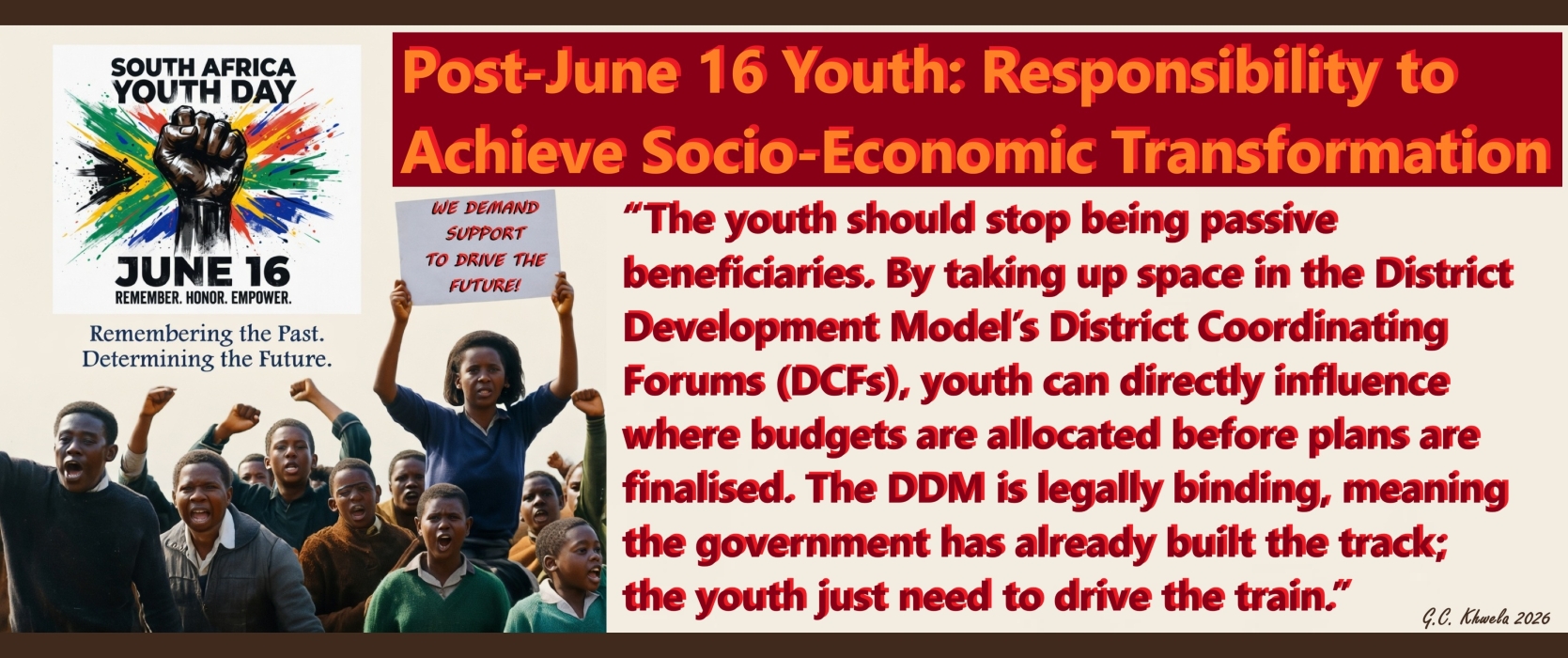
Post-June 16 Youth: Responsibility to Achieve Socio-Economic Transformation
This theme is a powerful and necessary revolutionary perspective of how South Africa should view Youth Day. It shifts the narrative from passive commemoration to active, modern nation-building, directly connecting the political liberation pursued by the generation of 1976 to the incomplete struggle for economic emancipation today. The generation of 1976 fought against an oppressive education system to secure political freedom. Five decades later, South Africa’s youth face a different enemy: structural economic exclusion. This theme acknowledges that political freedom is incomplete without economic emancipation and dignity.
While the youth of 1976 fought with protests and marches, today’s youth must fight using strategy, skills development and policy engagement. With youth unemployment rates remaining critically high, focusing on “socio-economic transformation” targets the exact pain point that threatens social stability. While the theme rightly calls for youth leadership, it creates a vital debate about where the blame – and the solution – lies. Critics often argue that placing the “responsibility” on young people can unfairly shield the government or private sector from their failures to create an enabling environment. The youth cannot achieve transformation alone. For this theme to be successful, it must be backed by institutional support, including funding, mentorship and structural changes to the economy.
To move the theme from a political slogan into reality, the modern youth responsibility can be broken down into four actionable areas. Modern youth must leverage the access to education won in 1976 to upskill in fields driving the global economy, such as digital literacy, data science and green technologies. With a shrinking formal job market, the responsibility lies in fostering entrepreneurship. Youth must build small businesses that solve local community problems while absorbing unemployed peers. Socio-economic transformation requires good governance. Today’s youth have a responsibility to vote, participate in local government’s Integrated Development Plans (IDPs), stand up against corruption, and demand constitutional accountability.
Young people must actively lead peer-led initiatives to address community crises that stall economic progress, such as substance abuse, gender-based violence and mental health challenges. This theme is a vital call to action that rescues June 16 from becoming just a celebratory public holiday. It honours the past by demanding justice for the present. However, for it to be meaningful, it must be met with a reciprocal responsibility from the state and corporate South Africa to provide the resources, capital, and market access that young people need to actually drive that transformation.
The crisis facing modern South African youth is a “moral emergency” driven by structural, spatial, and economic barriers that mirror the oppression of the past under modern names. While the legal framework of apartheid was dismantled, the economic architecture remains deeply intact, trapping a vast majority of the “Born Free” generation in systemic exclusion. The current “Neo-apartheid” arrangement refers to the preservation of racialised, segregated living spaces through economic barriers rather than laws. Poor black youth remain concentrated in townships and neglected rural municipalities far away from economic hubs. They face a crippling “spatial tax”, spending a massive portion of their non-existent income just on transport to look for work in city centres.
Access to quality infrastructure remains segregated by wealth. Wealthier urban youth enjoy high-speed internet and elite schooling, while rural and township youth attend under-resourced public schools that often lack basic libraries, computers and connectivity, barring them from the 4th Industrial Revolution (4IR). “Neo-colonial equality” describes a system where everyone is legally equal, but historical, multi-generational theft ensures that true competition is impossible. True equity is blocked by unequal basic education. Wealthier minorities and elites access top-tier private and model-C schools, while the majority encounter dysfunctional, underfunded public schools. As a result, nearly half of Black South Africans do not complete secondary schooling.
For the youth who manage to reach university, systemic exclusion continues through historical student debt. Tens of thousands of poor students are financially excluded or have their degrees withheld due to unpaid fees, creating a middle ground where they are “too rich” for government aid (NSFAS) but too poor to pay out of pocket. Youth unemployment in South Africa is the worst in the world, serving as the single greatest threat to democracy. According to the Stats SA Q1:2026 Quarterly Labour Force Survey, the youth unemployment rate stands at an alarming 45,8% for those aged 15–34. For the youngest tier (15–24), the rate hovers closer to 60%.
Even a university degree no longer guarantees a job. A severe structural skills mismatch exists between corporate requirements and public education outputs. This leaves thousands of qualified graduates competing for menial, low-skilled labour. Systemic gender inequality worsens the economic crisis. In early 2026, 39,2% of young women were classified as NEET (Not in Employment, Education, or Training), a rate that continues to climb higher than that of young men.
Poverty is not just a lack of money; it is a systemic trap that destroys human potential before adulthood even begins. According to The World Bank, South Africa is the most unequal country on earth. Almost half of Black South Africans live below the poverty line, compared to less than one percent of the white minority. Children raised in poverty face poor nutrition, weak early learning access, and hazardous living environments. They enter school on an uneven footing, which severely impairs their long-term cognitive development and future earning capacity.
When millions of young people are barred from entering the formal economy, the vacuum is filled by survivalist and destructive coping mechanisms. Despair and hopelessness drive an alarming number of township youth toward cheap, destructive drugs like nyaope or wunga. Urban edges have transformed into active recruiting grounds for criminal syndicates and gangs, making communities unsafe for everyone. Being perpetually unemployed and financially dependent on aging parents destroys dignity, leading to a silent wave of depression and anxiety among the youth.
The state’s current interventions – such as short-term public employment stipends – only patch over the cracks rather than fixing the foundation. To build an actionable path toward economic liberation, we must look at deeper structural reforms. The failure to empower South African youth is not due to a lack of policies, but rather to flawed policy design, institutional dysfunction and severe implementation gaps that treat systemic crises with short-term, superficial solutions. While the government writes excellent frameworks on paper, the actual execution leaves young people economically stranded.
The specific policy failures blocking youth development, leadership and entrepreneurship are structured around several critical areas. Government policies heavily push entrepreneurship as the primary antidote to youth unemployment, yet they fail to address the hostile economic ecosystem. Agencies like the National Youth Development Agency (NYDA) frequently prioritise short-term grants, such as equipment or micro-grants to meet annual targets. They lack sustained, multi-year operational funding or robust mentorship, leading to a high small business failure rate. Policies fail to force corporate monopolies or state-owned enterprises to absorb youth-led startups into their main supply chains. Young entrepreneurs are often left with capital but zero market access, making them unable to compete against entrenched, capital-intensive giants.
Compliance requirements for tax compliance (SARS), company registration (CIPC) and licensing are uniform for both a massive corporate entity and a township startup. There is a distinct lack of “regulatory sandboxes” or tax holidays specifically designed to protect vulnerable youth businesses. Youth leadership development is heavily bottlenecked by policies that treat young people as passive beneficiaries rather than decision-makers. Government departments routinely hold “youth parliaments” or “consultative workshops” to fulfil bureaucratic checklists. However, the actual input from young people is rarely integrated into the final legislative frameworks.
National policies require years of prior working experience even for entry-level governance and leadership roles. This policy structural defect automatically excludes brilliant young graduates, keeping public management aged and recycling the same leadership. The state institutions specifically mandated to spearhead youth development are structurally compromised. Youth development funds are scatter-shot across various portfolios – the Presidency, Department of Employment and Labour, National Youth Development Agency (NYDA) and Sector Education and Training Authorities (SETAs). Because these entities rarely align their databases or strategic goals, resources are wasted on overlapping initiatives.
Crucial youth development programmes are routinely hindered by governance crises. For example, the Presidential Youth Employment Intervention (PYEI) and its sub-programmes face continuous whistleblowing allegations regarding procurement irregularities and political patronage in awarding training contracts. National Treasury frequently claws back unspent youth allocations from government departments because administrators fail to implement the promised youth programmes. There are few or even none internal policy consequences for departments failing their youth mandates.
The current national curriculum policy fundamentally isolates itself from modern economic demands. The basic education curriculum does not mandate foundational financial literacy, credit management or taxation training. It fails to produce an entrepreneurial mindset, instead training youth solely to be employees in a job market that is actively shrinking. The Sector Education and Training Authorities (SETAs) absorb billions of rands via the Skills Development Levy but are plagued by structural inefficiency. The short-term learnerships they fund often function as temporary stipends rather than paths to formal employment or sustainable industry accreditations.
While the Social Relief of Distress (SRD) Grant serves as a vital survival mechanism, current social policy treats it as a permanent solution to poverty. Policy creates an environment where grant capital does not stay inside township boundaries. Instead of using this liquidity to stimulate localised township production, standard retail models ensure that the funds immediately leak back to major retail monopolies or to foreign-owned entities that do not plough back to the communities they service. The grant system operates in a complete silo, detached from youth employment databases. There is no active policy framework linking grant recipients directly to localised vocational apprenticeships, community work programmes or digital upskilling platforms.
Grassroots community organisations can fight back by shifting away from waiting for government intervention and instead building self-reliant networks. They operate directly on the ground, allowing them to bypass bureaucratic red tape and implement immediate, localised solutions to counter neo-apartheid spatial traps and economic exclusion. To counter the “monopolistic leakage” where money immediately leaves poor communities, grassroots groups can create hyper-local economic loops.
For example, pooling local savings through formalised burial societies and stokvels to invest directly in township-owned grocery cooperatives, local bakeries and clothing manufacturers. Transforming vacant municipal land, backyards and school grounds into agroecological community gardens. This cuts reliance on expensive corporate retail chains, foreign-owned competitors and ensures food security. Launching community voucher systems or digital trade directories that incentivise residents to spend their money exclusively with local youth-owned mechanics, plumbers and spaza shops.
Grassroots networks can directly bridge the spatial and digital divides by building community-owned utilities through partnering with non-profit tech organisations to install localised Wi-Fi mesh networks; by sharing a single fibre backhaul across a township, they can provide ultra-low-cost or free internet access to youth seeking employment; and creating community-managed solar charging stations in informal settlements. These hubs keep youth-led digital businesses running during power grid failures and provide safe spaces for evening studying.
Community organisations can use the power of the law and collective bargaining to force corporate and state accountability. Partnering with public-interest legal groups or creating Progressive Legal Resources Centres (with currently unemployed legal graduates) to challenge municipal zoning laws that block low-cost housing development near wealthy economic city centres and tracking local municipal budgets, including IDPs (Integrated Development Plans).
Youth groups can physically pack public municipal meetings to disrupt corrupt tender allocations and demand transparent youth employment hiring. Organising community advocacy forums to force local factories, malls and mines to source at least 30% of their operational goods and services from the youth enterprises situated right outside their gates.
Since official government training systems are broken, grassroots organisations can build localised, practical educational alternatives. Mapping out skilled retired builders, electricians and tailors within the community. Organisations can pair them with unemployed youth for direct, hands-on vocational mentoring that bypasses the need for costly college fees. Organising weekly peer-to-peer workshops inside community halls to teach practical, non-academic skills like basic tax compliance, digital marketing, contract drafting and smartphone-based bookkeeping.
To break through generational gatekeeping, grassroots groups must politically organise as Masupatsela Youth through contesting local government elections as independent community candidates or as contesting candidates when joining progressive left-wing political parties. This places young, accountable community activists directly into municipal council seats. Creating independent neighbourhood assemblies or interest groups that actively monitor local police stations, clinics and schools, using social media exposure and peaceful mobilisation to force accountability for poor service delivery.
The District Development Model (DDM) is one of the most strategic frameworks South African youth can champion to repair local government and build viable, sustainable communities. Because the DDM mandates a “One District, One Plan” approach, it cuts through the bureaucratic silos of national, provincial and local government. For young people, this means they no longer have to knock on dozens of different doors; they can focus their energy on a single, coordinated local development agenda. Every district municipality must draft a “One Plan” – a long-term strategic and economic blueprint. Currently, these plans are often outsourced to expensive private consultants who do not understand the community.
Unemployed graduates in urban planning, economics, data science and public administration can form localised technical cooperatives. They can then force the municipality to hire local youth to conduct the baseline research, data collection and Geographic Information System (GIS) mapping required for the district’s plan, putting young professionals at the steering wheel of local policy. The DDM aims to align municipal spending with local economic potential.
Youth can champion this by demanding that district supply chains are radically localised. They can build a unified District Youth Business Registry that categorises every youth-led enterprise in the municipality (from construction to catering). Using the DDM framework, they can demand that the 30% of local procurement quota is strictly enforced at a district level, preventing corrupt syndicates from looting local infrastructure budgets.
A major failure of the DDM is the lack of real-time monitoring. Local government structures remain broken because communities cannot easily see where money is being spent. Tech-savvy youth can build independent, open-source “Shadow District Dashboards” to track the implementation of DDM infrastructure projects, publish municipal spending data, and report delayed service delivery publicly. This uses transparency to kill corruption and holds ward councillors accountable. The DDM is managed through political and technical hubs at the district level, which are currently dominated by career politicians. The youth can mobilise civic organisations to demand permanent, voting seats for youth civil society representatives within the District Coordinating Forums (DCFs).
The youth should stop being passive beneficiaries. By taking up space in the District Development Model’s District Coordinating Forums (DCFs), youth can directly influence where budgets are allocated before plans are finalised. The DDM is legally binding, meaning the government has already built the track; the youth just need to drive the train.
Sources:
Naledi Ngqambela, “Corruption Hampers the Development of South Africa’s Youth”, Mail & Guardian, 31 August 2020.
Rinette Pickering, “African Policies Suffer from a Lack of Youth Engagement”, Gold-Youth, 7 May 2022.
Nduduzo C Ndebele, et. al., “The Challenges of Youth Entrepreneurship from a Local Government Perspective in South Africa”, International Journal of Management, Entrepreneurship, Social Science and Humanities (IJMESH), Vol. 5 No. 2, 2022.
Daryl Swanepoel (Ed.), “Understanding Youth Inequality”, Inclusive Society Institute, 8 February 2023.
I. P. Dube, “Entrepreneurship Development and Training Challenges of the National Youth Development Agency to Secure Youth Employment”, Administratio Publica, Vol. 32, No. 3, September 2024
SA Parliament, “Youth Day Statement: Press Releases”, Parliament of the Republic of South Africa, 16 June 2025.
DBSA, “3 Economic Challenges Unique to South African Youth”, Development Bank of Southern Africa, 2026.
Stats SA, “South Africa’s Youth and the Labour Market in Q1 2026”, Department of Statistics South Africa, 2026.
Gcina Mtengwane, “The Key to Unlocking South Africa’s Youth Unemployment Crisis”, University of the Free State, 5 March 2026.
NYDA, “National Youth Development Agency on Entrepreneurship and Youth Development Opportunities”, National Youth Development Agency (NYDA), 28 April 2026.
Statista Research Department, “Youth Unemployment Rate in South Africa from 1991 to 2025”, Statista, 2 June 2026.
Buti Manamela, “Carving Out a Better Future for SA’s Youth”, South African Government News Agency, 15 June 2026.
Zemvelo Ndlovu, “It’s Not Enough to Say Young People Must Start Businesses”, Independent Online, 16 June 2026.
Lindsay Dentlinger, “NYDA Chair Says It’s Being Unfairly Blamed for Youth Unemployment”, Eyewitness News (EWN), 16 June 2026.
Castro Khwela
Good evening fellow Compatriots!🙏🏾✊🏾👊🏾
Discover more from CASTRO KHWELA
Subscribe to get the latest posts sent to your email.