Angola Defeats Counter-Revolution: Lessons for South Africa
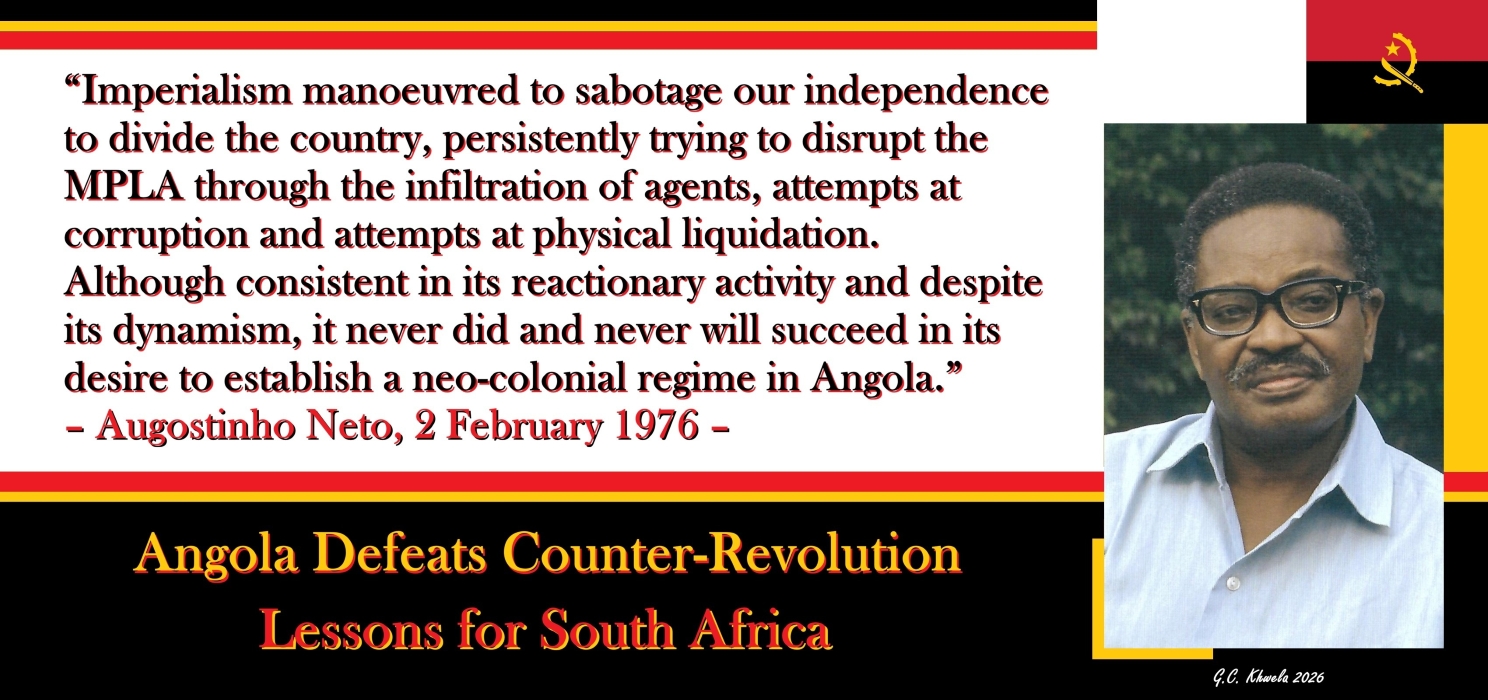
“Imperialism manoeuvred to sabotage our independence to divide the country, persistently trying to disrupt the MPLA through the infiltration of agents, attempts at corruption and attempts at physical liquidation. Although consistent in its reactionary activity and despite its dynamism, it never did and never will succeed in its desire to establish a neo-colonial regime in Angola.”
– Augostinho Neto, 2 February 1976 –
(Adapted from the Editorial Notes, “Angola’s Lesson for South Africa”, The African Communist, No. 65, Second Quarter 1976).
The events in Angola since the achievement of independence in November 1975 opened up a new chapter in the history of our continent. At the time that these words were written, the forces of imperialism and neo-colonialism as represented by apartheid South Africa, UNITA, FNLA and a motley ragbag of international mercenaries, whose murderous inhumanity accurately reflected the morality of their paymaster, had been routed.
All the main centres of Angola were in the hands of the MPLA and their allies, and the People’s Republic of Angola had won official recognition as an official member of the Organisation of African Unity. The way had been cleared for the people of Angola to move towards the era of peace and independence for which they had struggled and suffered so long.
It is, of course, too early to say that all is over bar the shouting. Too much is at stake, not only in Angola, but in all southern and central Africa, for international and local reaction to accept defeat meekly and resign themselves to the inevitable. The struggle to promote the independence of Angola and of all African countries in the face of imperialist, racist and neo-colonialist aggression and subversion will continue until the seed-beds of exploitation and profiteering throughout the world are finally destroyed.
Nevertheless, a truly qualitative change took place in Africa as a result of the events in Angola. The shattering victories of the forces of the MPLA, aided by their allies from Cuba, the Soviet Union and other socialist and African countries have not only taught a number of lessons about the nature of social and political struggle, but have also opened up gigantic new perspectives the possibilities of which are breathtaking.
From the point of view of logistics alone the achievements of the MPLA and its allies were staggeringly impressive. Given that up to the point of independence it was impossible for a single cargo of weaponry or soldiery to be landed by ship or plane anywhere in Angola, It was nevertheless possible to marshal in the space of a few short weeks and months an assault force which halted in its tracks the twin drive of the imperialists from north and south, reversed the flow and quickly drove back the enemy to the frontiers. From the point of view of military strategy alone, this gave the whole world something to think about. In the sphere of anti-colonial struggle, no operation of this magnitude and efficiency was ever witnessed before.
But the victories of the People’s Republic of Angola were not founded on fire-power alone, but fundamentally on the correctness of the political line of the MPLA. Had the MPLA not had the policies and programmes. and the cadres and organisational nucleus to carry them out, none of the victories on the field of battle would have been possible. It was because the MPLA represented the best interests of the people of Angola that it was able to mobilise the mass popular support in the absence of which the military victories would have been either impossible or valueless. The success of the MPLA had, in tum, exposed the lack of both policy and mass base on the part of FNLA and UNITA, who proved themselves to be the mere tools of the imperialists and racists.
Ever since it went into action the MPLA received, and was proud to acknowledge, the support and solidarity of the socialist and progressive forces. throughout the world. Through thick and thin, all parties to this relationship openly discharged their fraternal responsibility to one another, not shirking any of Its implications, nor overstepping its legitimate boundaries. It Is not as the western press and politicians were screaming, the relationship of an imperialist state towards its satellite, but. free alliance between anti-imperialist forces against their common enemy.
We in South Africa can perhaps best understand the nature of this alliance because in the course of our own struggle we have not only built up an alliance between the Communist Party and the national liberation movement against our common enemy, white supremacy, but have also been the joint recipients of fraternal aid and solidarity from the same world forces which helped consolidate the power of the People’s Republic of Angola.
The MPLA was never ashamed of its relationship with the socialist countries, stressing that it in no way affects its independence. It is the MPLA and the MPLA alone which will determine the direction and pace of the Angolan revolution, even though the People’s Republic of Angola may continue to receive the whole-hearted assistance and collaboration of the socialist world in the fulfilment of its task.
Compare this open and frank relationship with the miserable hypocrisy of FNLA and UNITA, who were kept alive by the blood money of the CIA and BOSS, while publicly repudiating them, who begged for arms, men and investments from the west while posing as their enemies, who were ready to sell their countries lock, stock. and barrel in return for the award of a licence as local agents of the multi-national corporations. It was the Guinean President Ahmed Sekou Toure who admitted that in the beginning he had first sponsored the progress of FNLA leader Holden Roberto in OAU circles, but later became aware of his treachery. After an investigation, he discovered that Holden was a permanent resident in Kinshasa and never went to the combat front.
“The evidence is overwhelming and no one can cover up the criminal manoeuvres of Holden Roberto. Holden even used the money sent by the OAU to the FNLA for his own personal use, and this is proved by the tremendous fortune he has piled up in Zaire and in other places, to the detriment of Angola’s liberation. Holden owns a large number of drugstores and other businesses in Zaire … a good part of the medicines sent by friends to the fighters was sold by Holden in Kinshasa” (“Afrique·Asie” No. 99, December 29, 1975.)
Similarly, UNITA boss Savimbi, while claiming to fight imperialism, was using a plane placed at his disposal by Lonrho chief “Tiny” Rowland, who could not be said to have lacked interest in the exploitation of the material and personal wealth of the African continent. Maybe Holden Roberto and Jonas Savimbi were figures of infamy lying as rejects on the rubbish dumps of history. We mention them partly because there were others of their kind in our own country. including some of the leaders of Vorster’s Bantustans, who used nationalism as a cloak for their personal ambition, and had also fallen victim to the disease of corruption.
We mention these traitors also as examples of so-called nationalists who used the weapon of anti-communism as though it were a guarantee of their independence, instead of a badge of their servitude to their imperialist masters. Yes, the time had come for all genuine nationalists and anti-imperialists to acknowledge humanity’s debt to the forces of communism which had helped to drive back the frontiers of imperialism.
Once again in Angola, as in Vietnam, Cuba, the Middle East and so many other storm-centres, the power of the Communist world was placed at the disposal of the oppressed peoples fighting for liberation and independence. Cuba herself, though advancing rapidly under socialism, is still a comparatively poor country by international standards, for obvious political and economic reasons quite incapable of functioning as an imperialist power in Africa or anywhere else. But Cubans have fought and died to help make Angola free, displaying a magnificent spirit of fraternal solidarity which is an example to the world of disinterested self-sacrifice in the cause of freedom.
The overwhelming majority of the oppressed people of South Africa had supported the cause of MPLA and were grateful that the international communist movement was able to give the MPLA the power to repel the South African and imperialist invaders. The experiences of the people of Portugal, Chile and now Angola have proved that anti-communism is a weapon of reaction and repression, not of liberation.
Now that the struggle for the liberation of all Southern Africa is steadily rising in pace and intensity, the white racists are perhaps for the first time seriously alarmed at the prospect of endless conflict which confronts them. Rightly or wrongly, they were always confident that they could contain any combination of forces which the oppressed peoples of South Africa, aided by independent Africa, could forge against them. But they overlooked the extra dimension given to the struggle of the oppressed by the alliance between the national liberation movement and the international communist movement.
It was this alliance which ensured the MPLA victory in Angola and sent the South Africans reeling, and it was the deepening of this alliance which became the key to the final victory. Events since November 11, 1975, made it clear that those who rejected the communists as allies were themselves the allies of Vorster.
It Is of crucial importance that this issue be sorted out in the minds of the people of South Africa now that the tide of struggle is surging against our borders. The struggle of MPLA and their allies is our struggle. It is in Angola that the myth of South African invincibility was shattered, and that racist South Africa was dealt the most humiliating military and political defeat in its whole inglorious history. But that was not the end of the story, for it became clear that what had happened up to now was only in the nature of a preliminary skirmish and that the grimmest struggles lay ahead. The main bastions of white supremacy in southern Africa were still intact.
The racist South Africans and the imperialists expressed alarm that the “Cubans and the Russians” (how they try to take away from MPLA the credit for its own indigenous achievements!) would not stop at the Angolan border, but would Invade Namibia, Rhodesia, South Africa, Zambia, Zaïre, in fact rampage over the whole continent establishing one communist regime after another. There may even be in the ranks of the oppressed those who hope that this would happen, and that freedom would be delivered to us at the tip of a Cuban or a Russian bayonet.
This is to misread the true lesson of Angola, which is that the MPLA created the condition in which the anti-imperialist struggle could be brought to a victorious conclusion. True, it received the aid of allies, not only from the socialist countries., but also from other African countries such as Guinea and Mozambique. But it is not the job of the Cubans and the Russians to carry the fire of revolution to the rest of southern Africa. Certainly, they will help, if they are asked and if they can. But the spark must be lit by our own struggle, fanned into flame by the bellows of our own lungs. It took the MPLA 15 years of unremitting struggle and sacrifice before they came in sight of victory, and it was only when the racist South Africans and imperialists threatened to dash the cup from their lips that they asked for extra help from their allies – not to make their revolution but to repel the foreign invaders.
For revolution is not just a matter of blood and bullets. It is basically a question of restructuring society, removing the exploiting class or nation from power and substituting the rule of the working class and oppressed peoples, transferring ownership of the means of production from the exploiters to the exploited, led by their vanguard parties and liberation organisations. For a revolution to succeed, certain basic conditions must be fulfilled:
1. The ruling class must be unable to continue to rule in the old way;
2. The oppressed class or nation must be unwilling to continue to be ruled in the old way;
3. There must be a party or liberation organisation capable of harnessing the people’s rebellion and mobilising the masses for struggle with a view to seizing power.
By the logic of its dialectic, a revolution will only succeed when these conditions have reached maturity. Revolutionary power must have a firm base among the people if it is to survive counter-revolution.
The Angolan war brought about a dramatic shift in the balance of forces in southern Africa, and called into question the ability of the white racists to continue to dominate in the old way. The confrontation which still lies ahead can take a variety of forms about which it is useless to speculate. There may yet be an all-out confrontation between South Africa and the forces upholding the People’s Republic of Angola on the Namibian border. The struggle for the final liberation of Namibia may be about to unfold.
Encircled Rhodesia may become the independent state of Zimbabwe within the near future. Nor is the struggle for Angola itself necessarily ended – the imperialists and their allies may yet stage a counter-attack of incalculable intensity. But whatever form the struggle in southern Africa may take, one thing is certain: the greater the pressures, the greater the strain on the apartheid South African state, the nearer the point of its ultimate collapse.
We have always maintained that the South African state is unstable because it has required the exertion of the utmost force and violence to keep the oppressed majority in subjection. The more the racist South African armed forces, whether military or police, are committed, the more the possibility arises that even a slight shift in the balance of power can bring the whole structure crashing down. At any rate, whatever the time scale, this is the perspective which is now revealing itself before our very eyes – a perspective which was greatly foreshortened by the events in Angola. The era of the South African revolution has opened. Are we ready for it?
For it is at this stage in history that the oppressed peoples of South Africa are called upon to raise their struggle to new heights. The initiative today is in the hands of the people. Whether the racist South African state manages to survive the pressures to which it is increasingly being subjected depends not on Cubans or Russians or the United Nations but on us and our organisations of national liberation.
The hour has come for striking weighty blows for freedom. The enemy must be harassed on every front, whether it be by strike action, by demonstrations, by sabotage or guerrilla struggle. Every South African who longs for freedom must decide now to join the liberation front at its nearest point. The time for talking, complaining and criticising is never over, but now imperatively it is also a time for action, for mass action, fur the whole people to resist.
The issue of defeat or victory for MPLA in Angola was decided in a few miraculous weeks following independence. The issue of defeat or victory for the people in South Africa may equally be decided at any stage in the Immediate future. History does not easily repeat itself. If we fail to strike when the iron is hot, we may have to wait years for another chance.
Sources:
Editorial Notes, “Angola’s Lesson for South Africa”, The African Communist, No. 65, Second Quarter 1976.
Augostinho Neto, “We Love Independence: Speech of Dr Neto to AAPSO Solidarity Conference, Luanda, Angola, 2 – 4 February 1976”, Sechaba, Second Quarter 1976.
Castro Khwela
Good day fellow Compatriots!
Discover more from CASTRO KHWELA
Subscribe to get the latest posts sent to your email.