Mandela’s PAFMECSA Address February 1962
On 3 February 1962, Nelson Mandela addressed the Heads of Delegates session at the meeting of the Pan-African Freedom Movement of East, Central and Southern Africa (PAFMECSA) in Addis Ababa, Ethiopia. The session had begun the previous day, 2 February, with His Imperial Majesty, Emperor Haile Selassie I opening the proceedings, speaking in Ahmaric on the theme of African Unity, where he specifically mentioned South Africa, saying he felt the need for new methods.
PAFMECSA, which later became the Organisation of African Unity (OAU), aimed to draw together the independent states of Africa and promote the liberation movement on the continent. Nelson Mandela was scheduled to speak after the Emperor, the first speaker the following morning.
The conference would furnish important connections for the African National Congress (ANC) and be the first and best chance for the leadership to enlist support, money and training for Umkhonto we Sizwe (MK). In accordance with the National Executive Committee decision in January 1962, Mandela was present to read the ANC address.
In his speech Mandela reviewed the history of the freedom struggle in South Africa and listed the brutal massacres that had been committed against the African people, from Bulhoek in 1921, when the army and police killed 183 unarmed peasants, to Sharpeville forty years later. Mandela thanked the assembled nations for exerting pressure on South Africa, citing in particular Ghana, Nigeria and Tanganyika, who spearheaded the successful drive to oust South Africa from the British Commonwealth. Mandela retraced the birth of Umkhonto we Sizwe (MK), explaining that all opportunities for peaceful struggle had been closed to the people.
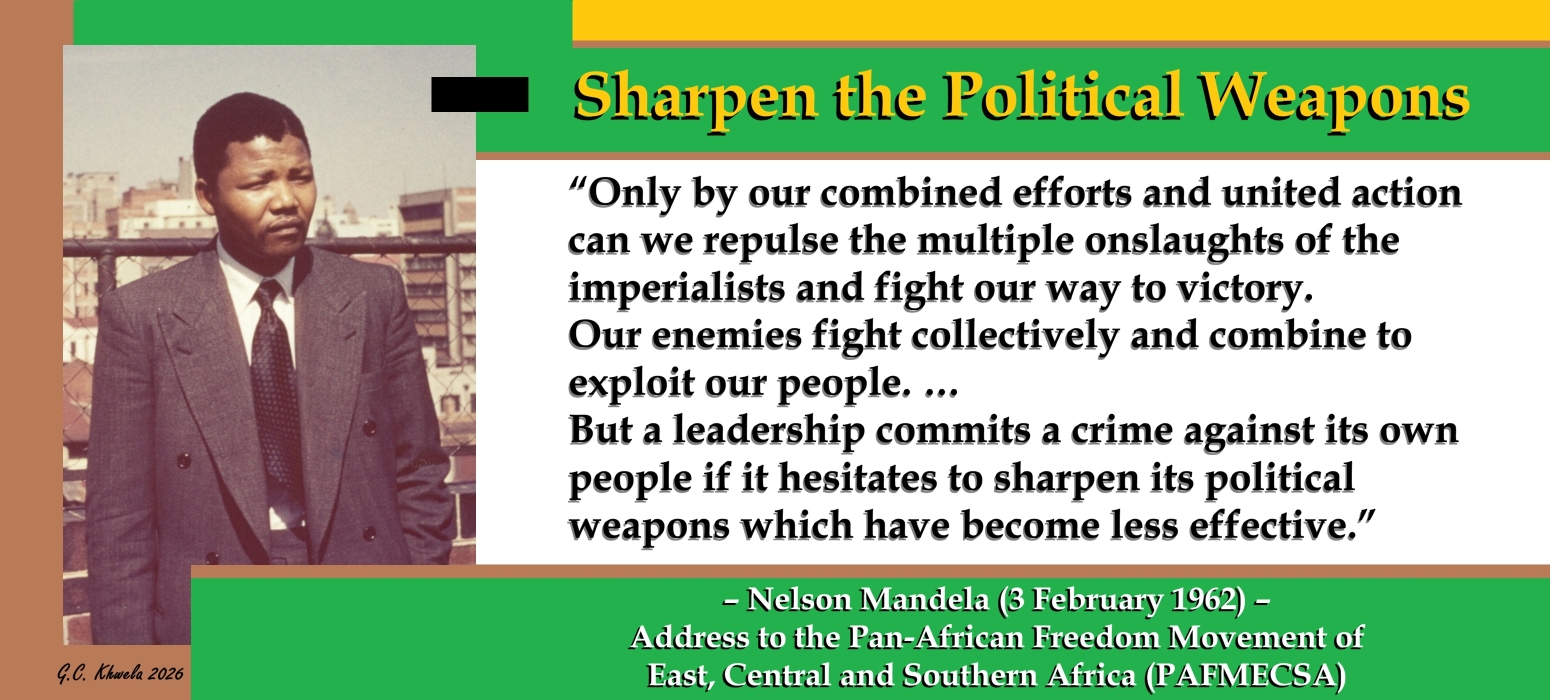
Referring to the ANC’s shift in policy, he said: “a leadership commits a crime against its own people if it hesitates to sharpen its political weapons where they have become less effective”. When he added that “On the night of 16 December last year, the whole of South Africa vibrated under the heavy blows of Umkhonto we Sizwe”, the Ugandan Chief Minister exclaimed: “Give it to them again!”
Nelson Mandela then began to relate his own experiences that he had just come out of South Africa, having for the last ten months lived in his own country as an outlaw, away from family and friends. When he was compelled to lead this sort of life, he made a public statement in which he announced that he would not leave the country, but would continue working underground. According to Mandela, “I meant it and I will honour that undertaking”.
The announcement that he would return to South Africa was met with loud cheers. The fact that the ANC was encouraged to speak first so that PAFMECSA could evaluate the South African cause and decide how much support to give it was reassuring. There was a natural reluctance among many African states to support violent struggles elsewhere, but the speech persuaded people that freedom fighters in South Africa had no alternative but to take up arms.
LONG LIVE THE GLORIOUS PEOPLE’S ARMY, UMKHONTO WE SIZWE!
Sources:
Nelson Mandela, “Address at the Conference of the Pan-African Freedom Movement of East and Central Africa”, Black Past. Ethiopia, Addis Ababa, 3 February 1962.
Nelson Mandela, “Long Walk to Freedom”, Abacus, 1994.
Castro Khwela
Good morning fellow Compatriots!🙏🏾✊🏾👊🏾
Discover more from CASTRO KHWELA
Subscribe to get the latest posts sent to your email.