Eduardo Mondlane: A Firm Revolutionary Posture
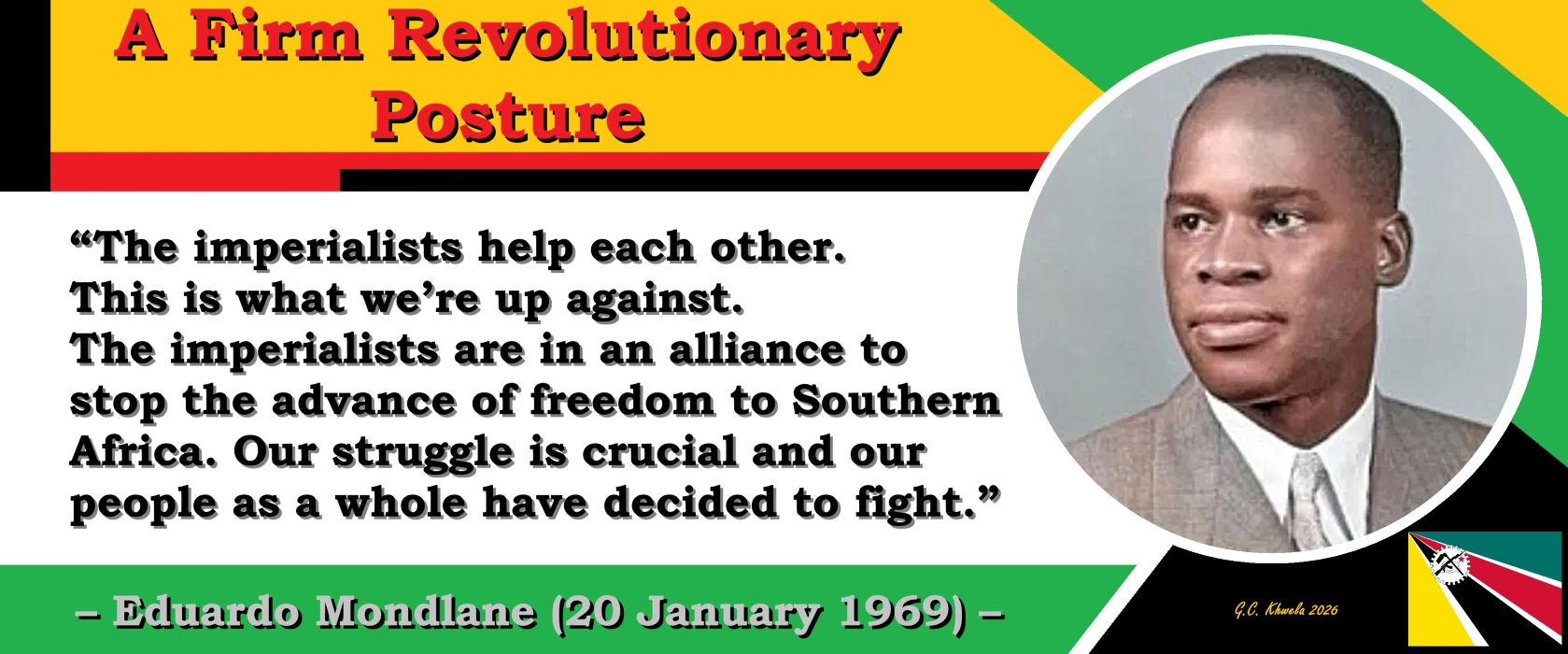
“The imperialists help each other. This is what we’re up against. The imperialists are in an alliance to stop the advance of freedom to Southern Africa. Our struggle is crucial and our people as a whole have decided to fight.” – Eduardo Mondlane (20 January 1969) –
As a political activist, insurgent leader and guerrilla fighter, Eduardo Chivambo Mondlane, born on 20 June 1920, and murdered on this day, 3 February 1969, was also a character of significant and visionary revolutionary ideas. Possessing a firm grasp of revolutionary doctrine, he insisted that the struggle would be a mixture of political and military action involving guerrilla operations with nation building and political education.
Mozambican nationalists established in the early 1960s three main, although fragile, movements in neighbouring countries beyond Portuguese control. Among these was the União Democrática Nacional de Moçambique (UDENAMO) formed by Mozambican workers in Southern Rhodesia on 2 October 1960. The second nationalist movement was a combination of several small groups that were organised as the Moçambique African National Union (MANU), in Mombasa, Kenya, in February 1961. This movement received support from similar African unions in Tanganyika (TANU) and Kenya (KANU). The third movement, which was established in Malawi, was the União Africana de Moçambique Independente (UNAMI).
During 1961, the three movements moved to Dar es Salaam, Tanganyika, where they received strong pressure to merge from African state leaders such as Kwame Nkrumah of Ghana and Julius Nyerere of Tanzania as well as from other Mozambican refugees. Mondlane went to Dar es Salaam during that time to assist in the formation of a united front. On 25 June 1961, UDENAMO, MANU and UNAMI merged to form the Frente de Libertação de Moçambique (FRELIMO), with Mondlane as president.
In September, the FRELIMO party congress drafted a programme, which focused for the next three years on political organising and military preparation for the initial phase of guerrilla warfare. From the beginning Mondlane knew the importance of patience, of following his own timetable and of unhurriedly constructing a revolutionary base from which to launch the struggle. By mid-1964, FRELIMO continued its preparation for guerrilla war and also saw its growth and success unsurpassed by other resistance movements south of the equator. FRELIMO’s success was rooted in Mondlane’s understanding of the realities of Mozambique’s history and his conception of a revolutionary programme and warfare strategy.
On 25 September 1964, FRELIMO began the military phase of its revolutionary programme by attacking Portuguese outposts in the Cabo Delgado district of Mozambique. Later the struggle was extended to the districts of Zambezia and Niassa, and finally to the Tete region in 1968 to disrupt the Cabora Bassa dam project along the Zambezi River. By that time, FRELIMO laid claim to substantial territory in northern Mozambique and won the loyalty of its population. The progress was so successful that FRELIMO held, with advance publicity, the second party Congress within the liberated Niassa province of northern Mozambique, in July 1968.
The success of Mondlane’s revolutionary thought was channelled toward four goals: the formation of a political movement capable of military conflict; the fostering of national consciousness among Mozambicans; ensuring independence from Portugal; and the restructuring of society to ensure true equality with an end to exploitation.
Mondlane defined the “first condition for success” to be the building of a political and military movement capable of “regaining power” for the Mozambican people. Mondlane, who had been associated with UDENAMO, worked tirelessly for unification of the three principal groups in Dar es Salaam. Once this goal was attained in the formation of FRELIMO, he concluded that an armed struggle would be necessary to obtain independence from Portugal, since it was obvious that the colonial power would not concede it through negotiations. For Mondlane, the insistence on the use of violence in the early 1960s was indeed revolutionary.
The conflicts raging in Angola and Guinea-Bissau and the reported killing of over five hundred Mozambican demonstrators at Mueda in 1960, convinced FRELIMO’s first leader of the futility of peaceful decolonisation. In fact, early attempts at discussion with Portugal through the United Nations failed even to receive a response. From the start he cautioned his followers that they were embarking on a protracted struggle that would not bring quick victory. However, despite the obstacles, Mondlane remained confident that “where there lies a popular war, people’s victory is certain. History testifies it.”
Mondlane placed minimal hope in clear-cut military victory; but held that economic and military costs to Portugal would force the colonialists to negotiate with FRELIMO. He focused his effort on the belief that protracted conflict to achieve political aims was the primary precept of anti-colonialist African revolutionary warfare. Portugal’s descent to negotiations entailed the recognition of Mozambique’s independence.
Regarding the second area of success for FRELIMO, Mondlane stressed its role in fusing the various ethnic and regional elements of Mozambique into a unified and politically conscious nation able to determine its own fate. He theorised that ethnic divisions were often the result of Portuguese policy, since the aim of Portuguese “colonialism, moreover, was to pervert all traditional power structures, encouraging or creating authoritarian and elitist elements”. These “elitist elements”, in order to maintain their privileged position in the colonial hierarchy, have a vested interest in perpetuating colonial rule and furthering divisions between members of their own ethnic groups and FRELIMO.
Cognisant of the dangers of ethnic fractures during the struggle and after independence, Mondlane aspired to make FRELIMO a truly national party, and used it and the guerrilla force to weld the disparate peoples together. He emphasised that the dependence on certain ethnic groups for the bulk of guerrillas should not impede the universality of the leadership, which under his guidance remained ethnically and regionally balanced. Through the example set by the movement and liberation army and the solidarity generated by the wartime situation, Mondlane envisioned a united Mozambique.
His third goal was to ensure that independence for Mozambique was attained before many of the plans for restructuring society could be fully implemented. Mondlane asserted that independence from Portugal’s rule encompassed economic as well as political self-determination and that “the struggle against Portuguese colonialism is also a fight against imperialism”. Foreign support to Portugal, itself an underdeveloped nation, increased the odds against which FRELIMO fought.
This complicity of countries, mainly apartheid South Africa and Western powers, that aided the Portuguese war efforts in Mozambique either unilaterally or through NATO, helped radicalise Mondlane’s ideas toward imperialism and made him identify FRELIMO’s cause with independence movements around the world. By fighting against Portuguese colonialism “the Mozambican people will be giving a great historical contribution to the total liberty of our continent and to the progress of Africa and of the world”.
The final and perhaps most critical success factor with which Mondlane charged FRELIMO concerned the political, social and economic reconstruction of Mozambique. According to Mondlane, “The struggle for independence constitutes only one phase of our revolution”. The liberation consisted of more than merely driving out the Portuguese colonial authority. However, true liberation required “constructing a new country”. For the president of FRELIMO, the vision was towards building a “society directed toward economic progress, where all Mozambicans will have the same rights, where the power will belong to the people”.
In the era of post-independence, strong central planning was advocated to develop Mozambique’s resources and to prevent the concentration of wealth on certain privileged groups. FRELIMO’s role, as planned by Mondlane, was to act as a “guide to the people to end the exploitation of man by man”. Therefore, he proposed a radical departure from those traditional political structures based on the absolute power of a few, and from the colonial structure based on the power and privilege of Europeans.
In the liberated zones, where the Portuguese evacuated large areas in northern Mozambique, Mondlane partially carried out his political, administrative and social goals. FRELIMO filled the void left by Portugal’s retreating military and administrative forces. He insisted, however, that FRELIMO’s political structure was not a “dictatorship of the party”, because “there is no deep distinction between party and population. The party was “the population engaged in political action”. To ensure active participation by the people, he initiated “people’s management committees”, the rudimentary organs of people’s power, to supervise whenever possible the “general tasks of life in FRELIMO zones”.
(Adapted from Thomas H. Henriksen, “The Revolutionary Thought of Eduardo Mondlane”, Genève-Afrique, Vol. 12, No.1, 1973).
Other sources:
Wikipedia.
Editorial Notes, “Eduardo Mondlane”, The African Communist, No. 37, Second Quarter, 1969.
Sechaba Column, “Eduardo Mondlane’s Last Interview: Mozambique Now One-Fifth Under African Rule, 20 January 1969”, Sechaba, Vol. 3, No. 4, April 1969.
Castro Khwela
Good evening fellow Compatriots!
Discover more from CASTRO KHWELA
Subscribe to get the latest posts sent to your email.